Unlocking U.S. Nuclear Growth Requires a Waste Strategy
Listen to the Brief
The Issue
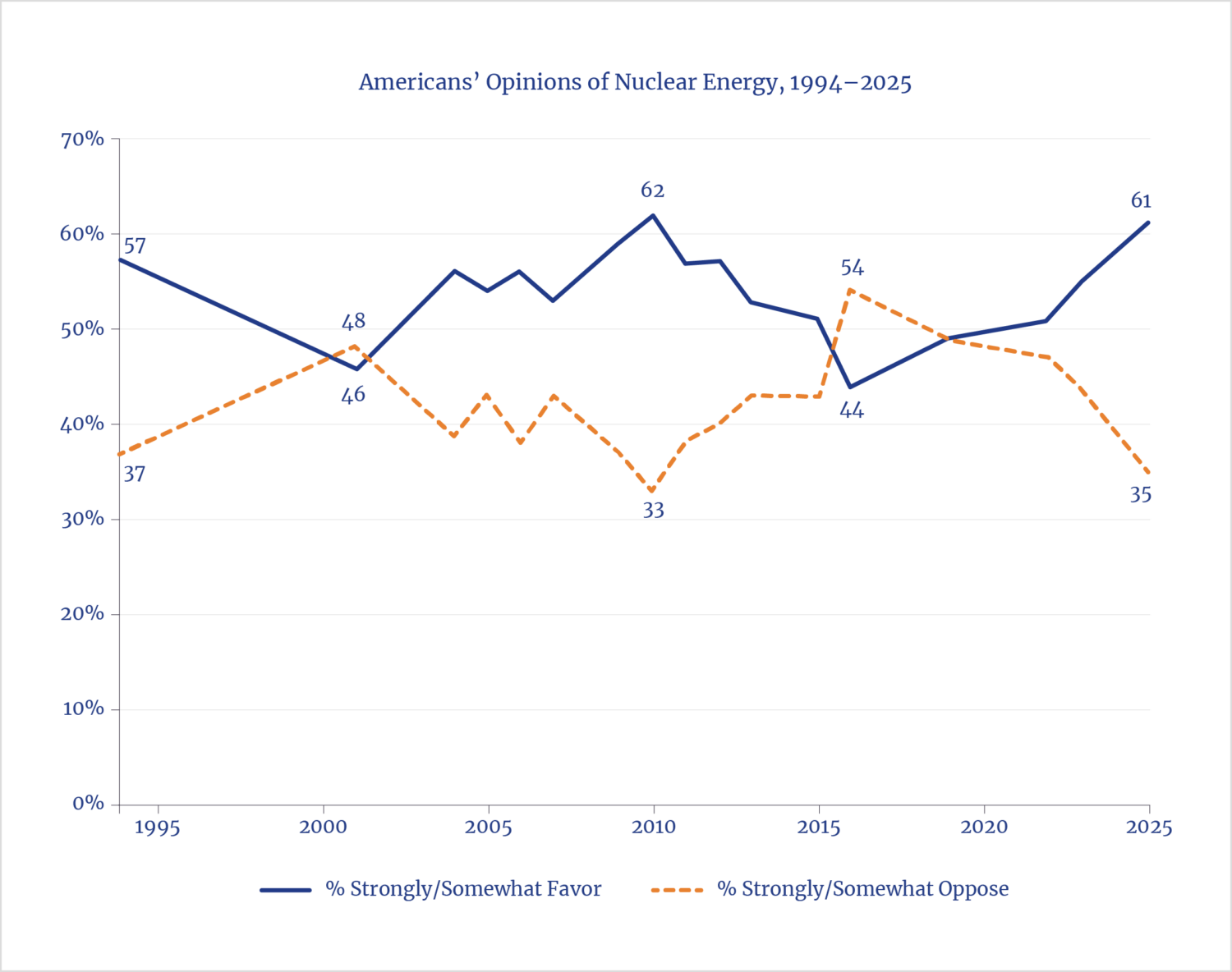
After decades of flat U.S. electricity growth, rapid changes—driven by reliability concerns, growing demand, and changing geopolitical tides—are forcing policymakers, business leaders, utilities, and other stakeholders to rethink existing strategies for energy development, generation, and procurement. Consequently, unprecedented levels of investment are now being channeled into nuclear technologies of all varieties to enhance the reliability and affordability of future energy systems. Moreover, support for the expansion of nuclear energy is near its highest since polling agencies like Gallup began tracking public sentiment, while opposition is near all-time lows (see figure 1).1
Figure 1. Gallup Poll on Americans’ Opinions of Nuclear Energy: 1994–2025
With a fervor not seen in decades, U.S. states and the federal government are embracing nuclear energy: repealing moratoriums, allocating billions in funding, and streamlining regulations to better reflect the stellar safety performance of modern nuclear technologies. Several generations have passed since misinformed media reports and antinuclear activism stoked public fear about the 1979 accident at Three Mile Island. Despite a release of radioactive material and serious damage to the reactor, the incident had no detectable adverse impact on the health of Americans.2 Decades of safe and reliable nuclear plant operation have allayed many safety fears and engendered new support. Japan has restarted 15 of the 33 operable nuclear reactors that the nation shut down after the 2011 Tohoku earthquake, with applications for another 10 reactor restarts, as well.3
However, questions about managing nuclear waste persist as a major public concern, exemplified by recent fuel cycle development activities in Wyoming that faced strong community and policymaker opposition over fears about nuclear waste.4 Texas and New Mexico host nuclear research, supply chain activities, and generation; however, both rejected proposed commercial nuclear waste storage sites within their borders. Despite decades of comprehensive scientific and technical evaluations, widespread misunderstandings regarding nuclear waste persist—ironically, as it remains one of society’s more tractable waste challenges.
While decades of domestic nuclear operations have contributed trillions of dollars to the U.S. economy and provided almost one-fifth of America’s electricity needs,5 the lack of a settled national waste-management policy threatens to undermine needed expansion and is exacerbated by inconsistent federal commitment.
The Reality
Since the inception of the nuclear energy industry over half a century ago, nuclear waste management has been an intrinsic part of any discussion related to the industry’s public acceptance. Opponents of nuclear energy have cited nuclear waste management as an intractable obstacle with substantial environmental, financial, and health costs. However, over decades of U.S. commercial operations, used nuclear fuel (UNF) storage and management have caused no harm to plant workers, members of the public, or the environment.6 UNF, also known as spent nuclear fuel, is nuclear fuel that has been removed from a reactor core after it is no longer economically viable to use, compared with loading fresh fuel to sustain the fission chain reaction. Unique among many (if not all) waste forms, UNF looks visually the same as new fuel and still contains substantial amounts of usable materials. However, because UNF is radioactive, it must be isolated and protected to prevent potential exposures to the nuclear workforce or the public.
A long-term nuclear waste-management strategy has been discussed since the end of World War II, when the entirety of the atomic-weapons effort, including all associated wastes, was inherited by the newly formed Atomic Energy Commission (AEC).7 While pioneering commercial nuclear electricity generation, the U.S. also developed nuclear fuel breeding technology, and established one of the world’s first commercial reprocessing facilities.8 The latter allows the recovery of uranium, other still-fissionable materials, and other useful constituents from UNF, while reducing isolation costs, volumes, and durations. An integrated or closed nuclear fuel cycle involves the reuse of usable UNF material through reprocessing or other means, an approach pursued more vigorously by countries such as France and Russia than by the U.S. in recent decades. UNF recycling by commercial industry was originally envisioned as a long-term component of the U.S. nuclear fuel cycle; however, a 1977 ban by the Carter administration changed the discussion. Federal lawmakers would remove commercial incentives prior to a 1981 repeal of the ban by the Reagan administration.9
The passage of the Nuclear Waste Policy Act of 1982 (NWPA) was intended to deal with the waste-management issue and transfer responsibility from the commercial industry to the federal government. The NWPA established the AEC’s successor, the U.S. Department of Energy (DOE), as responsible for the siting, construction, and operation of a geologic waste repository as well as establishing a long-term federal government responsibility for disposal and isolation of commercial UNF.10 After examining nine potential sites and narrowing down to three for detailed site characterization, Congress—citing high costs—amended the NWPA in 1987 to move forward with just one site, at Yucca Mountain, Nevada.11 In the decades since, Nevada state policymakers and stakeholders vigorously opposed its completion as an operational repository, despite billions of dollars spent by the DOE on licensing, research, development, and legal defense.
In 2008, the DOE submitted a license application to the U.S. Nuclear Regulatory Commission (NRC) for constructing the Yucca Mountain repository, but just two years later sought to withdraw its application, citing the action as consistent with congressional and presidential decisions to explore alternative solutions via a Blue Ribbon Commission.12 In May 2016, fleeting progress was made on the Yucca Mountain project when the NRC issued an Environmental Impact Statement;13 however, the site represents an abandoned legacy of decades of unsuccessful federal nuclear waste management. The 2012 Blue Ribbon Commission Report recommended a consent-based siting process with subsequent administrations providing varying levels of support for such actions.14 Despite stops, swerves, and starts over decades, U.S. efforts for comprehensive UNF management continue to face uncertainty.
Decades of failed or neglectful federal UNF policies point to the need for sustained commitment to bring both technological innovation and political consensus to the waste issue. The second Trump administration has made reprocessing development a priority and released a request for information (RFI) in January 2026 focused on developing campuses that would incorporate the entire nuclear fuel life cycle alongside other manufacturing, industrial, or generation activities.15 Bringing reprocessing back into the picture, as well as framing the challenge around the entire fuel cycle as multigenerational economic development opportunities for willing states, may finally breathe life into a conversation that has remained stalled for decades.
Today
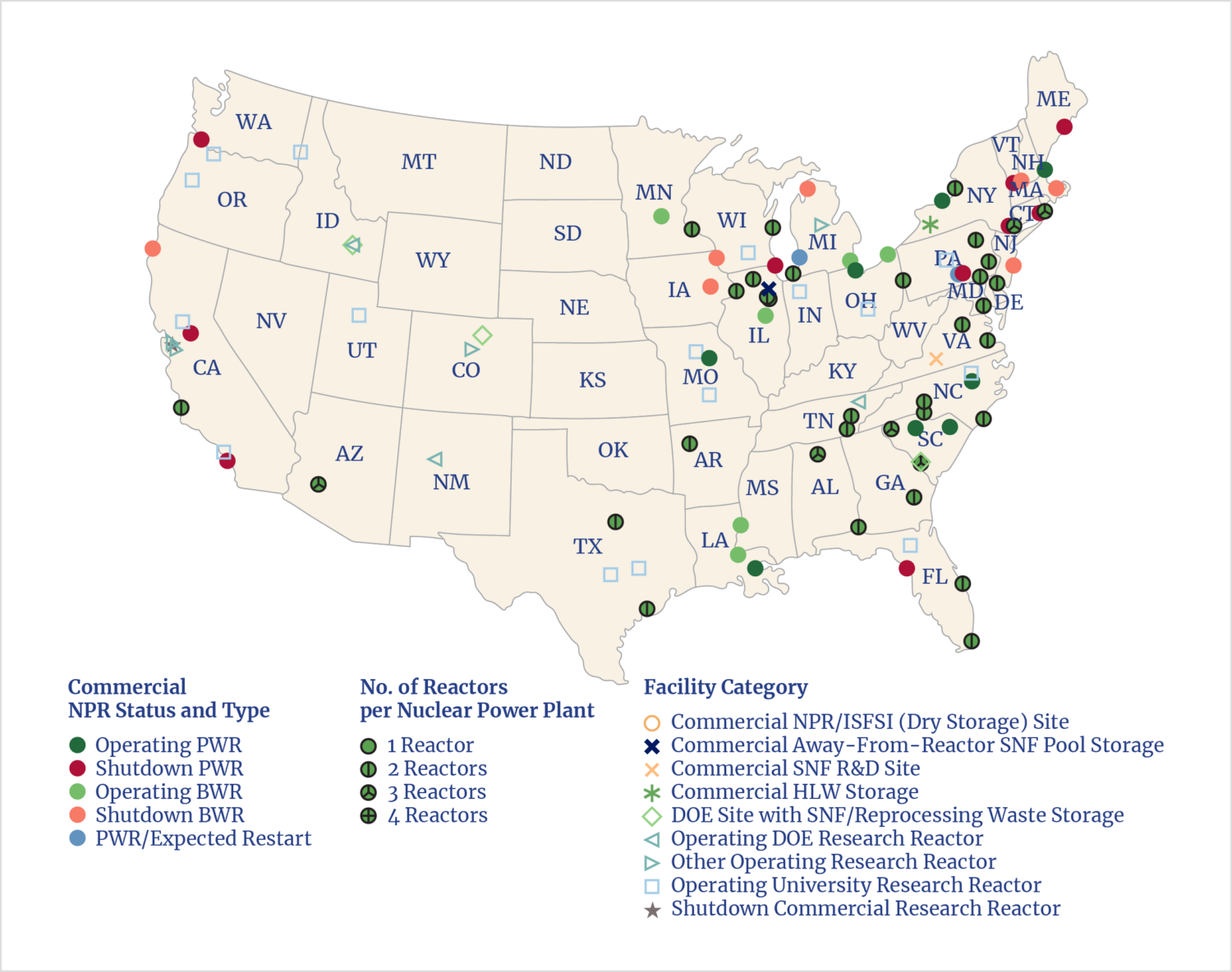
About 95,000 metric tons (MT) of UNF is contained in some 330,000 assemblies stored in water-filled spent fuel pools and dry casks at 73 sites around the U.S. (see figure 2).16 About 2,000 MT of UNF is discharged from commercial reactors each year, and all of it must be initially cooled in spent fuel pools due to residual decay heat produced from fission. The spent fuel pools, all located alongside reactors around the country, were originally designed for short-term storage before ultimate disposal. As it became clear in the 1970s and 1980s that a disposal solution would be decades away, and with pool capacities limited, the commercial nuclear industry around the world innovated by developing on-site dry storage. Dry storage utilizes casks, or large steel containers filled with inert gas, sealed from leaking, and encased in additional steel, concrete, or other materials for shielding. The first U.S. dry storage facility was licensed by the NRC in 1986 at the Surry Nuclear Power Plant in Virginia. Today, about 55% of America’s UNF is in dry storage.17 While dry storage has proved a highly successful interim solution for the nuclear industry, projections indicate that commercial UNF inventories could roughly double as most operating reactors see their operational licenses extended to 80-year lifetimes.18
Figure 2. U.S. UNF and Reprocessing Waste Storage Sites at the End of 2024
Federal UNF management has been a major black eye and policy failing for nuclear energy generation and technology; however, not all forms of nuclear waste suffer from problematic support, regulatory, or management structures. Less hazardous forms of nuclear waste, such as medical waste or contaminated personal protective equipment, have been disposed of and regulated for years as low-level waste (LLW).
U.S. nuclear waste forms can be broadly classified into four categories: LLW; high-level waste (HLW); transuranic waste (TRU); and mill tailings. UNF is considered HLW, alongside highly radioactive reprocessing wastes and other material determined by the NRC to require permanent isolation. TRU is DOE-generated material contaminated with elements beyond uranium on the periodic table. Mill tailings are mine wastes containing radon, thorium, uranium, and other lightly radioactive by-product material. LLW is lightly radioactive material produced in commercial, medical, research, or industrial activities such as protective equipment, machinery, and tools, among other things.
A state compact program—originally envisioned to foster greater collaboration among the states but instead reinforcing a disposal regime dominated by a handful of key players—managed the disposal of some 3.3 million cubic feet of LLW in 2023.19 By comparison, about 1.5 million cubic feet of commercial UNF has been produced and is currently in storage at the 73 interim sites around the United States. Without casks or shielding, that volume equates to roughly half the interior volume of a typical Walmart Supercenter, or the volume of the U.S. Capitol Rotunda.20
Many have argued that a federal policy focused on a once-through nuclear fuel cycle—that is, disposing of the UNF rather than recycling or reprocessing it—is shortsighted and creates more burdens than a closed recycling approach. The U.S. pioneered UNF reprocessing; but proliferation concerns, abundant low-cost uranium, and relatively high reprocessing costs prompted subsequent administrations, particularly those of Carter and Clinton, to deprioritize or effectively ban reprocessing activities.21 After several years of operation in a nuclear power plant, discharged UNF still contains about 95% of the initial uranium (along with about 1% of plutonium); the remainder comprises various radioactive fission fragments and transuranics.22 Advocates of a closed fuel cycle with reprocessing highlight the potential to recover unused uranium, plutonium, and other valuable materials that may be useful in industrial and medical uses. Some estimates suggest that recycling could unlock hundreds of years of additional U.S. nuclear electricity generation23 while offering new options for alleviating fuel cycle pressures related to nuclear expansion.
Reprocessing is any physical, chemical, or other process used to separate UNF into its constituent chemical, isotopic, or elemental components. For example, the PUREX process was invented and pioneered in the U.S.24 and utilizes acids and solvents to extract uranium and plutonium from UNF. Nations such as France and Russia have incorporated PUREX into their commercial nuclear industries, where it improves fuel utilization by 25%, reduces HLW volume for long-term storage by a factor of four, and lowers the long-term radiotoxicity of the remaining waste.25 Reprocessing has the potential to reduce overall national disposal burdens by changing protection requirements from hundreds of millennia to centuries through the separation and potential reuse of fertile, fissile, or fissionable radioactive components.26 However, the up-front costs to establish the needed infrastructure and capabilities may still challenge the feasibility of increased reprocessing usage in the U.S. and other nations. Globally, reprocessing has faced significant challenges in adoption, with some nations abandoning ambitions or others stalled after expending substantial funds. Japan, for example, has been developing its Rokkasho reprocessing facility since 1993, with construction costs ballooning to $25 billion, with estimates of $80 billion more for operations and decommissioning.27 For decades, scant commercial interest kept reprocessing sidelined, leading to the NRC’s 2021 decision to cancel its rulemaking efforts, citing lack of interest and no expected applicants.28 But today’s push for nuclear expansion is forcing a recalculation of reprocessing’s benefits and costs while encouraging developers and stakeholders to answer lingering questions about value and long-term responsibility.
Under the NWPA, all U.S. nuclear facilities contributed 1 mill ($0.001) per kWh of electricity generated by a reactor (paid by ratepayers) to the Nuclear Waste Fund. The fund was originally intended to finance the Yucca Mountain repository, and payments were suspended in 2014 following legal action from generators in response to the lack of federal action.29 After collecting some $22 billion from utilities in 34 states,30 over $51 billion remains in the fund, with only some $11.5 billion spent thus far on nuclear waste activities.31 Despite a problematic legacy, substantial resources and technical solutions remain available to sensibly address the nuclear waste challenge. The key factor will again be the necessary political will.
Perspective
Yucca Mountain is a lesson for the future of the politics of nuclear waste. While geologic disposal remains the consensus scientific choice for both closed and open fuel cycles, even if Yucca Mountain were operating today, it would have insufficient statutory capacity to store all the UNF now in the United States. To ensure that a modern UNF strategy doesn’t present a roadblock to nuclear ambitions, several sites and approaches will likely be needed, including renewed openness to reprocessing and recycling.
A useful lesson for the nuclear industry might be drawn from the general popularity of recycling in other domains. By some estimates, consumer-based recycling facilities recover less than 50% of their direct costs.32 Federal government estimates suggest that over $36 billion in investment will be needed by 2030 to expand curbside collection and processing access from about one-third to two-thirds of Americans.33 Yet, despite the lack of profitability for municipal recycling and limited access, it maintains strong public and political support, often for moral and symbolic reasons.
Recent dialogues around the value of mining and extraction activities have shifted markedly since President Trump’s reelection; however, the current fervor for expanded domestic production may face stronger headwinds in the future. Embracing reprocessing together with advanced nuclear technologies in a closed, integrated fuel cycle solution would likely reduce the need for significantly increased domestic extraction. In hindsight, previous administrations, Congresses, and policymakers who sought to restrict expanded domestic extraction on environmental grounds had, and should have embraced, a compelling case for prioritizing reprocessing. But then, as now, proliferation risks played an outsize role in the discussion, overshadowing any positive impacts being considered in the policy debate. While recycled plutonium remains a direct-use material vulnerable to theft, diversion, or misuse in weapons programs, robust international safeguards, inspections, and nonproliferation-technology innovation could foster renewed, constructive conversations on reprocessing.
Although recycling UNF may have an important role to play, it alone cannot resolve all nuclear waste-management challenges. Reprocessing reduces volumes, radiotoxicity, and disposal costs (when excluding initial reprocessing infrastructure costs, in many cases), but it does not eliminate the need for the ultimate disposal or isolation of remaining highly radioactive wastes. While disposal must be acknowledged as a priority, the previous track record of adversarial state-federal relationships and a focus on a single disposal location must not be repeated. The DOE’s proposed Nuclear Lifecycle Innovation Campuses aim to address many of these concerns. Providing states with the proper support and incentives to pursue this opportunity will be critical to the ultimate success of resolving the nuclear waste challenge.
Nuclear electricity stands peerless among energy sources when viewed through an environmental lens. It delivers unmatched reliability and geopolitical security in a single package. UNF has been safely isolated from the public for generations and is likely to remain so with appropriate oversight and commitment. U.S. UNF management is distinctive in that tens of billions of dollars sit in the Nuclear Waste Fund and no technological or scientific challenges remain, but progress has been persistently stalled. Legal challenges, the need for congressional action, and meaningful stakeholder engagement cannot be fully resolved by executive action alone. The combination of changing electricity demand and a growing appreciation of the value of nuclear energy, as well as strong commercial ambitions by an expanding industry, creates the best opportunity for action in generations. Despite these strong tailwinds, much is much to be done. Current statutory requirements and regulatory frameworks do not adequately provide for multiple final disposal sites or sufficient technology inclusivity to enable alternative approaches, such as deep borehole disposal. Even if states step up to take the opportunities offered by the federal government, millions, and likely billions, of dollars will be needed to support communities, stakeholders, and commercial entities willing to play a role. The Nuclear Waste Fund is already being eyed as a potential target to incentivize reprocessing and other activities; however, it is paramount that this generation’s choices do not deplete available funding or constrain the next generation’s options. The questions surrounding nuclear waste management are not new, nor is the federal attention that is being directed; however, today’s confluence of surging electricity demand, acknowledgment of nuclear energy’s reliability, and accelerating innovation may represent the best opportunity in generations for meaningful, consequential action.
Endnotes
- Megan Brenan, “Nuclear Energy Support Near Record High in U.S.,” Gallup News, April 9, 2025.
- “Backgrounder on the Three Mile Island Accident,” U.S. Nuclear Regulatory Commission (NRC), last updated October 2, 2025, https://www.nrc.gov/reading-rm/doc-collections/fact-sheets/3mile-isle.html.
- “Nuclear Power in Japan,” World Nuclear Association, updated February 13, 2026, https://world-nuclear.org/information-library/country-profiles/countries-g-n/japan-nuclear-power.
- David Madison, “BWXT Pitches Nuclear Fuel Plant in Gillette as Locals Wrestle with Mixed Emotions,” Cowboy State Daily, October 1, 2025.
- “Electricity Explained,” U.S. Energy Information Administration, last updated April 2, 2025, https://www.eia.gov/energyexplained/electricity.
- American Nuclear Society, Management of the Nation’s Used Nuclear Fuel and High-Level Waste, Position Statement #3 (American Nuclear Society, 2023); Nuclear Innovation Alliance, Spent Nuclear Fuel Management (Nuclear Innovation Alliance, 2025); and “Transportation of Spent Nuclear Fuel,” NRC, last updatedMay 16, 2023, https://www.nrc.gov/waste/spent-fuel-transp.
- Atomic Energy Act of 1946, Pub. L. No. 79-585, ch. 724, 60 Stat. 755.
- Idaho National Laboratory (INL), Experimental Breeder Reactor-I (INL, 2025); and James Blankenhorn and Bryan Bower, “West Valley Demonstration Project—Past, Present and Future,” paper presented at the WM2011 Conference, Phoenix, February 27–March 3, 2011.
- U.S. Nuclear Waste Technical Review Board (NWTRB), Commercial Spent Nuclear Fuel, rev. 2 (NWTRB, 2022).
- H.R. 3809—Nuclear Waste Policy Act of 1982, enacted as Pub. L. No. 97-425.
- U.S. Department of Energy (DOE), “Department of Energy Announces Three Proposed Sites for Potential Disposal of High-Level Radioactive Waste,” press release, December 19, 1984; U.S. Government Accountability Office (GAO), Nuclear Waste: DOE Expenditures on the Yucca Mountain Project, T-RCED-91-37 (GAO, 1991); and Omnibus Budget Reconciliation Act of 1987, Pub. L. No. 100-203, 101 Stat. 1330.
- Yucca Mountain; Notice of Receipt and Availability of Application, Federal Register 73, no. 117 (June 17, 2008): 34348–49; and DOE, “U.S. Department of Energy’s Motion to Withdraw,” ASLBP No. 09-892-HLW-CAB04, Docket No. 63-001, March 3, 2010.
- “High-Level Waste Disposal,” NRC, last updated March 12, 2020, https://www.nrc.gov/waste/hlw-disposal.
- Blue Ribbon Commission on America’s Nuclear Future, Report to the Secretary of Energy (DOE, 2012).
- DOE, “DOE’s Office of Nuclear Energy Awards $19 Million to Advance Recycling of Used Nuclear Fuel,” press release, February 5, 2026; and DOE, “Department of Energy Seeks Hosts for Nuclear Lifecycle Innovation Campuses,” press release, January 28, 2026.
- Office of Nuclear Energy, Spent Nuclear Fuel and Reprocessing Waste Inventory (DOE, 2025).
- “Dry Cask Storage,” NRC, last updated June 16, 2023, https://www.nrc.gov/waste/hlw-disposal; NRC, “Low-Level Waste Disposal Statistics,” last updated October 8, 2024, https://www.nrc.gov/waste/llw-disposal/licensing/statistics; and Office of Nuclear Energy, Spent Nuclear Fuel.
- Office of Nuclear Energy, Spent Nuclear Fuel.
- “Low-Level Waste Disposal Statistics.”
- “Where and What Is the Capitol Rotunda?,” Capitol Hill Facts, Architect of the Capitol, accessed March 23, 2026, https://www.aoc.gov/explore-capitol-campus/capitol-hill-facts/all?page=1#:~:text=The%20Rotunda%20is%20a%20circular,approximately%201.3%20million%20cubic%20feet.
- NWTRB, Commercial Spent Nuclear Fuel; and Jimmy Carter, “Nuclear Power Policy: Statement by the President on His Decisions Following a Review of U.S. Policy, April 7, 1977,” in Presidential Documents: Jimmy Carter, 1977 13, no. 15: 502–7.
- NWTRB, Commercial Spent Nuclear Fuel.
- Nick Touran, “How Much Energy Is Contained in Existing U.S. Nuclear Waste?,” What Is Nuclear, April 29, 2023.
- Herbert H. Anderson and Larned B. Asprey, Solvent extraction process for plutonium, U.S. Patent 2,942,506, filed October 20, 1950 and issued July 5, 1960.
- International Atomic Energy Agency (IAEA), Spent Fuel Reprocessing Options, IAEA-TECDOC-1587 (IAEA, 2008).
- Joseph Magill et al., “Impact Limits of Partitioning and Transmutation Scenarios on Radiotoxicity of Actinides in Radioactive Waste,” Nuclear Future 42, no. 5 (October 2003): 263–77.
- International Panel on Fissile Materials, “Rokkasho Costs Rise Again,” IPFM Blog, June 23, 2025; and “Reprocessing,” Japan Nuclear Fuel Limited, last updated February 28, 2026, https://www.jnfl.co.jp/en/business/reprocessing.
- Margaret M. Doane, “Discontinuation of Rulemaking—Spent Fuel Reprocessing,” SECY-21-0026, memorandum to the Commissioners, NRC, March 5, 2021.
- “Nuclear Waste Fund Payment Information by State,” Nuclear Energy Institute, last updated May 2019, https://www.nei.org/resources/statistics/nuclear-waste-fund-payment-information-by-state.
- “Nuclear Waste Fund Payment.”
- DOE, Nuclear Waste Fund (NWF) Annual Financial Report Summary, FY2025 and Cumulative (DOE, 2025).
- GAO, Recycling: Building on Existing Federal Efforts Could Help Address Cross-Cutting Challenges, GAO-21-87 (GAO, 2020).
- “U.S. Recycling Infrastructure Assessment and State Data Collection Reports,” U.S. Environmental Protection Agency, last updated August 6, 2025, https://www.epa.gov/smm/us-recycling-infrastructure-assessment-and-state-data-collection-reports.