The Nuclear Workforce: An Essential Energy Priority Facing the Nation
THE ISSUE
Jim Vinoski
Nuclear power is experiencing a bipartisan renaissance of newfound public acceptance driven by multiple factors, including the growing needs for data centers and the reshoring of factories, in addition to issues such as policy goals to reduce carbon emissions. Various projects are either in the planning stages or are already underway across the United States to repower shuttered reactors, increase existing nuclear facilities’ energy output, or build new nuclear power plants. President Trump’s 2025 executive order calls for the United States to quadruple its nuclear capacity to 400 gigawatts (GW) by 2050.[i]
Critical to making all that happen, however, is having the needed workforce—in numbers, talent, training, certification, and location.
What are the skills and trades required for these various efforts, and in what numbers will they be needed? What portion of the workforce can be drawn from the general skilled labor pool, and how many require additional nuclear-specific training and certification? What are the demographics of the current nuclear workforce, and where are they located? What are the challenges that will have to be tackled to get the needed workforce?
A few of the challenges are already known. In general, trade and technical worker pools are thin, thanks to society’s denigration of these jobs as “dead-end careers” for several generations and its well-meaning—but sometimes misguided—push toward college for everyone. Demographics are also against us: The aging-out of the baby boom generation in the skilled trades is a well-documented reality.
To better understand the labor requirements for the country’s nuclear power ambitions and the capacity to fulfill them over the coming years, this analysis was conducted in partnership with Professor Shon R. Hiatt at the University of Southern California (USC).
THE ANALYSIS
Shon R. Hiatt
To better understand workforce requirements for planned reactor restarts, power uprates, and new nuclear construction, the National Center for Energy Analytics commissioned a study from the USC Marshall School of Business.[ii] Projections from this study form the basis of the analysis in this section. This analysis extrapolated labor requirements based on various confidence intervals, using data from a combination of estimates by the Nuclear Energy Institute and from nuclear reactor operating company financial reports and news releases.
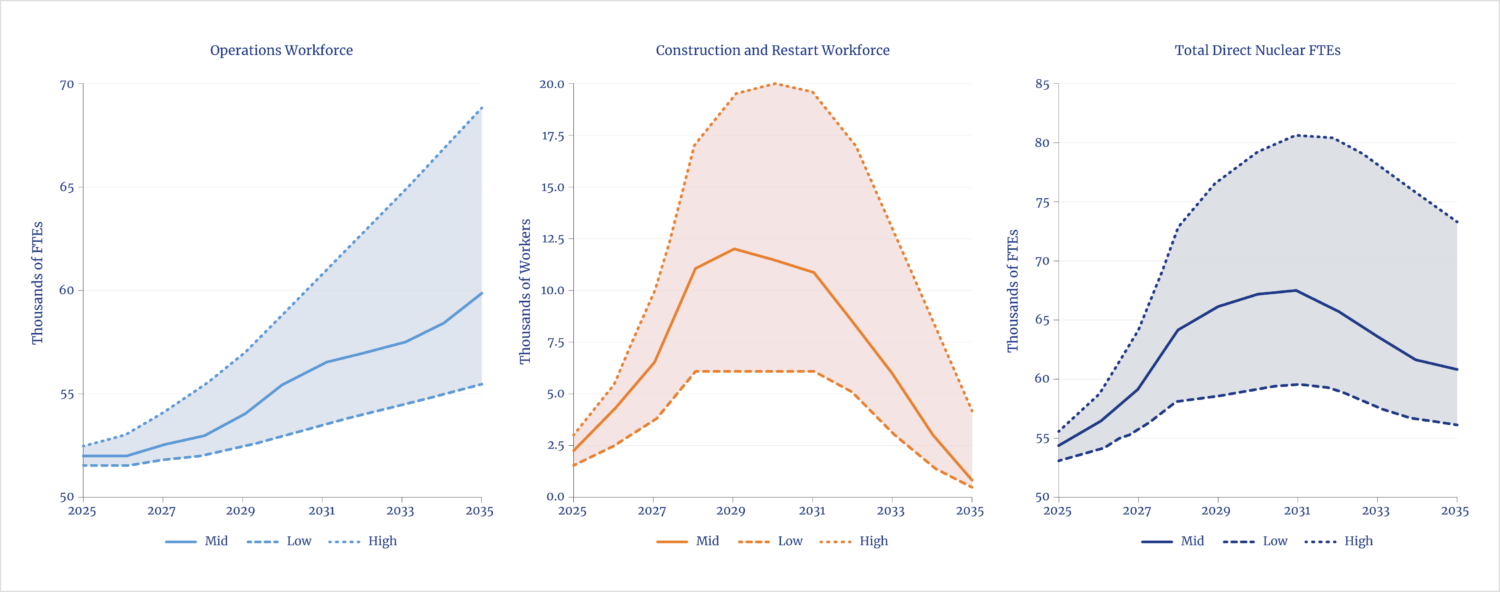
Three workforce scenarios (low, mid, and high) reflect different assumptions about the pace and scope of nuclear expansion. Under the mid scenario—which would lead to a 5%–10% increase in U.S. nuclear generation by 2030—total direct employment would rise from approximately 52,900 in 2025 to a peak of just over 66,000 by 2031. That employment level would shrink back to roughly 60,800 in 2035 as construction activity concludes.
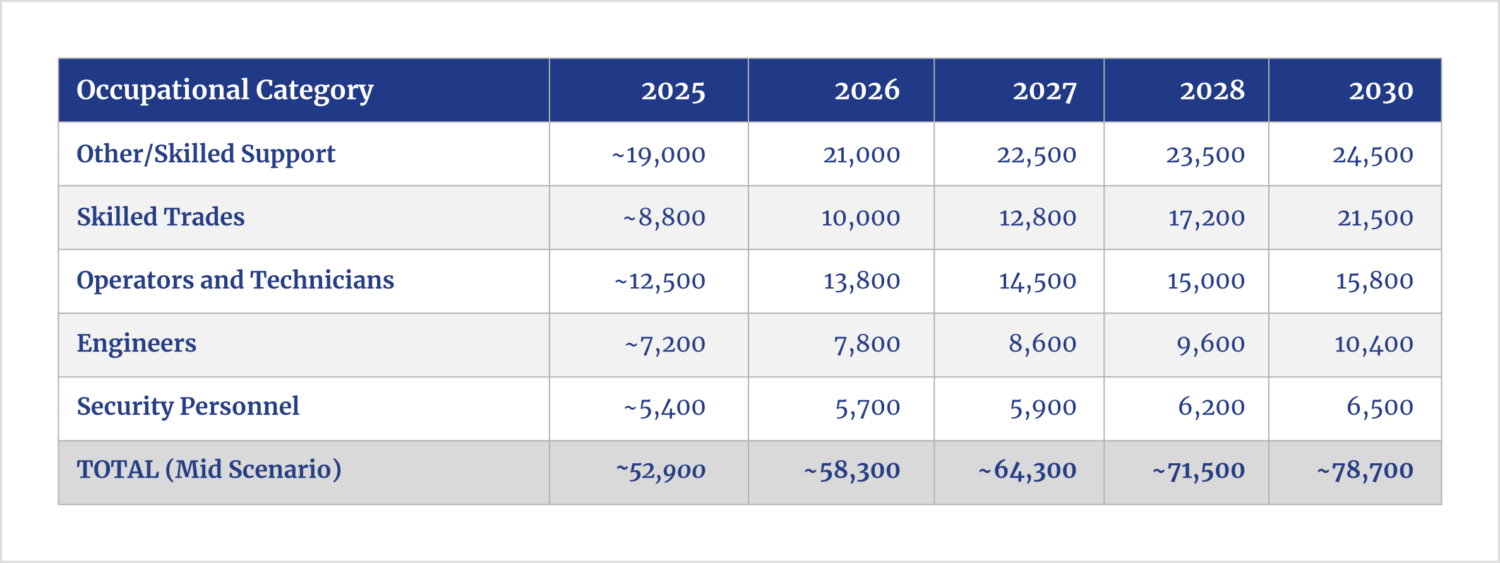
The 2025 U.S. Energy and Employment Report (USEER), published by the U.S. Department of Energy (DOE), indicates that the nuclear energy sector employed 67,900 workers in 2024 across fuels and electric power generation (EPG), nearly identical to the 68,008 workers reported in 2023.[iii] Eighty-five percent of those jobs were in EPG.[iv] Table 1 presents the USEER breakdown by industry for nuclear EPG employment.
Table 1. Nuclear Electric Power Generation Employment, by Industry: 2024
Source: Updated from Gal Blatman et al., U.S. Nuclear Power Industry Employment Forecast Analysis: Operations, New Construction, and Reactor Restart Workforce Projections (Zage Business of Energy Initiative, USC Marshall School of Business, 2026), 9, table 6.
Other/Skilled Support: This category includes health physicists, project managers, and information technology specialists, as well as administrative, procurement, and training staff. Consistently the largest share of the total headcount, it represents 30%–40% of operational staff and 20%–28% during construction. In full-time employee (FTE) terms, it totals 17,500–20,000 in 2025 and is projected to reach 20,500–24,500 by 2030—the largest category in absolute numbers across all phases.
Skilled Trades: This category includes electricians, pipefitters, American Society of Mechanical Engineers code welders, ironworkers, and millwrights—the fastest-growing category in absolute terms. It represents 15%–20% of operational staff but surges to 50%–60% during new construction and 35%–45% during restarts, making it the dominant workforce during any build or restart. FTEs in this category are expected to grow from 8,200–9,100 in 2025 to 16,000–21,500 by 2030 as AP1000 fleet construction ramps up. Although nominally transferable from other sectors, Nuclear Quality Assurance-1 certification requirements create meaningful supply constraints.
Operators and Technicians: This category is the largest occupational group during operations, representing 20%–28% of operational staff (roughly 11,500–13,200 FTEs in 2025, growing to 13,400–15,800 FTEs by 2030). Its share shrinks sharply during construction phases (3%–5%) and modestly during restarts (15%–22%). Growth is severely constrained by Nuclear Regulatory Commission (NRC) licensing requirements that impose an irreducible 18- to 24-month training pipeline per operator, making this the single binding bottleneck on fleet expansion speed.
Engineers: This category includes nuclear, mechanical, electrical, civil, and instrumentation and controls engineers, and it represents 12%–15% of operational staff and 12%–18% during construction. Projected FTEs rise from 6,900–7,400 in 2025 to 9,200–10,400 by 2030, reflecting growing design, commissioning, and startup engineering demand. Nuclear engineers ($135,760 median wage) represent the most highly compensated occupation; however, only approximately 15,400 are currently employed nationally, of whom roughly 20% work in nuclear electric power generation. This figure would need to roughly double under the DOE’s 200-GW expansion scenario.
Security Personnel: This category is unique to nuclear among energy sectors and are required by NRC regulation (10 CFR 73) at all operating sites. It represents 8%–12% of operational staff and remains relatively stable across all phases (2%–3% during construction, 5%–8% during restarts). Projected FTEs grow modestly from 4,800–5,500 in 2025 to 5,600–6,500 by 2030, scaling primarily with the number of sites entering operational status rather than with capacity additions.
For restart activity, specifically, cumulative FTE-years across all active projects totaled 12,800 (low, three plants); 21,600 (mid, three plants, plus potential Indian Point); or 32,000 (high, all five units) over the full duration of active restart work.
Under the mid scenario, peak total nuclear workforce reaches 66,000–67,300 direct FTEs by 2029–31, representing a 15%–20% increase over the current nuclear EPG baseline of approximately 57,900. However, the range of plausible outcomes is wide. Under the low scenario (only Palisades and Three Mile Island restarts proceed; AP1000 deployment is delayed), peak employment reaches approximately 57,000–60,000 FTEs. Under the high scenario (all restarts including Indian Point proceed; AP1000 fleet deployment accelerates alongside small modular reactor [SMR] demonstration projects), total employment could reach 80,000–85,000 FTEs by 2030–31. Figure 1 illustrates these three scenarios across operations workforce, construction and restart workforce, and total direct nuclear FTEs.
Figure 1. Nuclear Workforce Projections, by Scenario: 2025–35
Source: Adapted from Gal Blatman et al. U.S. Nuclear Power Industry Employment Forecast Analysis: Operations, New Construction, and Reactor Restart Workforce Projections (Zage Business of Energy Initiative, USC Marshall School of Business, 2026), 20, figure 3.
PERSPECTIVES
Jim Vinoski
The analysis and projections in this report indicate that it will be very difficult to provide the needed workforce based on current trends. The gap between skilled workers needed versus those available widens rapidly toward mid-century.
Demographics present a greater difficulty for the nuclear workforce than for general industry, as its skilled workforce currently skews older than the broader industry average. Meanwhile, cross-sector availability, where non–nuclear-specific workers can fulfill the needs, ranks as high or very high in only a few of the necessary disciplines.
Adding to those difficulties, the nuclear workforce needs cannot be viewed in isolation. There is a concurrent, bipartisan effort to enact policies to reinvigorate and reshore manufacturing, particularly in national security-sensitive areas, such as chipmaking and shipbuilding. Similar labor demands are being driven by the simultaneous construction of huge numbers of data centers, new power plants (e.g., gas, wind, solar) to meet demand, and overdue upgrades to the electricity distribution and fuel pipeline infrastructure.
It is necessary to identify and pursue effective mitigations for this challenge. These include the following short-term and long-term initiatives.
Short-Term Initiatives
Nuclear will not solve the nation’s immediate needs for added generating capacity. Maintaining and upgrading existing clean coal and gas turbine plants, as well as constructing new plants that are necessary for the next decade, will resolve short-term capacity requirements. A good first step can be seen in the DOE’s Notice of Funding Opportunity, issued this past fall, which will fund up to $100 million to refurbish and modernize the nation’s existing coal power plants.[v]
This approach will minimize immediate workforce challenges with its less labor-intensive construction requirements while allowing needed time for planning and preparation for expanding the nuclear fleet.
Bolstering U.S. trades and technical workforce must also be an immediate priority. Federal support should be provided for programs that provide training in the basic skilled trades and technical disciplines, which are increasing in demand and facing significant shortfalls.
Support should also be provided to retain skilled workers for as long as possible by incentivizing older workers to remain in the workforce rather than retire. Airlines have set an excellent example through their advocacy to raise the mandatory retirement age for pilots while instituting incentives for pilot retention.[vi]
Finally, it is vital that the nuclear industry and American educational institutions more aggressively market science, technology, engineering, and mathematics (STEM) programs, as well as skilled trades careers, to youths and untrained adults. Excellent examples for this abound in broader industry, such as METAL’s bootcamps for metal casting and forging[vii] and mikeroweWORKS Foundation’s advocacy and monetary support for skilled trades.[viii]
Long-Term Initiatives
Filling the pipeline for basic skilled trades and technical degree disciplines is only the first step. To mitigate the expected shortfall of nuclear-specific crafts, targeted program supports are also needed. They include establishing public-private partnerships with nuclear manufacturing, construction, and operating companies to develop their own training programs as well as prioritizing programs for the required technical disciplines in the nation’s public trade schools, community colleges, and universities. Once more, a broader industry provides an example: Kent Career Technical Center in Grand Rapids, Michigan, is a specific trades-oriented campus operated by the Kent County Public School System that serves the area’s high schools. This technical center has consulted with local manufacturers to identify needed skills and offers advanced manufacturing training, such as computer numerical control machining and mechatronics, to the 2,500 local students who study there.[ix]
Longer-term efforts to recruit workers for nuclear trades and technical careers are also needed. Women and men each represent high-potential pools for different reasons.
For women, it is a general recruiting opportunity, as the study showed that women represent only 32% of the nuclear workforce versus 47% of the overall American labor market. There are many female-targeted recruitment and retention efforts in the general trades and technical disciplines, including the Women in Trades Hub and the Society of Women Engineers. An excellent nuclear-specific example already exists in U.S. Women in Nuclear.
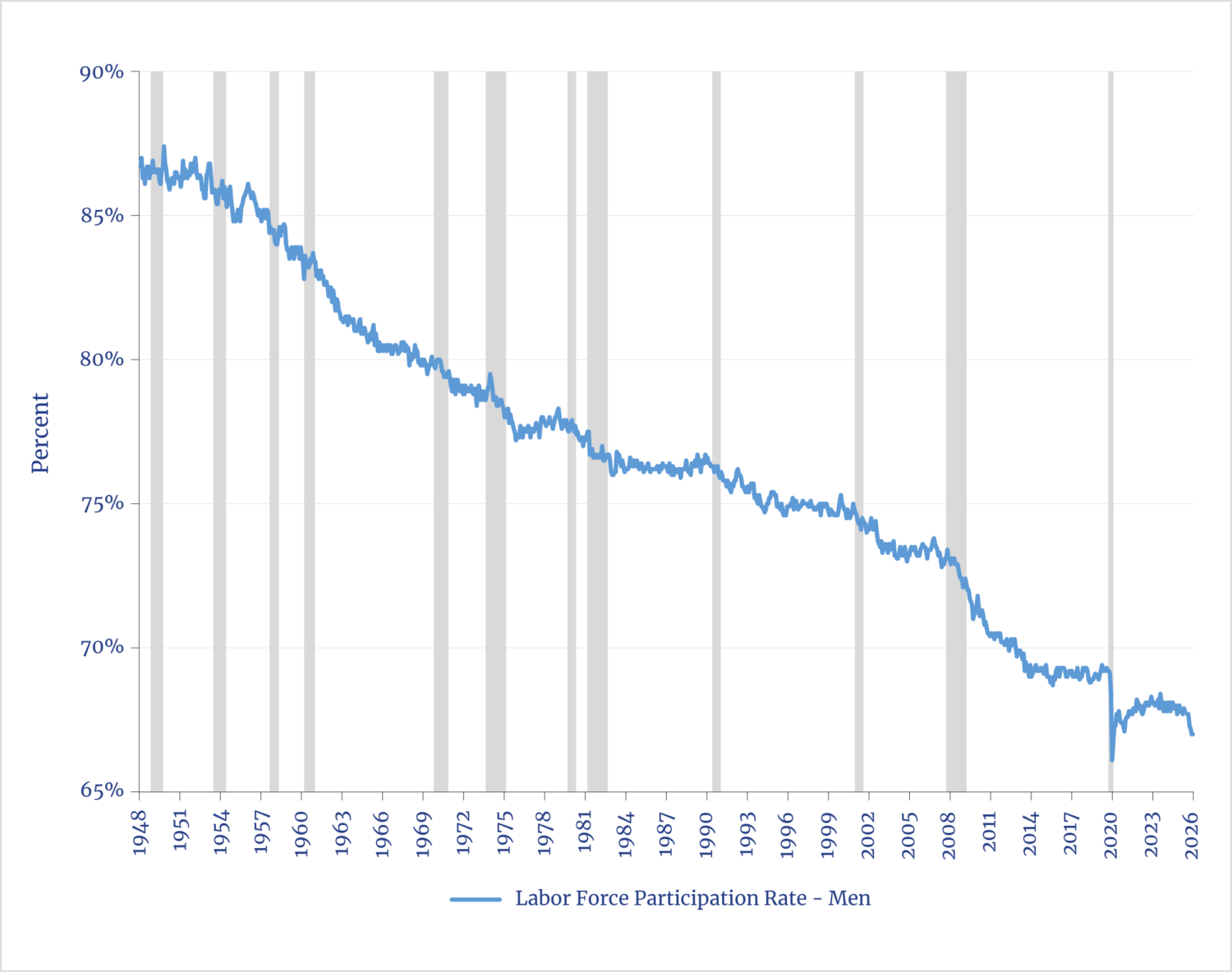
For men, the opportunity lies in the workforce participation rate. Unlike women, for whom workforce participation has increased steadily until very recently, men’s labor participation rate has been declining since the mid-twentieth century, dropping from about 87% to approximately 67% (see figure 2). Identifying and addressing the drivers of this phenomenon and the incentives that should bring some of those laborers back to the workforce offers great potential.
Figure 2. U.S. Male Labor Force Participation: Decades of Decline
Source: Data from “Labor Force Participation Rate—Men,” U.S. Bureau of Labor Statistics, FRED, Federal Reserve Bank of St. Louis, updated May 8, 2026, https://fred.stlouisfed.org/series/LNS11300001.
Immigration policy can also serve the nation’s nuclear energy needs. Nuclear design and construction companies can make use of the existing U.S. employment-based immigration policy[x] to provide lawful permanent resident status to workers with the specific skills for which the nation is experiencing domestic shortfalls.
In the technology sector, accelerating modular low-labor system designs and advanced automation for nuclear plant construction offers ways to reduce future demand for the nuclear workforce. For initial construction, as well as maintenance and refueling, companies such as Gecko Robotics offer a vision for automation and AI applications to streamline work.
Advanced reactor concepts also reduce labor needs for construction and operation. Holtec International provides a real-world demonstration of this concept: Holtec is currently executing the country’s first restart of an idled legacy reactor, the Palisades Nuclear Generating Station in southwest Michigan. Once complete, the company will begin civil site construction for two planned SMRs, Pioneer Units 1 and 2, which are supported by a $400 million grant from the DOE. These Holtec SMR-300s are expected to cost less and require less labor to operate than standard reactors:
The SMR-300 is expected to be less expensive to build and maintain than traditional nuclear plants. All of the reactor’s components are 12 feet in diameter or less. This allows for fabrication and pre-assembly of components in a factory that can be paired with flexible and more affordable shipping options. The removal of unnecessary redundant systems and addition of automated features are also expected to lower operations and maintenance costs.[xi]
The new modular units will deliver a total of 680 megawatts (MW) of generating capacity to add to the legacy reactor’s more than 800 MW.[xii]
Conclusion
Despite all these efforts, the reality may still be that the United States does not have the workforce required, when it is required, to deliver on President Trump’s goal of quadrupling nuclear capacity by 2050.[xiii] In that case, the only remaining option is to accept a longer timeline. But the mitigations proposed herein will allow the nation to achieve that goal much more quickly.
[i] Exec. Order No. 14300, 90 FR 22587–2590 (2025).
[ii] Gal Blatman et al., U.S. Nuclear Power Industry Employment Forecast Analysis: Operations, New Construction, and Reactor Restart Workforce Projections (Zage Business of Energy Initiative, USC Marshall School of Business, 2026). The study, which was commissioned by the National Center for Energy Analytics, synthesizes industry estimates and nuclear reactor operating company disclosures. All data, projections, and methodology in this section are drawn from this study; see the study for a full list of sources. Shon R. Hiatt, one of the authors of this issue brief, was also a coauthor of the study.
[iii] U.S. Department of Energy (DOE), 2025 United States Energy & Employment Report (DOE, 2025); and DOE, United States Energy & Employment Report 2024 (DOE, 2024).
[iv] DOE, 2025 USEER.
[v] DOE, “Energy Department Announces $100 Million to Restore America’s Coal Plants,” news release, October 31, 2025.
[vi] Prachi Patel, “Flying Until 67: Why Are Airlines Trying to Raise the Pilot Retirement Age?,” Simple Flying, September 4, 2025.
[vii] “Bootcamps,” METAL, accessed May 6, 2026, https://www.metalforamerica.org/get-involved/bootcamps. This program is led by the Institute for Advanced Composites Manufacturing Innovation (also known as IACMI—The Composites Institute) and supported by the U.S. Department of War.
[viii] “Skills That Pay,” mikeroweWORKS Foundation, accessed May 6, 2026, https://mikeroweworks.org/scholarship.
[ix] Melissa Frick, “See Inside New High-Tech Manufacturing Training Facility for High Schoolers,” Mlive.com, February 7, 2024, updated February 8, 2024; “Precision Machining Technology,” Program Overview, Kent Career Tech Center, accessed May 6, 2026, https://www.thetechcenter.org/programs/engineering-manufacturing-industrial-technology/precisionmaciningtechnology/program-overview; and “Mechatronics,” Program Overview, Kent Career Tech Center, accessed May 6, 2026, https://www.thetechcenter.org/programs/engineering-manufacturing-industrial-technology/mechatronics/program-overview.
[x] William A. Kandel et al., U.S. Employment-Based Immigration Policy (Congressional Research Service, 2024).
[xi] Office of Nuclear Energy, “Holtec’s Small Modular Reactor Can Go Almost Anywhere, Even Michigan,” DOE blog, April 10, 2024.
[xii] Holtec International, “With Major Refurbishment Milestones Achieved, Palisades Advances Toward Restart, Prompting the Beginning of Preparatory Site Construction Planning by the Holtec/Hyundai Team to Build the Pioneer 1 and 2 SMR-300 Units,” news release, March 30, 2026.
[xiii] Exec. Order No. 14300 (2025).