The Grid Doesn’t Charge Like a Phone
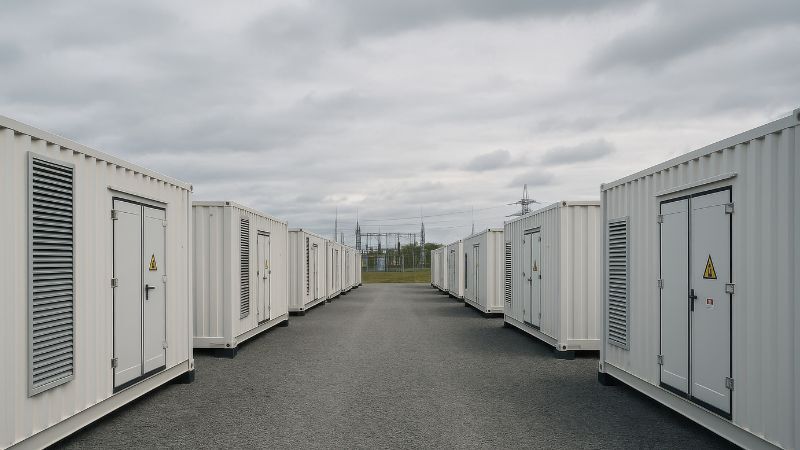
Picture a battery. A phone that runs out. A laptop that needs plugging in. The battery depletes, you refill it, life goes on.
Now scale that image up to the power demands of a modern city during a February cold snap — two weeks of overcast skies, wind barely moving, demand running at peak levels around the clock.
How many batteries would you need? When you actually do the math, the current narrative about grid storage begins to break down. Visiting Fellow Lars Schernikau, PhD reveals the mismatch in his latest issue brief.
Why It Matters
Battery storage has become the load-bearing assumption of clean energy policy. State mandates, federal subsidies, and utility planning models increasingly treat large-scale batteries as the mechanism that makes an intermittent grid reliable. When wind and solar fall short, the battery covers the gap. It’s a clean, simple story.
The physics tells a different one. And the gap between the narrative and reality isn’t small. Designing a grid around a misunderstanding of what batteries can do doesn’t just waste money — it leaves the system more fragile than the one it replaced.
The Fundamental Mismatch
Utility-scale lithium-ion batteries are designed to store one to four hours of power. A 1-gigawatt installation can deliver electricity — but only for that window before it’s empty. A 1-gigawatt natural gas plant can run continuously for months.
These are not substitutes, even though they increasingly appear side by side in the same capacity reports. Power grids need both capacity (the ability to generate) and energy (a sustained supply). Batteries provide the former in bursts. They cannot provide the latter during extended low-renewable periods — what German engineers call Dunkelflaute, or the “dark doldrums.”
Real-world efficiency compounds this. Manufacturers often cite round-trip efficiencies above 85%. Field data puts actual performance closer to 70% once inverter losses, thermal management, and auxiliary loads are factored in. Most lithium-ion systems also degrade 3–7% annually and require module replacement every six to eight years.
The Numbers Don’t Scale
Consider Germany. Covering a typical winter day — 60 gigawatts sustained over 24 hours, with no imports and no dispatchable backup — would require approximately 1.9 terawatt-hours of battery storage. Producing it would demand roughly 1.3 billion tons of raw materials and 850 terawatt-hours of manufacturing energy — mostly from fossil fuels. And it would need to be replaced every decade.
A single 1-GWh installation requires about 700,000 tons of mined and processed materials: lithium, nickel, cobalt, graphite, copper, rare earths. Much of this mining and refining occurs in countries with heavy coal dependence and limited labor protections. Recycling is frequently offered as a solution, but lithium iron phosphate batteries — now dominant at utility scale — lack the cobalt and nickel that make conventional battery recycling economically viable. Large-scale LFP recycling is largely theoretical.
“The question of whether a wind-and-battery system is genuinely better for the environment than what it replaces becomes considerably more complicated once manufacturing energy, mineral extraction, and replacement cycles are counted.
What Batteries Are Actually Good For
None of this means batteries have no place on the grid. They do — frequency regulation, voltage support, rapid-response bridging during brief generation gaps. These are real, valuable contributions for batteries.
The problem is the expectation that short-duration assets can perform long-duration functions at a national scale. They cannot. As dispatchable gas, coal, and nuclear capacity retires under policy pressure, batteries are being deployed as if they can fill the gap. For multi-day lulls and seasonal mismatches, they cannot — not economically, not physically, not within any foreseeable mineral supply or manufacturing constraint.
A grid built on that misunderstanding is a grid trending toward higher costs, greater volatility, and deeper dependence on foreign mineral supply chains — all while failing to deliver the reliability it promises. The solution isn’t to abandon batteries. It’s to be honest about what they can do, invest accordingly in dispatchable power generation, and build policy around physics rather than narrative.