
Some Needed Realism on Wind Power
Such a small change in CO 2 emissions would have no measurable impact on global temperature.
Listen
The issue
Wind power advocates are citing the conflict in Iran as another reason to reduce the world’s dependence on fossil fuels, claiming that wind and solar power insulate countries from volatile fossil-fuel markets.[i] In the United States, wind energy has faced increasing development hurdles including higher costs and local opposition to siting massive wind projects in rural communities and far higher costs that have crippled offshore wind projects. Nevertheless, the resulting increases for crude oil and refined products such as gasoline and diesel fuel do not change the underlying technological and economic issues facing wind (and solar) energy.
The U.S. Energy Information Administration (EIA) predicts that wind generating capacity—both onshore and offshore—will more than double between 2025 and 2035, from 160 gigawatts (GW) to about 350 GW.[ii] Setting aside the problem of how renewable capacity is reported by the EIA, as discussed in a previous NCEA issue brief,[iii] wind power introduces a range of technical, economic, legal, and environmental complexities that deserve closer scrutiny from policymakers and better disclosure to ratepayers.
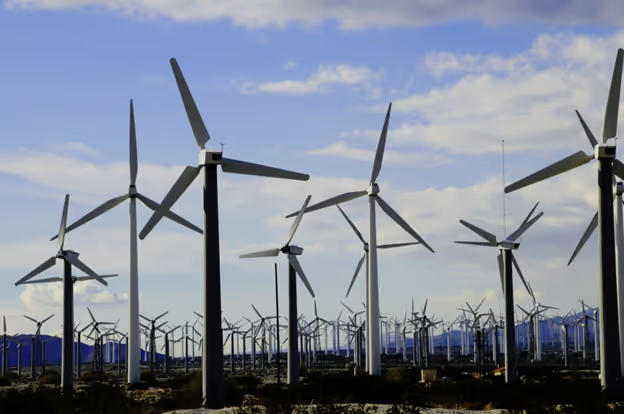
Wind power has been subsidized in various forms since 1978, when the Public Utilities Regulatory Policy Act (PURPA) was enacted to address concerns about U.S. reliance on foreign crude oil by promoting the development of wind (as well as solar and hydroelectric) generating facilities.[iv] Those initial subsidies led to a feeding frenzy of wind development, especially in California, as shown in figure 1.
Figure 1. Wind Farm Outside Palm Springs, California
Derided as “PURPA machines,” thousands of wind turbines were erected that generated little electricity.[v] The Energy Policy Act of 1992 (EPAct) enacted federal tax credits to subsidize wind turbines (and other renewable generators). Though destined to be temporary, these tax credits have been extended repeatedly. Ironically, wind power proponents have touted the technology’s low cost and lack of emissions as reasons to continue those subsidies.[vi]
EPAct introduced both an investment tax credit that allows qualifying facilities to claim a 30% credit against a project’s initial construction cost and a production tax credit (PTC) that enables qualifying facilities to claim a credit for each megawatt-hour (MWh) of electricity generated. Most wind developers have opted for the PTC, which has increased over time and now stands at $27.50 per MWh.[vii]
With the passage of the One Big Beautiful Bill Act,[viii] new wind facilities face accelerated phaseouts of tax credits and additional restrictions on ownership by foreign entities.[ix] However, any wind installations that are either under construction by July 4, 2026 or placed into service by December 31, 2027 will qualify for full tax credits for both production and investment.[x] (Qualifying developers cannot obtain both but must select one.) Arguably, beginning of construction loopholes exist for projects to qualify for safe harbor by meeting physical work tests and continuity requirements.[xi] Moreover, there is growing resistance to siting wind projects, with over 600 projects rejected.[xii]
Nevertheless, many states continue to pursue wind projects. Texas, the leader in U.S. wind capacity, has many more projects underway, including the 2,400-megawatt (MW) Mariah North Project.[xiii] In New Mexico, the 3,500-MW SunZia Wind and Transmission project will become the largest North American wind farm when it is fully operational later this year.[xiv]
The offshore wind industry has been roiled by canceled projects stemming from much higher construction costs and the need to renegotiate long-term contracts. Most recently, the administration canceled issuing offshore wind leases[xv] and temporarily halted development of offshore wind facilities, including several under construction,[xvi] because of concerns over the interference wind turbines cause to radar installations[xvii] and marine vessels.[xviii] The latter is being challenged by several wind developers that had threatened to cancel projects under construction, such as New York’s Empire Wind project.[xix] For now, their projects remain underway owing to judicial rulings allowing construction of the projects to continue.
The reality
Advocates have argued that wind power has lower costs than fossil-fuel and nuclear generation.[xx] They also argue that deploying wind power is crucial for reducing emissions of carbon dioxide and other greenhouse gases.[xxi] Neither claim is true. Moreover, high-profile offshore wind project setbacks, contract cancellations, and ongoing onshore wind project siting battles have exposed the economic, environmental, and social costs of wind power.
Intermittency, Cost, and Value
The most common, but least accurate, way of comparing the costs of electric generating resources is by calculating their levelized costs.[xxii] But levelized costs comparisons of different resources—both generating resources and energy efficiency measures—fail to consider that the value of the energy provided differs. In other words, simply evaluating levelized costs without considering the characteristics of the energy provided is akin to apples-to-oranges comparisons. Consequently, the use of levelized cost measures has increasingly been recognized as misleading.[xxiii]
Although wind power proponents tout the technology’s low levelized cost, at least for onshore wind, a more accurate descriptor for wind power is low value. Electricity that is available only intermittently and cannot be relied upon when needed has far less economic value than dispatchable electricity. When the costs of backup resources—primarily natural gas turbines and, more recently, large-scale battery storage facilities—are included, wind power’s costs become far higher.
Offshore wind is perhaps the highest-cost green energy resource, even before accounting for reliability issues.[xxiv] Although proponents often claimed ever-decreasing costs as the size of turbines increased,[xxv] offshore wind costs have risen substantially over the past five years because of higher interest rates and higher material costs. As a consequence, offshore wind developers—almost all of which are European firms wholly or partly owned by their respective governments—were forced to renegotiate previously signed contracts, such as in New York, or cancel projects altogether, as in New Jersey.[xxvi]
For example, several New York offshore wind developers renegotiated long-term contract prices that were almost 50% higher than those in their previously signed contracts.[xxvii] The contractual prices were far above wholesale market costs, and the developers not only avoided the costs of developing the necessary transmission lines to bring the electricity generated to shore but also the costs of additional backup generation.
Reliability, Reserves, and Inertia
A crucial component of electric power systems, especially as modern societies rely more on electricity, is reliability—ensuring that there is sufficient electricity to meet demand at all times. Power systems ensure reliability in various ways. These include a reserve margin of generating capacity in excess of projected peak usage, generators whose output can be instantly adjusted up or down to balance supply and demand, and generators that can be available within minutes in case of sudden outages.
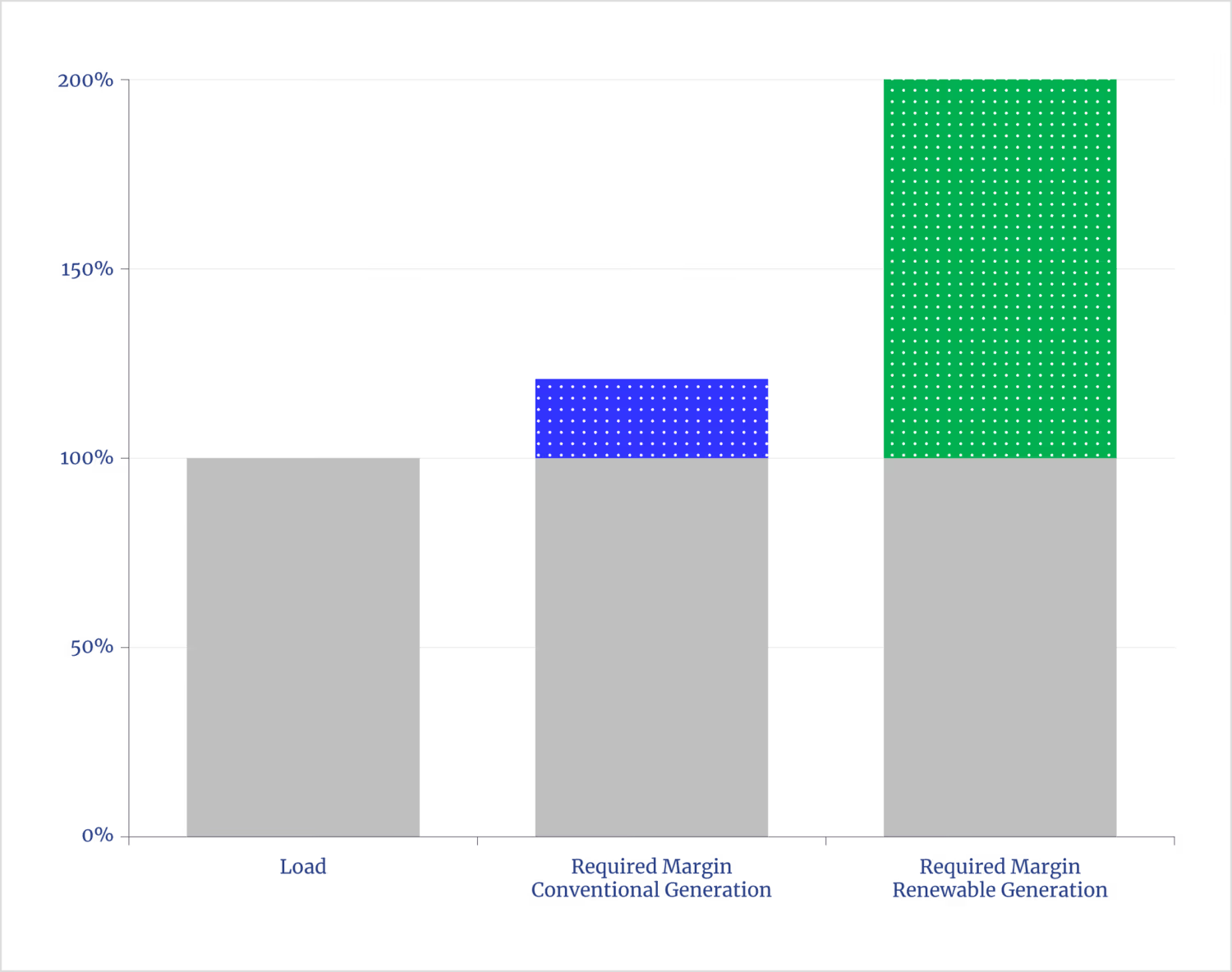
Wind power is inherently intermittent, generating electricity only when the wind blows. As more wind generation is connected to the power grid, reliability needs change. First, system operators must increase reserve margins. In most regions of the country, the reserve margin is around 20%.[xxviii] For example, if peak electricity demand is 100,000 MW, then generating capacity should be around 120,000 MW. As more intermittent generation is added, reserve margins must be increased to maintain reliability. In New York, for example, the state’s reliability planner estimated that, by 2040, the reserve margin would need to increase to more than 100% to meet that state’s requirements under its Climate Leadership and Community Protection Act, including a zero-emissions electric grid by 2040 for which the main resources would be wind and solar power (see figure 2).[xxix]
Figure 2. Reserve Margin Requirements for Conventional and Intermittent Generation Systems
Another key component of a reliable and resilient electric system is inertia.[xxx] Large spinning turbines provide inertia; their heavy mass means they will continue to spin and generate electricity even if their fuel source is cut off briefly. Inertia benefits the electric grid in several ways. First, it provides voltage and frequency stability. Most electric devices—from lights and computers to huge electric motors—can operate only within a narrow band of voltage and frequency. Inertia on the system helps maintain that stability and allows electric power systems to adjust to meet demand that continuously changes. Moreover, if a generator suffers a sudden forced outage, inertia provides a cushion for other resources to be brought online.[xxxi] But most wind turbines cannot provide system inertia.[xxxii] Consequently, electric power systems must compensate for sudden changes in wind output. As wind capacity increases in a region, the size of those changes increases, as do the costs of compensating for them.[xxxiii]
Another economic impact is the distortion of subsidized wind generation on organized wholesale power markets. In these markets, prices are determined hourly based on supply and demand. Wind generators receiving the PTC can profitably provide electricity even at below-zero prices. Hence, they can supply electricity even when doing so exacerbates hours in which supply exceeds demand and prices fall below zero. However, baseload generators such as coal and nuclear plants, and some natural gas generating plants, are not designed to be turned on and off intermittently. Thus, when market prices fall below zero, these generators must pay to provide electricity to the grid. The result of this market distortion has been the premature retirement of many generating plants, especially coal-fired power plants. (Nuclear power plants that have been shuttered are being restarted to meet the growing electricity demand of data centers and artificial intelligence.[xxxiv])
The premature retirements have caused other electric system prices, notably capacity prices, to soar. Capacity prices are designed to compensate generators for being available when needed. Unless coupled with dedicated backup, such as battery storage, wind power has no capacity value. For example, the most recent auction by regional grid operator PJM Interconnection, which covers 13 mid-Atlantic states and the District of Columbia and serves 65 million customers,[xxxv] cleared at the maximum allowed price of $333.44 per MW-day for the 12-month period beginning June 1, 2027.[xxxvi] And even at that price, PJM was unable to secure enough generating supply to meet reliability requirements. The overall cost to retail consumers over that period will exceed $16 billion.[xxxvii]
Low Power Density and High Environmental Impacts
Although individual wind turbines have a small footprint, the total amount of land (or ocean) they require is huge because turbines must be spaced far apart to avoid cannibalizing each other’s output, which is called a wake effect. (This is one reason why the wind turbines shown in figure 1 generated so little electricity.) For example, in the case of offshore wind turbines, wake effects can extend for miles, and many existing offshore wind projects in Europe have seen reduced output because of them.[xxxviii]
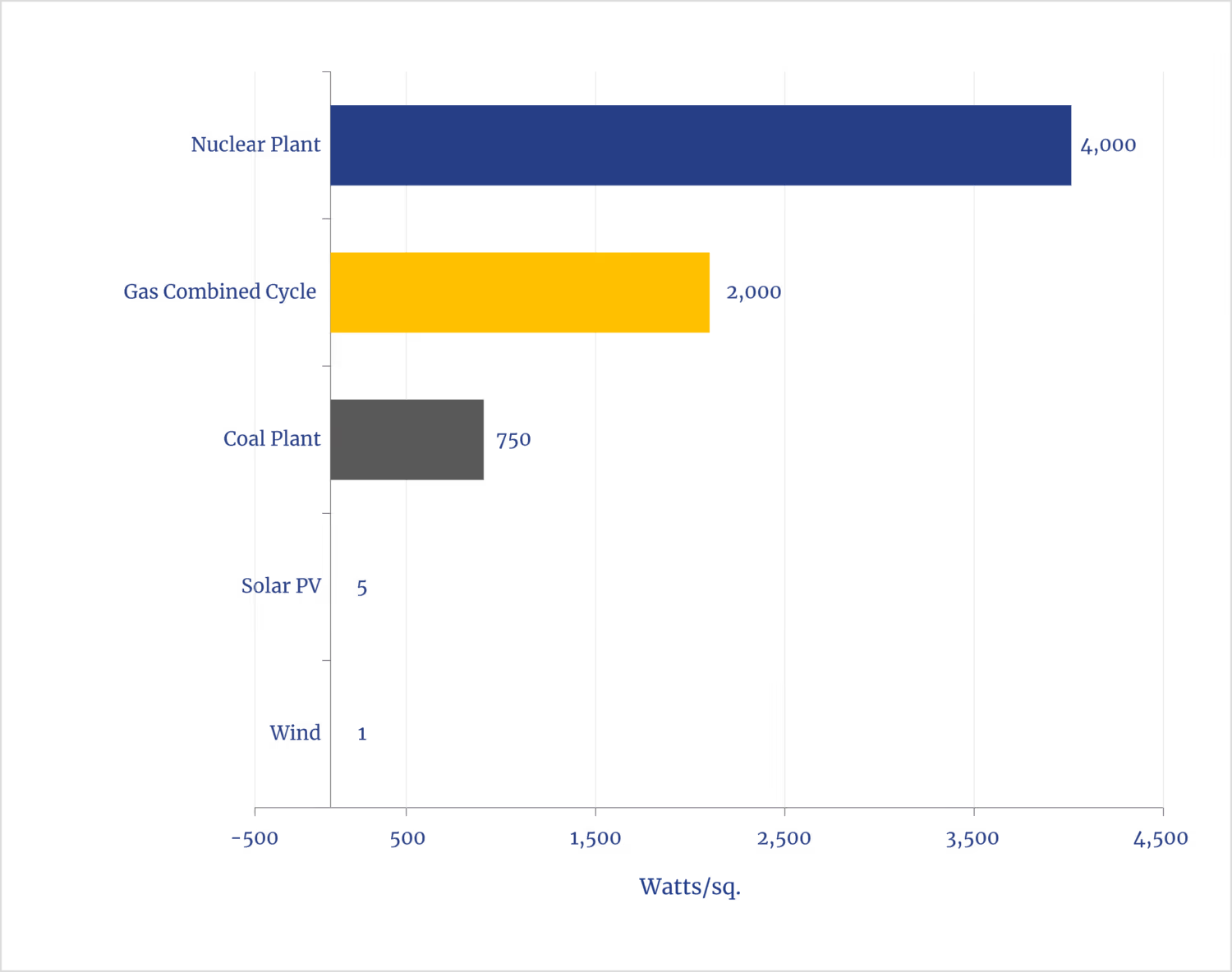
The spacing requirement is reflected in a measure called power density. Wind power has the lowest power density of any generating resource, at about one watt per square meter.[xxxix] In contrast, nuclear power has a typical power density of around 4,000 watts per square meter and natural gas generators have a power density of around 2,000 watts per square meter (see figure 3).[xl]
Figure 3. Power Density Values of Selected Generation Technologies
The large-scale deployment of wind generation to meet electricity demand while reducing carbon emissions, as some environmental advocates recommend, would require devoting millions of acres of land. For example, a recent study by Lesser showed that the land required to accommodate the wind capacity needed for PJM under an assumed wind-solar-battery storage system would exceed PJM’s total footprint.[xli]
The low power density and corresponding land requirements for onshore wind exacerbate wind power’s environmental and social impacts. The adverse health impacts on those living near wind turbines include the low-frequency sound turbines emit; reduced property values due to both health and visual impacts; species loss, especially raptors (e.g., eagles) and bats;[xlii] and soil degradation from turbine vibration.[xliii]
The low energy density and the correspondingly large land area required mean wind facilities must be built in rural areas far from city load centers, where electricity is needed. Hence, the electricity must be transmitted to those load centers. High-voltage transmission lines are not only costly, averaging around $4 million per mile to construct,[xliv] but also create their own land use impacts.[xlv]
Although offshore wind has a higher power density than onshore wind (around 4 watts per square meter) owing to steadier ocean winds, it still requires vast areas of ocean. Off the Atlantic Coast, offshore wind developments are located within some of the world’s most productive fishing grounds. But developers have built or planned to build turbines so closely together as to effectively prevent commercial fishing operations around them. Moreover, the turbines themselves affect habitats, especially for species that live on the ocean floor.
The impacts of offshore wind development on marine life have been the subject of vigorous debate. Whereas proponents claim that marine life will be unaffected or minimally affected, other studies claim that the potential impacts on marine life, including endangered species such as the North Atlantic right whale, will be devastating.[xlvi] The Bureau of Ocean Energy Management (BOEM) has recognized but allowed significant takings—a legal term for harm or disruption—of marine life, including right whales.
One indirect environmental impact of wind turbines is their use of rare earths for turbine magnets.[xlvii] Most of the rare earths required are mined and processed in China, with severe environmental impacts.[xlviii] Although restrictions on the mining of rare earth are being loosened, it will likely be years before domestic supplies are increased. Consequently, while proponents claim wind development reduces environmental impacts associated with climate change, it exports localized adverse impacts on air and water quality.
Finally, most states do not require wind developers to set aside funds for the eventual decommissioning of wind turbines.[xlix] Establishing decommissioning funds is crucial because most wind developments are structured as limited liability companies whose only assets are the turbines themselves. As such, without explicitly funded decommissioning reserves, the developers can simply abandon a project at the end of its physical or economic life, leaving electric ratepayers and taxpayers to pay for decommissioning. This has also been true at the federal level: BOEM has previously granted some offshore wind developers a 15-year waiver from posting decommissioning plans and bonds to ease their financing challenges.[l]
Inconsequential Reductions in Greenhouse Gas Emissions
A major justification for wind power development has been its potential for reducing greenhouse gas (GHG) emissions because wind power is emissions-free. Estimates of the potential reductions in GHG emissions are based on simplistic calculations. For example, when burned, coal releases between 200 and 230 pounds of CO2 per million British thermal units (Btus), depending on the type of coal. Hence, a coal plant with a heat rate—the amount of input energy needed to generate 1 kilowatt-hour (kWh) of electricity—of 10,000 Btus/kWh emits between 2.0 and 2.3 pounds of CO2/kWh, or roughly one metric ton of CO2 per MWh. New natural gas generators are more efficient, with heat rates of around 6,500 Btus/kWh, depending on the configuration.[li] As natural gas emits about 120 pounds of CO2 per million Btus, that translates into about 0.8 pounds per kWh or 0.35 metric tons per MWh.
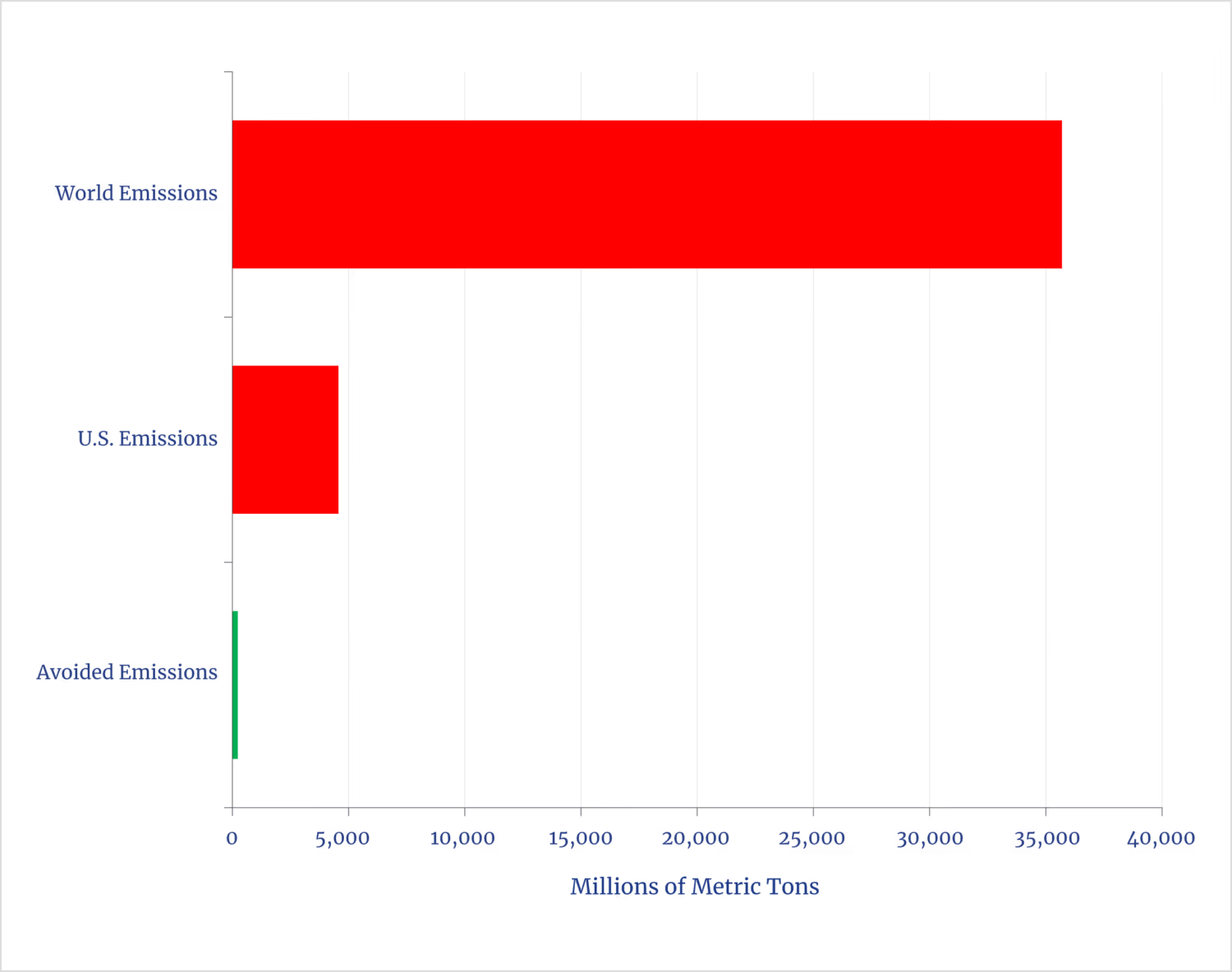
In 2025, wind generation totaled about 465 million MWh.[lii] Thus, based on this logic, wind generation avoided between 165 million and 465 million metric tons of CO2. By comparison, energy-related world CO2 emissions were 35.5 billion metric tons, as shown in figure 4.[liii] Hence, U.S. wind generation avoided the equivalent of 1.6 to 4.7 days of global CO2 emissions. Such a small change in CO2 emissions would have no measurable impact on global temperature.
Figure 4. Comparison of Wind-Avoided CO2 Emissions Versus Total CO2 Emissions
But even this small value overestimates emissions reductions because it fails to account for the additional emissions needed to ensure system reliability. Despite claims that greater reliance on battery storage will replace the need for fossil-fuel generation backup or that dispatchable, emissions-free generators (e.g., those that burn pure hydrogen) will be developed, system balancing is today almost entirely achieved through natural gas generation.[liv] In other words, natural gas generators must be operated, and operated less efficiently, to compensate for wind generation’s intermittency and lack of system inertia. Consequently, emissions reductions per MWh will be lower.[lv] (Reliance on large-scale battery storage, given current technology, is infeasible.[lvi]) Coupled with wind power’s adverse environmental and social impacts, claims that increased reliance on wind power should be pursued to significantly reduce GHG emissions are overblown.
Perspectives
Modern society needs reliable, affordable electricity, delivered with the lowest possible environmental impact. Although policymakers debate the optimal combination of all three attributes, wind power fails on all three. Wind power’s inherent intermittency and lack of key power system attributes threaten reliability and affordability, while its environmental and ecological impacts belie claims that wind is inherently clean. Finally, claims that wind power will have a material impact on world carbon emissions, a key rationale for continued wind power subsidies and mandates, have no empirical validity. Yet, despite wind power’s obvious economic, social, and environmental failings, its proponents—politicians, regulators, and developers intent on capturing subsidies—persist. Electric utilities, overseen by their state regulators and required to comply with state and federal laws, can simply pass along the costs of doing so, regardless of the economic harm to their customers. And as would be expected, politicians and regulators blame those higher costs—such as those seen in the recent capacity market auctions in PJM—on the markets rather than their ill-advised policies. Although a shoot-the-messenger approach may temporarily hide the economic and physical realities of wind power, those realities will assert themselves eventually. But the longer the wait, the more harm will be done.
Notes
[i] Kathryn Krawczyk, “The Iran War Is Driving a Clean Energy Wake-Up Call,” Canary Media, March 27, 2026; and Craig Hanson and Jessica Isaacs, “As Iran War Strains Fuel Supplies, Clean Energy Is Secure Energy,” World Resources Institute, April 10, 2026.
[ii] “Table 16. Renewable Energy Generating Capacity and Generation,” Annual Energy Outlook 2026, U.S. Energy Information Administration, accessed May 12, 2026, https://www.eia.gov/outlooks/aeo/data/browser/#/?id=16-AEO2026&cases=cb2026&sourcekey=0.
[iii] Jonathan Lesser, The U.S. Energy Information Administration Needs to Fix How It Reports Renewable Power Capacity (National Center for Energy Analytics [NCEA], 2025).
[iv] P.L. 95-617 (92 Stat. 3117); and “PURPA Qualifying Facilities,” Federal Energy Regulatory Commission, last updated April 10, 2023, https://www.ferc.gov/qf#:~:text=One%20of%20the%20ways%20PURPA,facilities%20and%20qualifying%20cogeneration%20facilities.
[v] Jonathan Lesser, The Biden Administration’s Offshore Wind Fantasy (The Manhattan Institute, 2022); and Beth Dunlop, “Qualifying Facilities Under PURPA: What Qualifies?,” Environs 15 (October 1991): 7–17, 8.
[vi] Eric Williams and Eric Hittinger, “If We Keep Subsidizing Wind, Will the Cost of Wind Energy Go Down?,” The Conversation, August 3, 2017.
[vii] “Renewable Electricity Production Tax Credit Information,” U.S. Environmental Protection Agency, last updated December 4, 2025, https://www.epa.gov/lmop/renewable-electricity-production-tax-credit-information.
[viii] One Big Beautiful Bill Act, Pub. L. No. 119-21, 139 Stat. 72 (2025).
[ix] Bradley J. Nowak and Philip J. Delano, “The One, Big, Beautiful Bill Amends Renewable Energy Tax Credits—Summary of Key Changes,” Williams Mullen, July 10, 2025.
[x] Internal Revenue Service (IRS), Beginning of Construction Requirements for Purposes of the Termination of Clean Electricity Production Credits and Clean Electricity Investment Credits for Applicable Wind and Solar Facilities, Notice 2025-42 (IRS, 2025).
[xi] Amish Shah et al., “Beginning of Construction for Solar and Wind Facilities: What’s Changed?,” Holland & Knight, September 3, 2025.
[xii] “Renewable Rejection Database,” Robert Bryce, accessed April 22, 2026, https://www.robertbryce.com/rrdb.
[xiii] “Mariah North (USA),” Wind Farms, The Wind Power, last updated December 21, 2025, https://www.thewindpower.net/windfarm_en_24617_mariah-north.php.
[xiv] Michelle Lewis, “The U.S.’s Largest Clean Energy Project Is Generating Power [Update],” Electrek, April 17, 2026.
[xv] Eleanor Green et al., “Offshore Wind Development,” Georgetown Climate Center, February 5, 2026.
[xvi] U.S. Department of the Interior, “The Trump Administration Protects U.S. National Security by Pausing Offshore Wind Leases,” press release, December 22, 2025. On January 12, 2026, a federal judge allowed construction on the Revolution Wind project, located off the coast of Rhode Island, to resume.
[xvii] Russell J. Colburn et al., Radar Interference Analysis for Renewable Energy Facilities on the Atlantic Outer Continental Shelf, OCS Study BOEM 2020-039 (Bureau of Ocean Energy Management, U.S. Department of the Interior, 2020).
[xviii] National Academies of Sciences, Engineering, and Medicine, Wind Turbine Generator Impacts to Marine Vessel Radar (National Academies Press, 2022).
[xix] Orlando Jenkinson, “Empire Wind Could Be Cancelled by Friday—Equinor,” Windpower Monthly, January 12, 2026.
[xx] Benjamin Storrow, “Wind and Solar Energy Are Cheaper than Electricity from Fossil-Fuel Plants,” Scientific American, June 17, 2025.
[xxi] Integrated Energy Systems Office, “How Wind Can Help Us Breathe Easier,” U.S. Department of Energy, August 21, 2024.
[xxii] A levelized cost is similar to a fixed mortgage payment. Levelized costs for wind power and other generating resources are based on assumptions about their construction and operation costs, which are then converted into per-kWh values (i.e., levelized) based on assumed annual generation and resource lifetimes. See Lazard, Levelized Cost of Energy + (Lazard, 2025).
[xxiii] Quantified Carbon, Understanding the Full System Costs of the Electricity System, prepared for the United Nations Economic Commission for Europe (Quantified Carbon, 2025).
[xxiv] Jonathan Lesser, Out to Sea: The Dismal Economics of Offshore Wind (The Manhattan Institute, 2020); and Lesser, Biden Administration’s Wind Fantasy.
[xxv] Integrated Energy Systems Office, “The Future of Offshore Wind Is Big—Literally,” U.S. Department of Energy, October 13, 2021.
[xxvi] Diana DiGangi, “2.4-GW New Jersey Offshore Wind Project Canceled by Developer,” Utility Dive, November 13, 2025.
[xxvii] Donna Andersen, “New Yorkers Would Be Forced to Pay 2.5x Market Rate for Wind Energy from Empire Wind One Offshore Farm: Expert,” New York Post, April 25, 2025.
[xxviii] North American Electric Reliability Corporation, Long-Term Reliability Assessment (North American Electric Reliability Corporation, 2026).
[xxix] Mayer Sasson et al., “Reliability Challenges in Meeting CLCPA Requirements,” presented to the Climate Action Council Reliability Planning Speaker Session, August 2, 2021.
[xxx] Vishu Gupta et al., “Brief Understanding of Inertia in the Smart Grid, Its Challenges and Solutions,” IEEE Smart Grid Bulletin, November 2020.
[xxxi] Electric Power Research Institute, Meeting the Challenges of Declining System Inertia (Electric Power Research Institute, 2019).
[xxxii] Electric Power Research Institute, Meeting Challenges. Although the spinning rotor of a wind turbine can provide some inertia, most wind turbines are considered to be asynchronous, meaning that their output cannot respond to changes in demand.
[xxxiii] Most wind turbines also cannot provide blackstart capability, which enables a power grid to recover from a widespread blackout by starting individual generators and then gradually connecting them to the grid. Various technologies have been proposed to overcome this problem. See, for example, Hugo N. Villegas Pico and Vahan Gevorgian, “Blackstart Capability and Survivability of Wind Turbines with Fully Rated Converters,” IEEE Transactions on Energy Conversion 37, no. 4 (December 2022): 2482–97.
[xxxiv] Mark P. Mills, The Rise of AI: A Reality Check on Energy and Economic Impacts (NCEA, 2025).
[xxxv] “About PJM,” PJM, accessed April 20, 2026, https://www.pjm.com/about-pjm.
[xxxvi] PJM, 2027/2028 Base Residual Auction Report (PJM, 2025).
[xxxvii] Ethan Howland, “PJM Capacity Prices Hit Record High as Grid Operator Falls Short of Reliability Target,” Utility Dive, December 18, 2025.
[xxxviii] Simon C. Warder and Matthew D. Piggott, “The Future of Offshore Wind Power Production: Wake and Climate Impacts,” Applied Energy 380 (February 2025): 124956.
[xxxix] Vaclav Smil, Power Density: A Key to Understanding Energy Sources and Uses (MIT Press, 2016).
[xl] Smil, Power Density.
[xli] Jonathan Lesser and Mitchell Rolling, Batteries and the Grid: Hype, Hope, and Economic Reality (NCEA, forthcoming).
[xlii] Suzanne Richardson et al., “Peaks in Bat Activity at Turbines and the Implications for Mitigating the Impact of Wind Energy Developments on Bats,” Scientific Reports 11, no. 3636 (2021); and Sana Kazilbash, “The Realities of Bird and Bat Deaths by Wind Turbines,” Engineering.com, September 30, 2020.
[xliii] Estefania Velilla et al., “Vibrational Noise from Wind Energy-Turbines Negatively Impacts Earthworm Abundance,” OIKOS 130, no. 6 (June 2021): 844–49.
[xliv] Midcontinent Independent System Operator (MISO) Transmission Cost Estimation Guide for MTEP 2025, (MISO, 2025).
[xlv] Larissa D. Biasotto and Andreas Kindel, “Power Lines and Impacts on Biodiversity: A Systematic Review,” Environmental Impact Assessment Review 71 (July 2018): 110–19; James A. Chalmers, “Transmission Line Impacts on Rural Property Value,” Right of Way, May/June 2012, 31–35; Thomas Jackson and Jennifer Pitts, “The Effects of Electric Transmission Lines on Property Values: A Literature Review,” Journal of Real Estate Literature 18, no. 2 (2010): 239–59.
[xlvi] Anastasia E. Lennon, “NOAA Scientists Propose More Protection for Right Whales in Offshore Wind Area,” The New Bedford Light, November 3, 2022.
[xlvii] P. Alves Dias et al., The Role of Rare Earth Elements in Wind Energy and Electric Mobility: An Analysis of Future Supply/Demand Balances, Joint Research Centre Science for Policy Report (Publication Office of the European Union, 2020).
[xlviii] Yong-He Han et al., “Environmental Impacts of Rare Earth Elements Mining and Strategies for Sustainable Management: A Comprehensive Review,” Journal of Hazardous Materials 500 (December 2025): 140400.
[xlix] Curtis Schube and Mark P. Mills, Who Pays When Wind Turbines and Solar Panels Wear Out? A Hidden Energy Liability (NCEA, 2025).
[l] Heather Richards, “Emails: Interior Granted Offshore Wind Project 15-Year Delay on Cleanup Costs,” Greenwire, November 30, 2023.
[li] EIA, Capital Cost and Performance Characteristics for Utility-Scale Electric Power Generating Technologies (EIA, 2024).
[lii] “Table 1.1.A. Net Generation from Renewable Sources: Total (All Sectors), 2016–January 2026,” Electric Power Monthly, EIA, accessed May 12, 2026, https://www.eia.gov/electricity/monthly/epm_table_grapher.php?t=table_1_01_a.
[liii] Energy Institute, 2025 Statistical Review of World Energy, 74th ed. (Energy Institute, 2025).
[liv] Jan Emblemsvåg, “Wind Energy Is Not Sustainable When Balanced by Fossil Energy,” Applied Energy 305 (January 2022): 117748.
[lv] Hannele Holttinen et al., “Estimating the Reduction of Generating System CO2 Emissions Resulting from Significant Wind Energy Penetration,” paper presented at the 13th Wind Integration Workshop, Berlin, Germany, November 11–13, 2014.
[lvi] Lesser and Rolling, Batteries and the Grid.
-2%20(15).png)
-6%20(9).png)
-6%20(8).png)
-3%20(1).png)