
Rising Electricity Rates: Don’t Blame the Data Centers
-2%20(5).png)
In the summer of 2025, a Heatmap Pro poll found that 28% of respondentsblamed data centers for higher electricity prices.
Listen
The Issue
In the summer of 2025, a Heatmap Pro poll found that 28% of respondents blamed data centers for higher electricity prices.1 By early summer 2026, that figure had risen to 53%. A recent survey from Pew Research Center found that 43% of people blamed data centers for higher home energy costs.2 This trend should not be surprising, given the growing news coverage and increasing number of politicians and pundits pointing to data centers as the cause for higher consumer electric bills.
Data show that residential electric rates have risen significantly over the past six years. Simultaneously, there has been an enormous increase in plans for more data centers nationally. But most of the facilities are still only in the planning phase. While they will have impacts in the future, prospective data centers cannot be blamed for what has already occurred. Electric rates may be rising for many reasons. In fact, an earlier NCEA issue brief noted one key reason: “The loss of dispatchable generating capacity is contributing to higher electric rates.”3 In other words, rates are rising because of a push by regulators and activists to add solar and wind energy to grids that cannot be called on, or dispatched, when needed.
To explore this issue further, NCEA’s partners at the University of Southern California (USC) Marshall School of Business examined whether empirical data support the claim that the existing data centers are a driver for rising electricity rates.
The Reality
A new USC Marshall study examined electricity cost trends using high-resolution wholesale pricing data during 2020–25 and utility-level retail data during 2015–25.4 The study traced the price effects of data-center entry across three geographic scales: individual transmission nodes, regional wholesale price zones, and retail electricity rates. A transmission node is a single point, such as a substation or switchyard, through which power flows onto the high-voltage grid. A wholesale price zone is a broader region comprising hundreds of nodes for which a grid operator determines a single market-clearing price for utilities and other large buyers. Retail electricity rates are what homes and businesses ultimately pay, encompassing several wholesale price zones and representing averages across an entire utility’s service territory.
Node-Level Wholesale Findings
At the most granular level, using individual transmission nodes for the bulk power authority in California (the California Independent System Operator, or CAISO), data-center entry is associated with a measurable increase in congestion costs of $1.45–$2.30 per megawatt-hour (MWh); see figure 1. This makes intuitive sense, as a new large load near a constrained transmission point tightens local grid conditions. Notably, the system-wide energy component of prices does not differ at the node level—consistent with how CAISO sets a uniform energy price across its grid—while congestion costs vary by location.
To understand what this means for everyday electricity users, the congestion cost increases are components of the locational marginal price (LMP)—the cost of delivering an additional 1 MWh of electricity to a specific point on the high-voltage transmission grid. LMP comprises three parts: an energy component (the system-wide cost of generating power), a congestion component (a location-specific surcharge that arises when transmission lines are too constrained to move power freely), and a loss component (accounting for electricity that dissipates as heat in the wires). Congestion pricing functions as a real-time signal. When a data center crowds a constrained corridor, prices at that node rise, which discourages additional load and, in theory, incentivizes investment in new transmission to relieve the bottleneck. Yet these wholesale node-level congestion charges are largely invisible to homes and businesses; retail utilities typically average costs across their entire territory, which dilutes any single node’s congestion spike into a rounding error on a monthly bill. However, persistent congestion signals can eventually justify billion-dollar investments in new long-haul transmission lines.
Figure 1. CAISO Node-Level Wholesale Price Effects of Data Center Entry

Note: The figure shows a difference-in-differences comparison of wholesale prices before and after data centers begin operating at specific grid locations, measured against similar locations without data centers to account for normal market-wide price movements. Data center entry increases the congestion component of the locational marginal price (LMP) by $2.30 per MWh in the first year (first-entry, p < 0.01) and $1.45 per MWh across all entries (all-entry, p < 0.001). The first-entry model measures the effect in the 12 months after a node’s first data center comes online; the all-entry model measures the average effect after each entry event at a node, where an event can include one or more data centers.
* Not significant
† p < 0.01
‡ p < 0.001
§ p < 0.10
Source: Adapted from Angela Ryu and Shon R. Hiatt, Data Center Entry and U.S. Electricity Prices: From the Wholesale Market to the Power Bill (University of Southern California Zage Business of Energy Initiative, 2026), 8, figure 2.
Regional Wholesale Findings
When reviewing the zone level, the study examined 55 wholesale price zones across four regional transmission organizations (PJM Interconnection [PJM], the Electric Reliability Council of Texas, Midcontinent Independent System Operator [MISO], and Southwest Power Pool), spanning about 30 states; here, the picture changes. The dominant effect is not congestion from moving electricity but the price of energy to produce electricity in the first place. The arrival of a data center on the grid is associated with an increase of $3.44 per MWh in total wholesale prices in the year after entry, driven almost entirely by a jump of $5.43 per MWh in the energy component (see figure 2). When a new large load connects to a local grid zone, operators must dispatch more expensive marginal generation to cover it, thereby increasing the zone-clearing price for consumers. Loss and congestion charges stay close to zero because data centers are usually built close to power plants and on parts of the grid that can handle more electricity use.
Figure 2. Non-CAISO Zone-Level Wholesale Price Effects of Data Center Entry
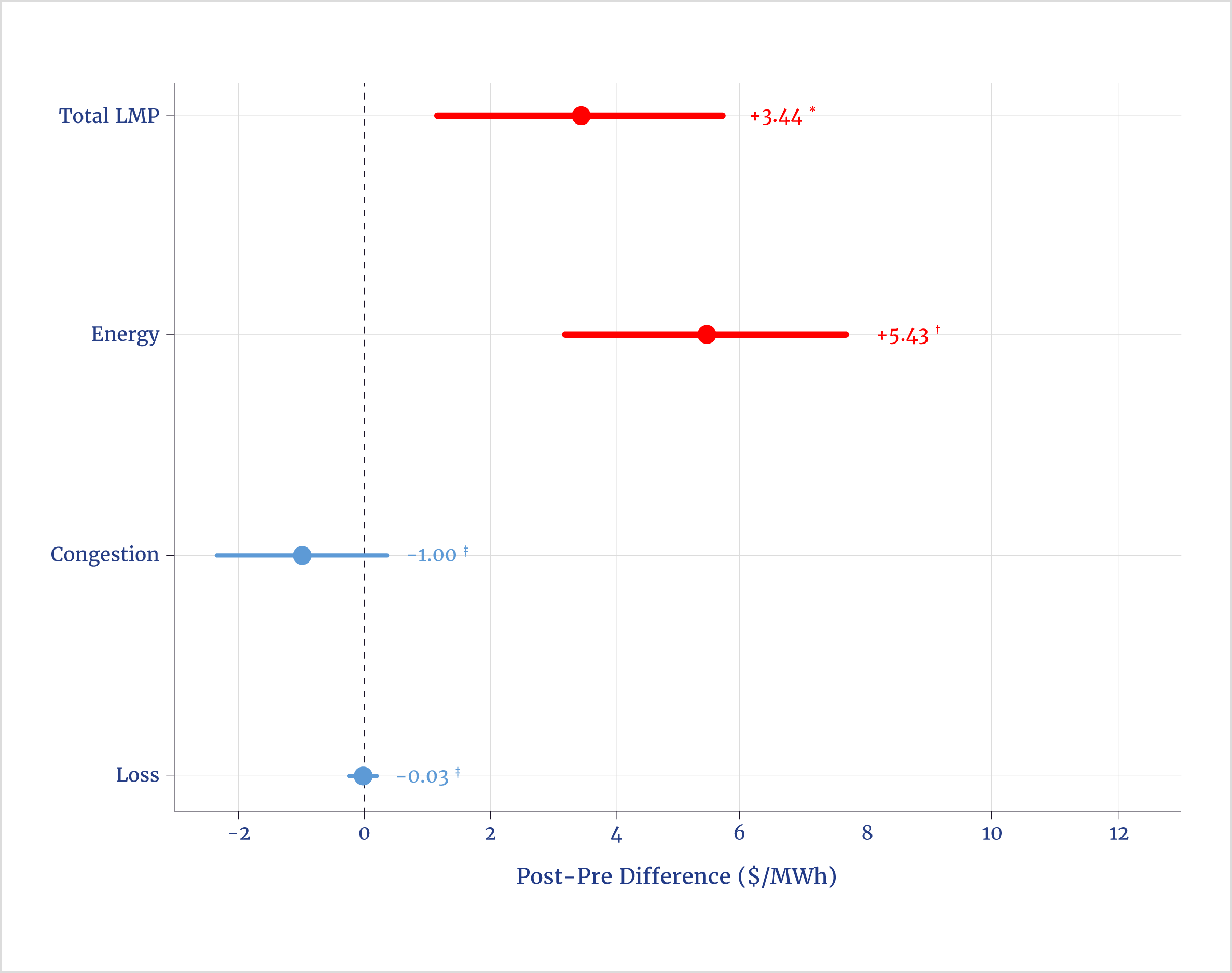
Note: The figure shows a difference-in-differences comparison of wholesale prices before and after data centers enter a zone, adjusted for Henry Hub natural gas prices to account for fuel-cost movements. On average, each entry event raises local wholesale prices by $3.44 per MWh in total locational marginal price (LMP) (p < 0.01). The increase is driven entirely by the system-wide energy component, which rises $5.43 per MWh (p < 0.001); effects on local congestion and losses are not statistically significant. All models include zone, month, and entry-year fixed effects; entry-year fixed effects are omitted in single-cohort specifications. Standard errors are clustered at the cohort level, and 95% confidence intervals are shown.
* p < 0.01
† p < 0.001
‡ Not significant
Source: Adapted from Angela Ryu and Shon R. Hiatt, Data Center Entry and U.S. Electricity Prices: From the Wholesale Market to the Power Bill (University of Southern California Zage Business of Energy Initiative, 2026), 9, figure 3.
Retail Price Findings
At the retail level—the point at which consumers pay their bills—data centers can affect utilities, but the impact is small and concentrated on a specific subset of utilities. Overall, the data show that doubling a utility’s operating data-center capacity is associated with a 0.62% increase in residential electricity prices, or $1.00–$1.06 per MWh. For a typical household, this translates to an increase of less than $1 per month. Critically, this effect is seen mainly in service territories operated by electric cooperatives and municipal utilities. There is no statistically significant effect on consumer costs for investor-owned utilities (IOUs), which serve 68% of U.S. retail customers.5 Cooperatives—which cover vast rural geographies but have smaller customer bases—along with municipal utilities appear more exposed to wholesale price pass-through. This is likely because they lack the hedging capabilities and market scale of IOUs that are accustomed to serving larger loads.
Limitations
There are limitations to this analysis. First, the USC Marshall study’s estimates captured recent entry effects in markets that, in many cases, already hosted data centers before the sample window began. Second, the study identified first-within-panel entries, not necessarily first-ever entries; therefore, some treatment events represented marginal additions to already-exposed areas rather than true greenfield impacts. The retail estimates are conditional associations—not definitive causal effects—so unobserved, utility-specific trends correlated with data-center growth could bias the coefficients upward. For example, utilities in fast-growing regions might simultaneously attract more data centers and see rising retail electricity prices for unrelated reasons (e.g., population growth, aging infrastructure, fuel costs), which would cause the coefficients to overstate data centers’ true price impact. Third, the study reflected conditions under which overall reserve margins were still generally adequate. Because the North American Electric Reliability Corporation projects declining reserve margins and specific shortfalls in PJM and MISO through 2030, price effects could grow as tighter grid conditions raise the marginal cost of generating electricity and, in turn, increase household bills. Put simply, electricity becomes more expensive for everyone when the grid is running closer to its limits. Depending on how the electricity is produced and who produces it, the price effects from more data centers may be considerably larger in the coming years than what the study has found.
Perspectives
It is worth noting that the speed and scale of projected data-center electricity demands are unprecedented in the history of electric utilities.6 The facts do not support claims that existing data centers have been responsible for the recent rise in consumer electricity prices. But what happens in the future will depend mainly on how that power is provided and who pays for the associated costs. Until recently, planners had operated under the assumption that there was no growth in demand; the challenge now is that most grid regions have degraded reliability and suffer from years of deferred upgrades.
There are two main options for insulating consumers from the costs associated with building new electricity capacity to meet future data-center needs. One option distills to the owner or operator of the data-center site paying the public utility—whether investor-owned, cooperative, or municipal—for the entire cost associated with supplying the massive new loads, provided power systems can be built at the speed needed. The second option is for the new large load to build and operate its own private grid entirely disconnected from the public grid. Both options are technically feasible, and both are being pursued. The jury is out on which approach will dominate over the next several years.7
- Emily Pontecorvo, “Americans Now Blame Data Centers for Their Rising Power Bills,” Heatmap News, June 3, 2026.
- Brian Kennedy and Emma Kikuchi, “Many Americans Hold Utility Companies Responsible for Their Rising Home Energy Bills,” Pew Research Center, May 6, 2026.
- Jonathan Lesser, What’s Driving Higher Retail Electric Rates? (National Center for Energy Analytics, 2025).
- Angela Ryu and Shon R. Hiatt, Data Center Entry and U.S. Electricity Prices: From the Wholesale Market to the Power Bill (University of Southern California Zage Business of Energy Initiative, 2026). Except where otherwise noted, the data, projections, and methodology discussed in this section are drawn from this study; see the study for its full list of sources. Shon R. Hiatt, a coauthor of this issue brief, was also a coauthor of the study.
- “Annual Electric Power Industry Report, Form EIA-861 Detailed Data Files,” Analysis & Projections, Electricity, U.S. Energy Information Administration, released October 7, 2025, https://www.eia.gov/electricity/data/eia861. The 68% figure is calculated in Ryu and Hiatt, Data Center Entry and U.S. Electricity Prices, from a 2024 sample of bundled-service utilities reporting ownership-type data for 2015–24, excluding utilities present for fewer than three years and those filing the EIA-861 Short Form.
- For more on this topic, see Mark P. Mills, The Rise of AI: A Reality Check on Energy and Economic Impacts (National Center for Energy Analytics, 2025).
- Mark P. Mills, “Americans Shouldn’t Have to See Data Centers on Their Electricity Bill,” The Washington Post, March 23, 2026.
About the author
Shon R. Hiatt, PhD
Continue Reading

Unreasoned Decisionmaking: FERC's Ever-Changing Methodology for Estimating the Return On Equity
The financial crisis that began in 2008 led to unprecedented actions by the U.S. Federal Reserve (Fed) to lower interest rates and stimulate the economy.

The SEC's Climate Rules Will Wreak Havoc on U.S. Financial Markets
The final climate disclosure rules issued by the Securities and Exchange Commission (SEC) in March 2024 will require every large U.S. corporation to report in detail all the climate-related physical and transition risks faced by their businesses, along with the direct and indirect greenhouse gas emi
