
Testimony of Curtis M. Schube “Ensuring Responsible Renewable Energy Decommissioning,”
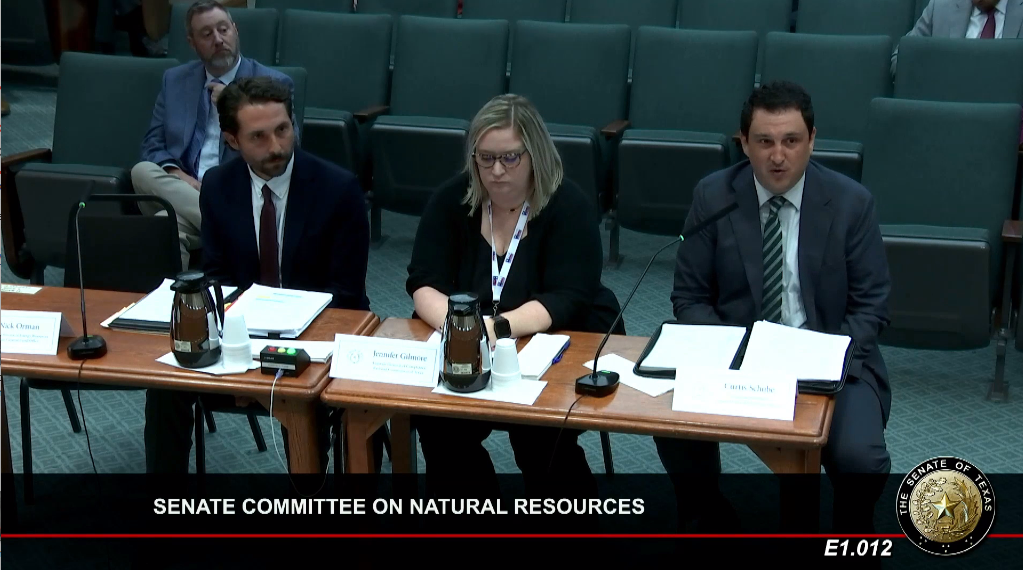
To be clear, our mission is not anti-wind or anti-solar. Rather, our mission is to have appropriate laws in place to protect the taxpayer,
Testimony of Mr. Curtis M. Schube Executive Director, Council to Modernize Governance and Visiting Fellow at National Center for Energy Analytics
The Senate Committee on Natural Resources
“Ensuring Responsible Renewable Energy Decommissioning,”
Monday, September 21, 2026, at 9:00 a.m. CT, Room E1.012
Mr. Chairman, thank you for the opportunity to testify.
I. Introduction and Executive Summary
My name is Curtis Schube. My background and qualifications are as a lawyer. I practiced law for twelve years before transitioning to policy work in 2023.
Now, I am the Executive Director of The Council to Modernize Governance (CMG). CMG is a non-partisan organization that educates policymakers, thought leaders, and the American public on the principles of reducing the power of the administrative state. We produce and present intellectual research, policy analysis, and real-world data to drive innovative solutions.
Since joining CMG, I have published four papers on financial assurance—two1 of which specifically focused on renewable energy—along with numerous op-eds, podcast and radio appearances and have advised state elected officials and staffers on the subject.
To be clear, our mission is not anti-wind or anti-solar. Rather, our mission is to have appropriate laws in place to protect the taxpayer, no matter the industry.
Consistent with that mission and objective, our recommendation is to make two critical changes to Texas’ financial assurance laws for wind and solar facilities. First, financial assurances should be required to be in place—in irrevocable form—prior to the commencement of any project. Second, Texas should determine2 a minimum financial assurance that all companies must account for, rather than rely on an engineer’s estimate, which can be self-serving for the energy company. With these two simple changes, Texas would be protecting its taxpayers as well as any state in the country.
II. Decommissioning
Many are focused on the perceived costs and benefits of “renewable energy” projects. Some might focus on the “clean” aspect of the energy. Others might just view them as additional energy to the grid. And others might focus on the expense of the subsidies that are required to make the projects happen. All of this is focused far more on the “now.” But insufficient focus has been given to what happens at the end, when the site technology is obsolete or unusable, at the end of its productive life.
As with any energy producing facility, when its productive life has concluded, most or all structures must be removed and their components must be disposed of. Virtually all states at least require the disposal of the physical structures and a restoration of the site so that it does not pose an environmental or safety risk.3 This process involves the disassembly of the components, transportation of the components to their end-of-life destination, restoring the location, and management of all residual components.4
Specific to wind sites, the process starts with the blades, which are a challenge because they have fiberglass and carbon fibers that can give off dust and toxic fumes.5 Although some blades are recycled, my research suggests that most are destined for a landfill. Blade waste is projected to be 2.2 million tons by 2050.6
The volume of blades that must be responsibly decommissioned is already problematic, and most facilities are not even to the decommissioning phase. In Texas, Attorney General Ken Paxton recently had to go to court and obtain an injunction7 to force Global Fiberglass Solutions (GFS) to stop taking blades. Rather than properly dispose of them, GFS had stockpiled roughly 3,000 blades, which became an eyesore.8 A very similar situation is developing in Iowa.9 Clearly, the waste disposal ecosystem cannot handle the volume demanded even now, much less the increase it will see in the future.
Blades are not the only concern. Wind facilities have turbines, underground electricity systems, a collector substation, roads and maintenance buildings, all of which most often must be removed.10 Particularly difficult to remove are the foundations, which often are fifteen feet of cement going into the ground.11 Nationally, turbines alone will require 3,000 football fields of landfill space by 2030.12 By 2050, roughly 200,000-370,000 tons of total waste will need to be disposed of per year.13 To give perspective, in 2018, nationwide municipal waste amounted to 146 million tons and construction waste amounted to 145 million tons.14
The cost estimates for decommissioning vary wildly, primarily because it has not yet been performed often. One estimate from 2019 in Minnesota projects the cost to be $532,000 per turbine—meaning one site owned by Xcel Energy would cost $71 million to decommission.15
Solar decommissioning similarly presents a waste disposal issue. According to the United States Department of Energy, by 2030, roughly 1 million tons of solar equipment waste will have to find landfills, as recycling costs 15-30 times the cost of landfill disposal.16 By 2050, that number will be 78 million tons.17 Placing them in a landfill becomes particularly difficult—too—because the materials contain elements like lead and cadmium, which limits the amount of landfills equipped to take them, and drives up the cost of containing the pollutants.18
III. Abandonment Examples for Renewable Energy
Wind energy installation projects have been rapidly deployed in recent years. A 2021 study demonstrated that from 2011 to 2021, wind energy capacity had nearly tripled in Texas.19 Nationwide, wind energy accounted for less than 1 gigawatt of new grid capacity additions in 2004, but exploded to over 14 gigawatts of additions in 2020.20 Clearly, wind energy is not only a rapidly growing industry, but also most of this development has occurred recently. Since a wind turbine has an estimated life of 20-30 years,21 decommissioning has not yet attracted the attention it requires, but decommissioning these sites will be an unavoidable issue in the future.
Likewise, the vast majority of solar sites are in the early years of their operational lifespan, with 70% of those sites having been built in 2019 or later.22 With a 20-30 year lifespan,23 the challenge of the removal and disposal of this equipment has not yet become a source of concern for residents and regulators.
Indeed, there is an ever-growing cost attributed to the future need to decommission these sites. However, the potential price tag is quite costly. Mark Mills and I made conservative assumptions when we calculated the total cost nationally for decommissioning existing projects to be $52 billion in our 2025 study for the National Center for Energy Analytics.24
Despite the fact that the vast majority of wind and solar energy sites are still online and have not reached the end of their useful life, there are already examples of these sites imposing liabilities on state or local governments.
In Hawaii, for example, Kamaoa Wind Farm built one of the first wind plants in the United States in 1987. After it reached the end of its useful life in 2006,25 the facility stood as an eyesore, with “peeling paint and missing turbine blades”26 until 2012, when its owners finally disposed of the materials.27
A similar situation happened in California. The Tehachapi and Altamont Wind Energy areas were built on the back of federal subsidies in the 1970’s and 1980’s.28 “But the federal tax breaks soon dried up and the developers vanished, leaving behind thousands of rusty, cranking turbines,” with as many as 4,000 turbines left abandoned and unworking.29 In both instances, the states had failed to anticipate that sites could be abandoned, did not set standards (or sufficient standards) for the decommissioning process, and were therefore unprepared when there were no private funds in place when the time came.
Solar sites, too, have proved to be financially risky, and thus are candidates for abandonment. For example, Ivanpah solar power facility —which has been beset by problems from the start, including killing birds, tortoises, and other wildlife—has struggled to keep up with the market, as cheaper technologies have developed.30 It was planned to remain in service until 2039, but its ownership tried to close the facility this year, before the California government rejected the plan.31 Regardless of whether Ivanpah can be kept online, the struggles demonstrate that solar companies are not assured to be financially solvent by the time they reach the end of their useful life.
A major theme over the years has been that renewable energy is heavily reliant upon subsidies, making their long-term financial viability uncertain. According to Ryan M. Yonk, “Most renewable energy industries are heavily dependent on government subsidies, and without constant taxpayer support, many renewable energy industries cannot survive.”32 Maybe their viability is more feasible now33 than in the past, but the fact remains that subsidies keep cash flowing into many wind and solar projects even when the grid is not paying for the energy.34 Other forms of energy do not enjoy this benefit. And, there is a definite push to reduce or eliminate these subsidies, making these projects exist on their own merit.35 Common sense tells us that if project subsidies of significant magnitude dry up, projects and sponsors that rely on them are at serious risk of floundering.
Texas projects also hold the potential to have financial difficulties, leading them to not have funds left for decommissioning. In Texas one wind company has created concerns over whether decommissioning costs will be covered in the future. The Shannon Wind Farms wind facility in Clay County filed Chapter 11 bankruptcy this year.36 There, the project sponsor suffered financial difficulties after the 2021 winter storm and is now unable to even meet its current financial obligations (an annual $1.5 million abatement payment is specifically referenced), much less future ones.37 Now that it is in Chapter 11 bankruptcy, however, its assets are tied up, subject to the whims of a court and the demands of other creditors.
Another example is Pine Gate Renewables, a utility-scale38 solar company, which in 2025 filed for Chapter 11 bankruptcy proceedings in the Southern District of Texas.39 Factors such as high interest rates, supply chain issues and tariffs have caused financial strains on solar energy companies, which has caused an increase in solar bankruptcies.40
Regardless of the reasons for renewable energy company failures, they do fail. They at least hold the risk of drying up based upon things like the weather, the economy, or the political direction that federal and state governments take in the future. And, sometimes such projects are simply not economically viable. Therefore, it is imperative that projects and their sponsors be required to have the proper financial backing in place, before the collision course of widespread decommissioning occurs when more facilities hit the point of their ends of useful life.
IV. Financial Assurance
As stated previously, decommissioning is expensive. One 134-turbine wind site will cost an estimated $71 million to decommission.41 Another 30-acre solar plant is estimated to cost $8.4 million.42 And, the larger facilities would obviously be much more expensive. The cost, however, is very dependent upon factors like location and the age of the technology.43
Many have heard of abandoned coal mines or orphaned oil wells. These problems of the past were created when the companies extracting energy from the earth either intentionally disappeared or they ran into financial difficulty and, accordingly, did not decommission the sites. As a result, federal, state, and local governments were compelled to spend taxpayer money to decommission these sites. As described above, this risk is no different for renewable energy.
To help protect the taxpayer—or risk environmental and aesthetic concerns of abandoned sites—all energy facilities are required to provide assurances that the costs of decommissioning are paid for. This assurance comes most frequently in the form of a surety bond, but can also include escrow, cash, letters of credit, trusts, etc.44
V. Grading Renewable Energy Financial Assurance Law and Comparison to Oil and Gas
Given the relative recency of the boom of wind and solar industries, my organization, Council to Modernize Governance, and the National Center for Energy Analytics collaborated to review each state’s financial assurance regulations.45 We observed that with the speed with which wind and solar plants were being approved and constructed, it was worth reviewing whether the laws were accounting for the end-game decommissioning and financial assurance demands. To demonstrate perspective, the same was done with the far more established oil and gas industry regulations.
Each state’s renewable energy and oil and gas regulations were given letter grades based upon five criteria:
• Does state law use mandatory terminology, such as “shall,” or discretionary language, such as “may”?
• Does the law fix the amount of financial assurance with certainty, as opposed to giving discretion that could lead to insufficient assurance? Many states articulate something such as “sufficient to cover the cost of decommissioning,” but the idea here is to establish a firm minimum.
• Is the financial assurance of a sufficient amount? Bonds that comprise a small fraction of the cost to decommission do not satisfy this criterion.
• Is the financial assurance guaranteed (i.e., is the financial instrument irrevocable)?
• Is the financial assurance required before the start of a project, or can it be waived or delayed?
The idea was to ask whether the state’s regulations allow for a company to evade—intentionally or unintentionally—the cost of financial assurance or, if not, whether the company is required to put aside enough money to cover the cost in the future. If a regulation did not satisfy a category, its letter grade was reduced by one increment.46
The results showed a stark contrast. If calculating a grade point average (GPA), wind and solar received a 1.18 nationally. Just one state—Virginia—received an A grade. Seven states received a B. 30 states received a failing grade (D or F).
Oil and gas received a 3.40 GPA. 26 states received an A. Only one state failed.
Texas was far from the worst state, but still has considerable room for improvement for its wind and solar regulations, for which it received a C grade. By contrast, Texas received an A grade for its oil and gas regulations.
Texas’ regulations for wind and solar47 state that a financial assurance “must” be in place. Additionally, the assurance can be in the form of a credit rating, letter of credit, bond, or other financial assurance acceptable to the landowner. The amount would be an estimate, created by a third-party engineer. Here, three of the five boxes were checked.
However, the delivery requirements for financial assurance are not in effect until year 20 for solar and year 10 for wind,48 which gives companies time to have their finances go into disrepair before ever having to put up any money. Additionally, the amount is vague: “at least equal to the estimated amount”49 that exceeds the salvage value, less the value of any debt. While this does try to account for an accurate cost (another box checked), there is no statutory minimum.
Contrast this with Texas’ oil and gas regulations.50 In Texas, the operator is “required to file” a financial security “at the time of filing an initial organization report, as a condition of the issuance of a permit to drill.” The amount is either $2/foot or a blanket amount of $25,000 for 10 or fewer wells, $50,000 for 11-100, or $250,000 for more than 100 wells. They can be in the form of bond, letter of credit, or cash. This regulation is very clean, in that, financial assurance is mandatory, required before drilling commences, has a statutory minimum, calculated of a sufficient amount, and has mostly reliable financial instruments.51
The only A grade for wind or solar nationwide is Virginia, which is worth exploring. Virginia’s law52 governs solar energy,53 as wind does not represent a meaningful portion of Virginia’s grid at this time.54 That law requires the owner to be responsible for decommissioning, have a written agreement in place during the approval process, and must obtain certified funds, cash escrow, bond, letter of credit, or parent guarantee, based upon an engineer’s estimate of cost. It is noteworthy that the amount is nonspecific, which standing alone would lower Virginia’s grade. However, Virginia has a unique provision not seen elsewhere that raises its grade. In Virginia, the project developer is not the only liable party. If the developer defaults, the landowner or lessee would also be liable. This de facto joint and several liability framework adds additional protections, justifying the A grade.
VI. Recommendations
Texas already has sufficient financial assurance provisions in place to achieve a passing grade. However, two essential—yet simple—changes to its framework would make Texas a leading state on how to protect taxpayers from having to foot the bill for renewable energy decommissioning.
First, Texas should require financial assurance as a condition precedent during its approval process for wind and solar projects. The financial assurance requirement should not be delayed until year 10 or 20 of a project as it is presently. During that first or second decade, a project or its owner may go bankrupt or some other event may occur that would prevent it from having the funds in place to meet the requirements.
Second, Texas should establish an explicit minimum threshold for the required amount of financial assurance. Some states’ oil and gas laws require a firm minimum number combined with a professional estimate. At the very minimum, an expressly stated number of dollars—of a sufficient amount—must be set aside. And if the estimate is a higher number, the financial assurance amount can be increased from the minimum.
It should be stated that cost estimations vary wildly from one study to another. Our study concluded that it could cost anywhere from about $160,000 to $250,000, per turbine.55 For a specific site, that number is many multiples of that per turbine number. Therefore, a typical state’s financial assurance for a wind site should be at least $150,000 per turbine.56 Texas should retain the part of its law that requires an estimate, in case a project’s cost will exceed the statutory minimum.
For solar, estimates also vary within a very wide national range. It is estimated that the cost to decommission could be anywhere from about $38,000 to $112,000 per MW.57 Therefore, it is recommended that a minimum financial assurance should be in place in the amount of about $30,000 per MW.58 Similarly, the requirement for a site-specific estimate should be retained from Texas’ current law.
There is one additional, but less essential, recommendation that Texas could change to further tighten its regulations. Currently, Texas allows for a credit rating to satisfy its financial assurance requirements. A credit rating is also subject to change. A company that might be financially healthy now might not be in 10 years. Requiring irrevocable forms of assurance would reduce the risk of default.
VII. Conclusion
Thank you for the opportunity to testify about this important matter that is ultimately an effort to protect taxpayers. Companies selling energy should ultimately also be responsible for cleaning and restoring the lands that they use to earn their profits. The two changes recommended above represent simple, yet effective, steps toward protecting taxpayers if bills for decommissioning wind and solar sites should come due in rapid succession in years to come.
- My testimony relies, in large part, on two of my own policy papers, one of which I wrote in partnership with Mark P. Mills of the National Center for Energy Analytics, where I was also writing as a visiting fellow. Curtis M. Schube, Are Taxpayers Exposed as Renewable Energy is Put on the Fast Track? Council to Modernize Governance, December 2024, https://www.modernizegovernance.org/are-taxpayers-exposed-as-renewable-energy-is-put-on-the-fast-track/ (“Schube, Are Taxpayers Exposed?”); Curtis Schube and Mark P. Mills, A State-by-State Assessment of Financial Assurances Required for Decommissioning Wind and Solar Facilities? National Center for Energy Analytics, October 2025, https://cdn.prod.website-files.com/698171fc2ab2be1c0ffe1751/69f414feb2d23579bac5b20d_State-Financial-Assurance-Requirements.pdf. (“Schube and Mills, State-by-State Assessment.”).
- CMG’s studies have not done a Texas-specific analysis—nor did it find any—on the cost to decommission wind or solar facilities. Therefore, CMG’s recommendations use the national average for its suggested numbers. Should this Committee have access to numbers more specific to Texas, CMG recommends using those numbers.
- See generally Schube and Mills, State-by-State Assessment.
- Daniel Pardo Tovar, “Begin at the End: The Cost of Decommissioning Renewable Energy Projects,” DNV, October 16, 2023, https://www.dnv.com/article/begin-at-the-end-the-cost-of-decommissioning-renewable-energy-projects-248187.
- IER, “The Cost of Decommissioning Wind Turbines is Huge,” Institute for Energy Research, November 1, 2019, https://www.instituteforenergyresearch.org/renewable/wind/the-cost-of-decommissioning-wind-turbines-is-huge/.
- Laura Paddison, “Wind Energy Has a Massive Waste Problem. New Technologies May be a Step Closer to Solving It,” CNN, May 28, 2023, https://www.cnn.com/2023/05/28/world/wind-turbine-recycling-climate-intl/index.html.
- Ken Paxton, Attorney General of Texas, “Attorney General Ken Paxton Secures Legal Victory to End Illegal Wind Turbine Dumping and Force Cleanup of West Texas Sites,” press release, July 7, 2026, https://www.texasattorneygeneral.gov/news/releases/attorney-general-ken-paxton-secures-legal-victory-end-illegal-wind-turbine-dumping-and-force-cleanup.
- Ken Paxton, Attorney General of Texas, “Attorney General Ken Paxton Sues Wind Turbine Recycling Company for Destroying Beautiful Texas Land by Illegally Disposing Turbine Blades,” press release, February 5, 2026, https://www.texasattorneygeneral.gov/news/releases/attorney-general-ken-paxton-sues-wind-turbine-recycling-company-destroying-beautiful-texas-land.
- Brenna Bird, Iowa Attorney General, “Attorney General Bird Sues Global Fiberglass Solutions Over Abandoned Wind Turbine Blades,” press release, September 26, 2024, https://content.govdelivery.com/accounts/IACIO/bulletins/3b84cc6.
- Tovar, “Begin at the End.”
- IER, “The Cost of Decommissioning Wind Turbines is Huge.”
- Ben Tracy and Analisa Novak, “A Black Eye for Green Energy? Renewable Energy Growth Brings Mounting Waste Challenge,” CBS News, May 1, 2023, https://www.cbsnews.com/news/green-energy-waste-problem-used-solar-panels-wind-blades/.
- U.S. Department of Energy, “Wind Energy End-of Service Guide,” accessed September 3, 2026, https://www.energy.gov/cmei/systems/windexchange/wind-energy-end-service-guide.
- Ibid.
- Schube, Are Taxpayers Exposed? 19, citing IER, “the Cost of Decommissioning Wind Turbines is Huge.”
- Smruthi Nadig, “Recycling Renewables: What Happens to Waste from the Solar Industry?” Power Technology, August 10, 2023, https://www.power-technology.com/features/recycling-renewables-what-happens-to-waste-from-the-solar-industry/.
- Ibid.
- Ibid.
- U.S. Energy Information Administration, “Most U.S. wind Capacity Built Since 2011 is Located in the Center of the Country,” eia.gov, June 23, 2021, https://www.eia.gov/todayinenergy/detail.php?id=48476.
- U.S. Energy Information Administration, “The United States Installed More Wind Turbine Capacity in 2020 than any other year,” eia.gov, December 28, 2021, https://www.eia.gov/todayinenergy/detail.php?id=50624.
- 21 Mitch Rolling, “Limited Lifespans of Wind Turbines Result in Higher Costs of Energy,” American Experiment, June 26, 2018, https://www.americanexperiment.org/limited-lifespans-of-wind-turbines-result-in-higher-costs-of-energy/.
- U.S. Department of Energy, “End-of-Life Management for Solar Photovoltaics,” accessed September 3, 2026, https://www.energy.gov/cmei/systems/end-life-management-solar-photovoltaics.
- Emma Penrod, “U.S. Solar Farms Are Aging. Is It Time to Begin Repowering?” Utility Dive, October 6, 2023, https://www.utilitydive.com/news/us-solar-farms-are-aging-is-it-time-to-beginrepowering/690978.
- Ibid., 3.
- A date which some would argue was well past its actual useful life. M. Ragheb, “Decommissioning Wind Turbines,” mragheb.com, January 20, 2020, https://www.mragheb.com/NPRE%20475%20Wind%20Power%20Systems/Decommisioning%20Wind%20Turbines.pdf.
- William S. Stripling, “Wind energy’s Dirty Word: Decommissioning,” Texas Law Review, 95 (2016): 123-151, https://texaslawreview.org/wp-content/uploads/2016/12/Stripling95.pdf.
- Jeremy Fugleberg, “Abandoned Dreams of Wind and Light,” Atlas Obscura, May 8, 2014, https://www.atlasobscura.com/articles/abandoned-dreams-of-wind-and-light.
- Ibid.
- Ibid.
- Michael R. Blood, “11 Years After a Celebrated Opening, Massive Solar Plant Faces a Bleak Future in the Mojave Desert,” Associated Press, January 30, 2025, https://apnews.com/article/california-solar-energy-ivanpah-birds-tortoises-mojave-6d91c36a1ff608861d5620e715e1141c.
- Emerson Drewes, “Ivanpah Solar Plant off Interstate 15 to Remain Open,” Las Vegas Review-Journal, December 5, 2025, https://www.reviewjournal.com/business/energy/ivanpah-solar-plant-off-interstate-15-to-remain-open-3591182/.
- Ryan M. Yonk and Jordan Lofthouse, “The Hard Truths About Renewable Energy and Subsidies,” The Hill, December 15, 2015, https://thehill.com/blogs/pundits-blog/energy-environment/263214-the-hard-truths-about-renewable-energy-and-subsidies/.
- Philip Rossetti, “Low-Energy Fridays: How Long Should Energy Subsidies Last?” R Street, July 18, 2025, https://www.rstreet.org/commentary/low-energy-fridays-how-long-should-energy-subsidies-last/.
- Schube, Are Taxpayers Exposed? 16, citing Isaac Orr and Mitch Rolling, “The Death of a Wind Farm,” Energy Bad Boys, January 20, 2024, https://energybadboys.substack.com/p/the-death-of-a-wind-farm?utm_source=share&utm_medium=android&r=vuih1.
- Rossetti, Low-Energy Fridays; Joe Sohm, “Let the Market Decide—the Wisdom of Ending Wind and Solar Subsidies,” The Heritage Foundation, July 31, 2025, https://www.heritage.org/energy/commentary/let-the-market-decide-the-wisdom-ending-wind-and-solar-subsidies.
- Annie Young, “Clay County Could be Short $1.5M with Wind Farm Bankruptcy,” Texas Home Page, February 21, 2026 (updated February 23, 2026), https://www.texomashomepage.com/news/wind-farm-bankruptcy-in-clay-county/.
- Ibid.
- “Pine Gate Renewables Announces a $650 Million Total Investment From Generate Capital, Healthcare of Ontario Pension Plan (HOOPP) and HESTA,” Pine Gate Renewables, accessed September 3, 2026, https://pinegaterenewables.com/pine-gate-renewables-announces-a-650-million-total-investment-from-generate-capital-healthcare-of-ontario-pension-plan-and-hesta/.
- “Case Overview,” Pinegate Renewables, accessed September 8, 2026, https://cases.omniagentsolutions.com/?clientId=3751.
- Plamena Tisheva, “Interview-US Solar Bankruptcy Filings May Continue as Challenges Persist,” Renewables Now, December 4, 2025, https://renewablesnow.com/news/interview-us-solar-bankruptcy-filings-may-continue-as-challenges-persist-1286111/.
- Schube, Are Taxpayers Exposed? 19.
- Ibid., citing Ronnie W. Heiniger, “Cost of Reclaiming Land Currently Used for Solar Panels Back to Farmland,” North Carolina State University-Department of Crop and Soil Sciences, October 17, 2017, 3, https://craven.ces.ncsu.edu/wp-content/uploads/2022/11/Cost-of-returning-solar-facilities-back-to-their-original-use-as-farmland.pdf?fwd=no.
- IER, “The Cost of Decommissioning Wind Turbines is Huge.”
- See generally Schube and Mills, State-by-State Assessment.
- Ibid.
- In some instances, such as Virginia described below, another factor created cause to raise or lower a grad
- Tex. Util. Code Ann. §§301.0004; .0005.
- Ibid.
- Ibid.
- Texas Admin. Code, tit. 16, pt. 1, chap. 3, Rule Sec. 3.78.
- It is estimated that an oil well would cost about $33,000 to decommission in Texas. This study deemed an amount sufficient so long as the financial assurance was not a small fraction of the total cost. The only nitpick for oil and gas is that a letter of credit can lead to a situation where a project sponsor is financially sound at the project’s inception, but have their financial situation change by the time decommissioning occurs.
- Va. Code Ann. § 45.2-1708.
- Va. Code Ann. § 15.2-2241.2.
- Though perhaps Virginia now needs to update its laws to account for its first wind plant. Mason Adams, “Virginia’s First Onshore Wind Farm Rises from the Mountains,” Canary Media, June 8, 2026, https://www.canarymedia.com/newsletters/virginias-first-onshore-wind-farm-rises-from-the-mountains.
- Schube and Mills, State-by-State Assessment, 46.
- It is recognized that NCEA’s dollar range was a nationwide estimate. Should this Committee have its own Texas-specific study to rely on, or is offered evidence by another witness, Texas should consider that in determining an appropriate number for its statutory minimum financial assurance. Additionally, it is not the intention to impose requirements that are punitive but only those that are prudent and related to reasonable projections of decommissioning costs.
- Schube and Mills, State-by-State Assessment, 46.
- Similarly, it is recognized that this recommendation is based upon a national average range. Should this Committee have Texas-specific numbers to rely on, this Committee should recommend numbers more specific to Texas.
About the author
Continue Reading
-3.png)


.jpeg)
Who Pays When Wind Turbines and Solar Panels Wear Out? A Hidden Energy Liability
This means that consumers or taxpayers-not the owners-will likely be left to pay a significant portion of the $50 billion or more in future decommissioning costs.