Regulatory Reform for America’s Energy and Industrial Future

The pursuit of virtually every national objective, whether in energy and housing or in data centers and defense industries, depends on the nation’s domestic manufacturing and industrial capabilities.
Listen
The Issue
The pursuit of virtually every national objective, whether in energy and housing or in data centers and defense industries, depends on the nation’s domestic manufacturing and industrial capabilities. Much has been written about the impact of labor shortages, particularly in the skilled trades, and of the rising cost of capital. Attention is now returning to one of the most pernicious and politically fraught challenges: regulatory impediments.
The sheer number of regulations now affecting industrial production of all kinds is daunting to quantify, as are their total cost impacts. Indeed, even defining what counts as a regulation can be subjective. Given bipartisan aspirations for expansion in so many industrial domains, it is important to start with a clear understanding of the scale of the regulatory problem and thus of the need for aggressive reform—if not deregulation—in many areas.
The Reality
One of today’s popular political narratives is that America can no longer build big things.1 That is demonstrably untrue, given recent massive projects ranging from wind farms to data centers to manufacturing plants. Yet regulatory overload certainly slows their progress while also imposing tremendous incremental costs. As a result, some big projects do not get built as fast as they could, and many do not get built at all.
For a general view of the state of U.S. regulations, the Code of Federal Regulations (CFR) is useful. The mere number of pages it contains indicates the proliferation of regulatory burden on Americans. From about 10,000 pages in 1950, the CFR metastasized into a behemoth of more than 190,000 pages in 2024 (see figure 1).2
Figure 1. Total Page Count in the Code of Federal Regulations: 1950–2024
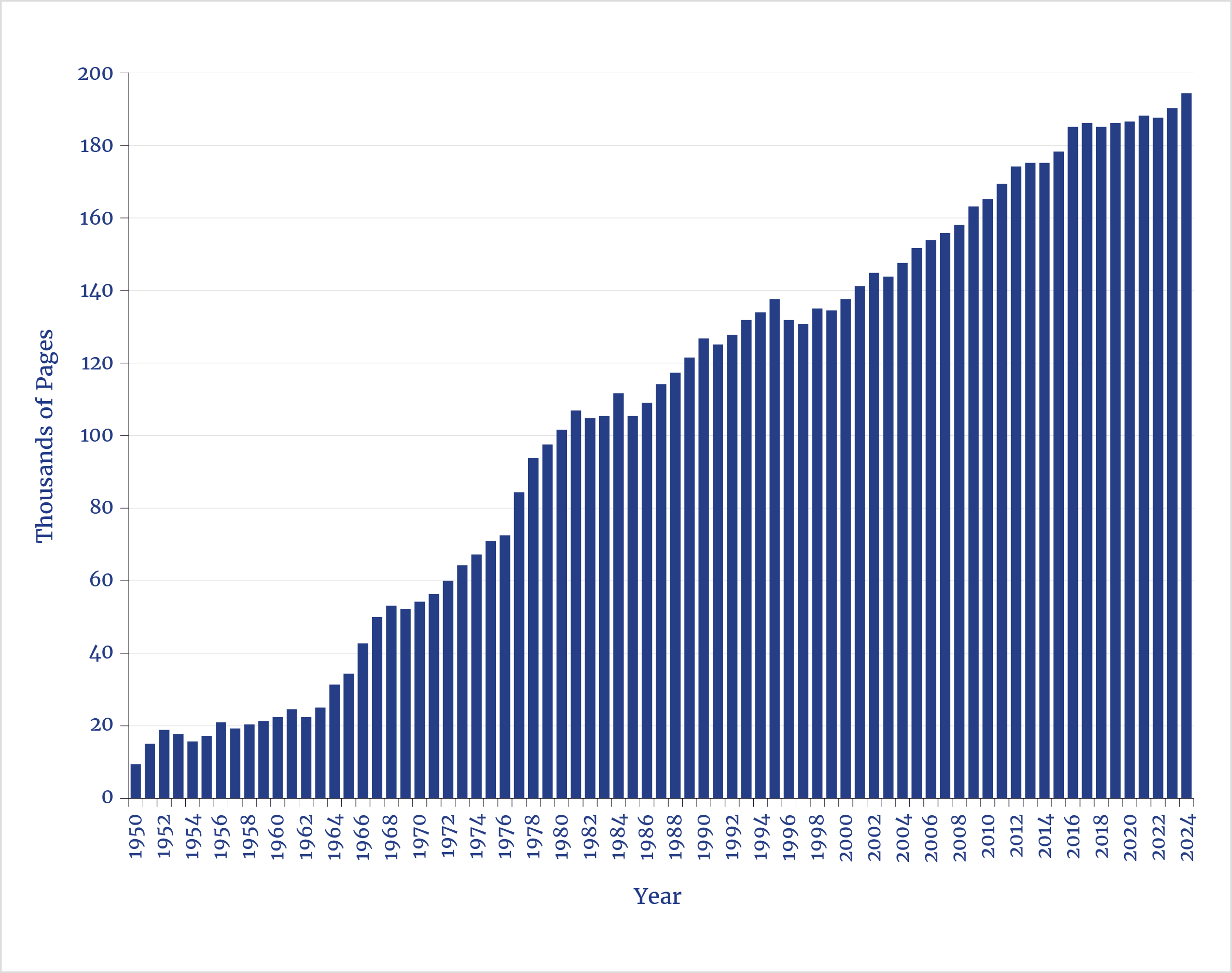
Source: Adapted from “Total Pages Published in the Code of Federal Regulations,” updated March 22, 2026, in “RegStats,” Regulatory Studies Center, The George Washington University, accessed October 30, 2026, https://regulatorystudies.columbian.gwu.edu/regstats.
While the CFR encompasses all regulations and not only those governing energy, the staggering scale of the growth in page count reveals just how encumbered producers are. The energy industry is among the most regulated business segments in the U.S., so it has an outsize share of this regulatory strain.
To better understand the cost of energy industry regulations, manufacturing serves as an excellent proxy. Regulations on manufacturing necessarily affect energy production, both directly in its industrial processes, such as petroleum refining, and indirectly in the vast array of production equipment essential to the industry. This includes everything from oil-and-gas drilling equipment to the gas and steam turbines, nuclear reactor components, and power transformers that make electricity generation possible.
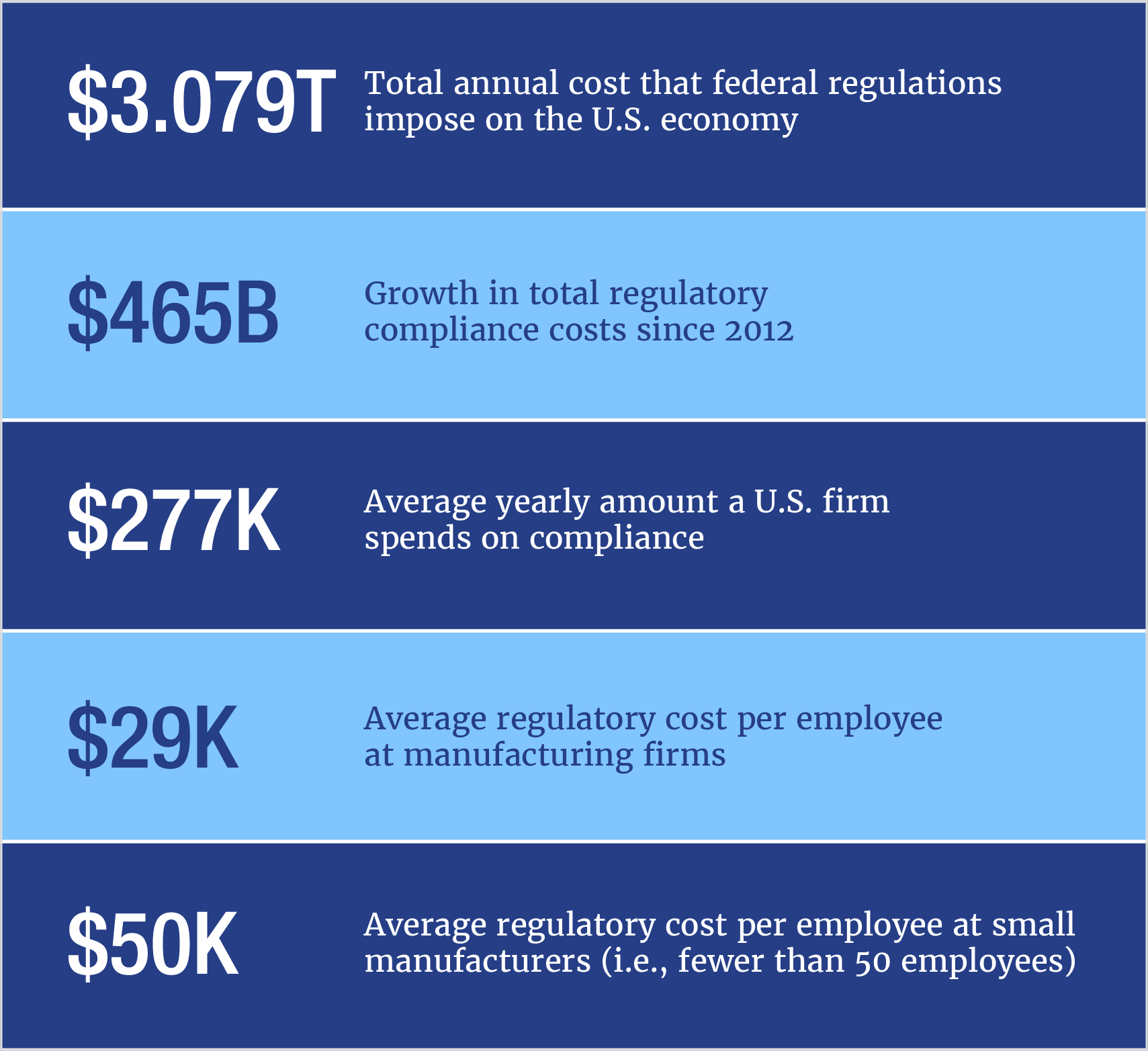
In 2023, a landmark study for the National Association of Manufacturers (NAM) quantified the number and cost of U.S. manufacturing regulations.3 It found that federal regulations impose an annual cost of over $3 trillion, as seen in figure 2. More than 217,000 restrictions are relevant to manufacturing.4
Figure 2. The Cost of Total U.S. Manufacturing Regulations: 2022
Source: Adapted from Nicole V. Crain and W. Mark Crain, The Cost of Federal Regulation to the U.S. Economy, Manufacturing and Small Business: A Study Conducted for the National Association of Manufacturers (National Association of Manufacturers, 2023).
These costs are the totals for all industry sectors, so the figures for energy-related manufacturing alone are smaller, as table 1 shows. Energy-related manufacturing accounts for 11.1% of U.S. manufacturing value added.5 If the regulatory cost burden is proportional to value added, then about $39 billion of manufacturing's $349 billion in annual regulatory costs falls on energy-related manufacturing.
Table 1. U.S. Manufacturing Verticals: Value Added and Energy-Related Value Added, 2025
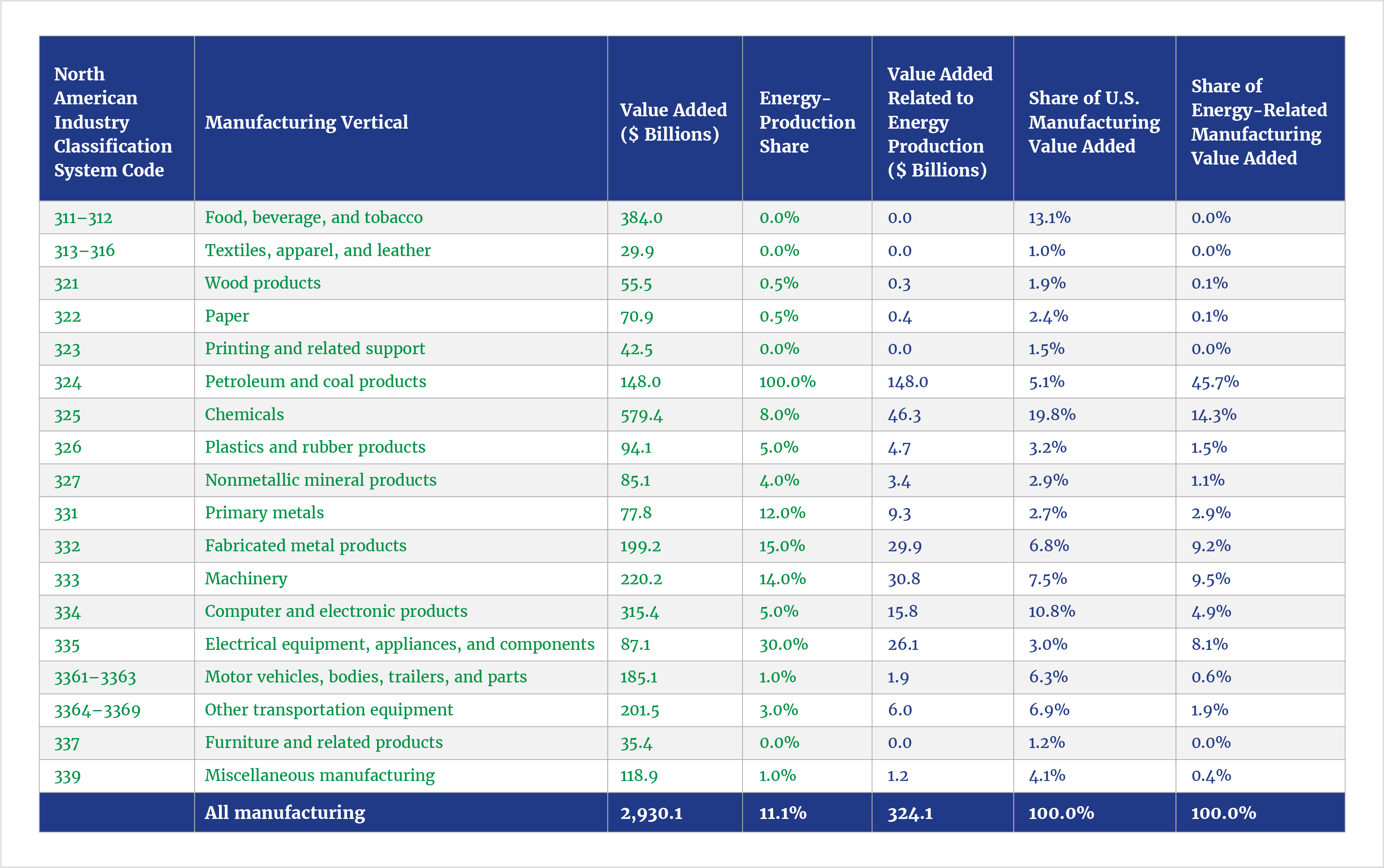
Note: Value added is an industry’s gross output minus its purchases of intermediate inputs, both domestic and imported. Percentages may not sum to 100 due to rounding.
Sources: Data from “Gross Domestic Product: Manufacturing (31–33) in the United States,” FRED, Federal Reserve Bank of St. Louis, updated September 30, 2026, https://fred.stlouisfed.org/series/USMANNGSP; and “Manufacturers’ Value of Shipments: Mining, Oil, and Gas Field Machinery Manufacturing,” FRED, Federal Reserve Bank of St. Louis, updated October 2, 2026, https://fred.stlouisfed.org/series/U33DVS. Author’s calculations also used related FRED industry series; energy-production shares are the author’s estimates, with the machinery share drawing in part on the shipments series.
Given the large additional areas of regulation aimed at nonmanufacturing energy production, such as power plant and grid operation, further substantial regulatory costs are not included in the NAM analysis. Major, well-known programs that directly constrain energy production or power generation include the Acid Rain Program, Cross-State Air Pollution Rule, Mercury and Air Toxics Standards, and New Source Performance Standards, as well as rules governing greenhouse gas emissions from fossil fuel power plants, methane and volatile organic compounds from oil-and-gas operations, effluent limitations for steam-electric plants, and coal-combustion residuals (coal ash). Each of these areas is itself a large, multipart regulatory package that has been amended numerous times.
Regulations of power plant emissions is one example. The authors of a 2025 National Center for Energy Analytics (NCEA) analysis, Assessing the Costs of Regulations to Reduce CO₂ and Other Greenhouse Gas Emissions,6 examined greenhouse gas regulations and related subsidies and concluded that the combined state and federal policy package could cost trillions of dollars if fully implemented. Those costs include:
- Methane regulation compliance: The Environmental Protection Agency estimated that the 2024 oil-and-gas methane rules would impose $18.8 billion in present-value compliance costs from 2024 to 2038, or about $1.5 billion annually.7
- Electric-grid and transmission changes: The authors reported that replacing dispatchable generation with wind, solar, and storage could require more than $1 trillion in additional transmission investment under a moderate-growth scenario by 2040.8
- Federal subsidies and tax credits: The report cited an external estimate that the Inflation Reduction Act’s energy subsidies, including financing costs, could approach $5 trillion; it also cited a Cato Institute estimate of more than $4.7 trillion through 2050.9
- Higher electricity prices and reliability impacts: NCEA argued that regulations and subsidies that accelerate wind and solar deployment can retire dispatchable plants prematurely, increasing the need for backup generation, storage, transmission, and ancillary services. For example, the report cited a $720 million reliability-must-run agreement to keep two Maryland fossil fuel plants operating for four additional years.10
- Broader economic effects: NCEA attributed higher energy costs to inflationary pressure, reduced investment, deindustrialization, and lower economic growth, estimating that U.S. GDP in 2024 might have been $6.7 trillion higher if energy-intensive industries had retained their 2007 share of gross output.11
The nuclear power industry has its own regulatory burden, one that is even more onerous. In his recent NCEA study A Strategy for Financing the Nuclear Future, Paul H. Tice reported that reactors completed before the 1979 Three Mile Island nuclear plant accident in Londonderry, Pennsylvania took a median six years to complete and cost $1,897 per kilowatt (kW) in 2024, while reactors completed afterward took 12.2 years and cost $7,627 per kW.12 The difference of $5,730 per kW (302% higher) amounts to about $6.3 billion in additional capital cost for a 1.1-gigawatt (GW) reactor.
Tice identified post–Three Mile Island safety requirements, Nuclear Regulatory Commission (NRC) licensing, approval delays, and plant backfit modifications as important contributors to that cost increase. He pointed out that the NRC has been the chief source of construction delays and completion risk for the U.S. nuclear industry over the past half century.
The recently completed Vogtle Plant in Burke County, Georgia reinforces that argument. NRC approval was required for design changes under the combined construction-and-operating license. The AP1000 reactor project experienced 197 license amendments for Unit 3 and 194 for Unit 4. The two reactor units cost $34.9 billion, including an estimated $7 billion in financing, and took nearly 11 years to build instead of the five years initially projected.13
America’s current tangle of permitting regulations—which include National Environmental Policy Act (NEPA) reviews, Clean Air Act and Clean Water Act permits, and Endangered Species Act mandates—imposes a heavy economic burden on energy producers. A McKinsey analysis of federal permitting finds that capital projects totaling 240–280 billion in infrastructure investment—including energy, transportation, manufacturing, mining, and related sectors—enter the federal permitting process each year.14 These projects spend an average of four to five years in review, leaving 1.1–1.5 trillion of planned spending awaiting approval at any given time.
The McKinsey study estimated that direct permitting costs are 5–14 billion annually. Far larger are the opportunity costs of unrealized returns on capital sitting in the queue, which run 100–140 billion per year. McKinsey places the broader economic effects from delayed construction spending and wages at 1.7–2.4 trillion cumulatively.
While the substantial costs of the energy industry’s overregulation would seem to make cost savings an obvious priority of deregulation, the shorter-term focus should be on eliminating friction. Policy changes must make energy production project timelines as short and predictable as possible. With the rapidly burgeoning demand for energy on all fronts, the highest-return reforms are the ones that remove time, uncertainty, and duplication from projects that are already economically viable.
While perhaps the biggest legislative lift, permitting reform is needed most urgently. Policy changes that deliver a single predictable permitting process with hard deadlines, rather than dozens of sequential approvals, are imperative. Core deregulation objectives should include:
· One lead federal agency per project
· A single consolidated environmental review
· Firm deadlines
· Concurrent rather than sequential reviews
· One coordinated judicial review process instead of years of serial litigation
These reforms are particularly important now because electricity demand is accelerating while the projects needed to provide for that demand are stalled in the permitting process. The eastern U.S. regional transmission organization PJM Interconnection, for example, recently had more than 50 GW of generation with interconnection agreements ready for development, but another 220 GW were under evaluation in its development queue.15
A specific case that would have benefited from these proposed changes is the Mountain Valley Pipeline, first proposed in 2015 to transport shale gas from the mountains of West Virginia to usage points in Virginia.16 The pipeline, which finally began operating in 2024, took nearly twice as long and more than double the cost of its original estimates. Those overruns were driven largely by a series of permitting lawsuits that caused repeated work stoppages during the pipeline’s construction.
Similarly, interconnection reform can deliver enormous benefits with limited investment.
The reality is that much of America does not have an energy production shortage but instead has an energy throughput problem—an inability to move energy from production to use. A generator can be economically attractive but still sit for years waiting to connect to the grid.
To address interconnection delays, the Federal Energy Regulatory Commission (FERC) and regional transmission organizations should focus on the following reforms:
· First-ready, first-served queues
· Strict deadlines for utilities to complete studies
· Standardized interconnection requirements
· Expedited interconnection for projects at existing power plant sites
· Streamlined upgrades of existing generators
· Simplified rules for co-located generation, storage, and large loads
The last item is of particular interest, as existing power plants already have transmission connections. Replacing or expanding generation at those points of interconnection can be significantly easier than building an entirely new connection. An excellent example is Holtec International’s plan to add two of its SMR-300 small modular reactors to its southwest Michigan Palisades nuclear site after it has completed the historic restart of the legacy reactor.17
The current PJM situation illustrates the potential value of regulatory reforms: Its latest capacity auction came up 6.8 GW short of its target, even though enormous amounts of prospective generation existed.18 Regulatory reform should also support the addition of new transmission capacity. FERC’s Order No. 1920 is already attempting to improve long-term regional transmission planning and cost allocation.19
An additional opportunity exists in federalizing the siting of genuinely interstate transmission. A project crossing several states should not allow any one state to deny the project by blocking the portion within its borders. A sensible system would allow FERC the authority to approve an interstate transmission route if a review process determines that it is necessary for reliability or substantial new generation. States would still have input and could potentially receive compensation and mitigation, but they would not have indefinite veto power.
The Boardman to Hemingway Power Line is an excellent example of the current challenges and the need for reform.20 Permitting efforts for the Idaho Power Company transmission line, intended to serve the Pacific Northwest and Intermountain West through a new connection between Oregon and Idaho, began in 2007. However, the project has faced repeated legal and regulatory hurdles. Construction, originally planned for a 2018 start, finally began last year, with an anticipated startup date in 2027 as a best-case scenario. The delays are estimated to have added about $300 million to the original cost projection of 1–1.2 billion.21
For broader regulatory reform, NEPA should be a primary focus. To increase the potential for meaningful change in environmental policy, reforms should center on process rather than outcomes. Again, the objective should be to reduce friction and favor action on economically viable projects. Similar to the approach for permitting reform, updates to NEPA requirements should emphasize:
· Limits on environmental-review page counts
· Fewer alternatives that must be evaluated
· Restrictions on repetitive supplemental reviews
· Firm litigation deadlines
· Constraints on serial lawsuits over essentially identical issues
The U.S. Department of the Interior has already begun experimenting with such an approach. For example, its proposed “categorical exclusion” would accelerate permits for winter oil-and-gas exploration activities, such as seismic surveys and exploratory drilling in Alaska’s National Petroleum Reserve, relying instead on decades of previous environmental analysis.22
This approach can set a general principle to work from going forward: If a certain class of activities has already proven to ordinarily have limited environmental impact, then every individual project should not have to redo the exercise.
Energy development leases on federal lands is another regulatory area that is ripe for revitalization. The goal should be to make such leasing boring and predictable. A producer should be able to know at the start of the process what acreage will be offered, the royalty regime, the environmental standard, and the project timetable.
Today’s on-again, off-again lease offerings that come and go according to which party holds office are an unnecessary barrier to energy production—one that exists because a more predictable system was not in place to begin with.
Perspective
The good news is that there is strong bipartisan support for energy development and reshoring of manufacturing, which will bolster the case for energy and industrial deregulation. Additionally, several positive moves toward sector deregulation have occurred, including rescission of both the Obama-era Greenhouse Gas Endangerment Finding that enabled the Environmental Protection Agency to regulate greenhouse gas emissions (although this move faces judicial challenges)23 and the Biden-era tightening of power plant particulate emissions regulations.24
The Trump administration’s Executive Order 14192, which requires that each new regulation be offset by identifying at least 10 existing regulations for elimination, sent a strong deregulation message.25 However, far more remains to be done, and effective long-term change will require Congress to act.
Streamlining all the aforementioned areas of permitting and project flow will accelerate the major energy projects the nation needs, which will lead to dramatic cost reductions. But bigger efficiencies must be driven by a wholesale effort at industrial deregulation.
The sheer scale of such a task will require years of work. Congress may struggle to tackle the problem effectively, given its complex processes and short-term focus. Fortunately, a model for what could work in the long term already exists in the Base Realignment and Closure process.26 In 1988, Congress established a structured process for the closure or realignment of military installations, granting an independent commission temporary authority to review and approve changes recommended by the secretary of defense.
Congress should similarly establish a nonpartisan expert commission to conduct comprehensive reviews of industrial regulations and recommend elimination or restructure based on cost-benefit considerations and enhanced American industrial competitiveness.
This agenda is much broader than “drill, baby, drill.”
If the objective is maximum additional energy production, public policies must aim to remove barriers from anything that could economically produce energy and simply enable investors to build what they already want to build.
The U.S. already has enormous quantities of energy resources and the private capital to develop them. A two-pronged effort to ensure their flow is long overdue: Policymakers must eliminate the regulatory friction that delays major projects and increases their costs, and they must reduce the overall regulatory burden on American producers and the economy.
- Adam J. White, “Why Can’t America Build,” American Enterprise Institute, August 8, 2024.
- Office of the Federal Register, “Code of Federal Regulations Total Pages 1938–1949, and Total Volumes and Pages 1950–2021,” in 2022 Aggregated Charts (U.S. National Archives and Records Administration, 2023), 7–9; Office of the Federal Register, “CFR Volumes and Page Breakdown,” U.S. National Archives and Records Administration dataset, accessed October 23, 2026; and “Code of Federal Regulations (Annual Edition): 2024,” GovInfo, accessed October 23, 2026, https://www.govinfo.gov/app/collection/cfr/2024.
- Nicole V. Crain and W. Mark Crain, The Cost of Federal Regulation to the U.S. Economy, Manufacturing and Small Business: A Study Conducted for the National Association of Manufacturers (National Association of Manufacturers, 2023), 4.
- Patrick McLaughlin et al., “Regulatory Accumulation in the Manufacturing Sector,” Mercatus Center, George Mason University, August 31, 2017.
- Crain and Crain, The Cost of Federal Regulation, 33.
- Jonathan Lesser et al., Assessing the Costs of Regulations to Reduce CO2 and Other Greenhouse Gas Emissions (National Center for Energy Analytics [NCEA], 2025).
- Lesser et al., Assessing the Costs of Regulations, 6.
- Lesser et al., Assessing the Costs of Regulations, 3–4.
- Lesser et al., Assessing the Costs of Regulations, 1.
- Lesser et al., Assessing the Costs of Regulations, 3–5, 8–10.
- Lesser et al., Assessing the Costs of Regulations, 11–12.
- Paul H. Tice, A Strategy for Financing the Nuclear Future (NCEA, 2025).
- Tice, A Strategy for Financing the Nuclear Future, 11–12.
- Bob Sternfels and Adi Kumar, “Unlocking U.S. Federal Permitting: A Sustainable Growth Imperative,” McKinsey & Company, July 28, 2025.
- Anna Flávia Rochas, “PJM Capacity Market Woes Spur Activity in Bilateral Power Deals,” Reuters Events Energy Transition, LinkedIn Pulse, August 26, 2026.
- Chris Knight, “MVP Start-Up Shows Permitting Troubles in U.S.,” Argus Media, June 24, 2024.
- “Major Regulatory Developments in the Palisades Pioneer Unit 1 & 2 Program,” Holtec International, September 30, 2026, https://holtecinternational.com/hh-41-23.
- PJM Interconnection, “PJM Capacity Auction Procures 138,318 MW of Generation Resources as Work Continues to Address Growing Electricity Demand,” news release, July 14, 2026.
- “Explainer on the Transmission Planning and Cost Allocation Final Rule,” Federal Energy Regulatory Commission, updated May 7, 2025, https://www.ferc.gov/explainer-transmission-planning-and-cost-allocation-final-rule.
- Laura Feinstein, “The High Cost of Slow Permitting,” Sightline Institute, November 20, 2025.
- Feinstein, “The High Cost of Slow Permitting.”
- Adam Federman, “Arctic Drilling in Alaska Won’t Get Environmental Review in New Proposal,” High Country News, August 26, 2026.
- Lisa Whitley Coleman, “Courts Weigh Future of EPA’s Endangerment Finding as Litigation Advances,” EHS Leaders, June 1, 2026.
- “Mercury and Air Toxics Standards,” Environmental & Energy Law Program, Harvard Law School, updated August 13, 2026, https://eelp.law.harvard.edu/tracker/mercury-and-air-toxics-standards.
- Executive Office of the President, Executive Order 14192, “Unleashing Prosperity Through Deregulation,” Federal Register 90, no. 24 (February 6, 2025): 9065–67.
- Andrew Tilghman, Excess Military Infrastructure and the Base Realignment and Closure (BRAC) Process (Congressional Research Service, 2025).
About the author
Continue Reading

Energy and Materials: A New Synthesis
There is widespread bipartisan appreciation for the risks and realities of import dependencies for minerals, particularly those designated as critical, because of practicalities in supply chains and especially for strategic and geopolitical reasons.