Can Batteries Help Wind and Solar Provide Continuous Electricity Year-Round?
Are leaders making trillion-dollar energy decisions based on a misunderstanding of what reliable electricity requires?
Listen
The Issue
Are leaders making trillion-dollar energy decisions based on a misunderstanding of what reliable electricity requires?
Around the world, governments are investing trillions of dollars in electricity infrastructure that includes battery energy storage systems (BESS) and transmission, based on the assumption that batteries can help enable wind and solar energy to provide reliable, affordable, on-demand electricity that can replace much of today’s dispatchable generation.
A May 2026 International Renewable Energy Agency (IRENA) report, titled 24 / 7 Renewables: The Economics of Firm Solar and Wind, claimed that “battery energy storage systems (BESS) can reliably and cost-effectively provide round-the-clock electricity in favorable resource conditions” using solar or wind as the electricity source.1
If this were the case, the implications would be profound: This claim would redefine how countries build electricity systems and allocate public and private capital.
Supplying reliable electricity requires more than generating kilowatt-hours (kWh) when the sun shines or the wind blows and then storing the electricity until it is needed; the electricity must also be delivered in the right form—that is, the sources must be grid-ready.
The issue therefore is not simply whether batteries can help compensate for the inherently intermittent nature of wind and solar—they can, but only for a limited period. The issue is whether they can provide the level of service and reliability required by modern society without also requiring substantial additional infrastructure, increasing system complexity, reducing power quality, compromising cybersecurity, and imposing higher economic and environmental costs. The word reliable therefore takes on another meaning: Reliability also means providing system strength.
The Reality
Understanding the distinction between generating electricity and delivering reliable, continuous electricity is therefore essential for policymakers, investors, and the public alike.
Discussions surrounding the combination of wind and solar plus batteries often focus on how these technologies can inexpensively generate electricity while operating,2 often omitting that generation of kWh is only one part of a useful electrical grid system. Grid-scale systems must account for—among other considerations—overbuilding, curtailment, ancillary infrastructure requirements, and net-energy efficiency.
Reliable electricity depends on continuously balancing supply and demand while maintaining system stability, frequency, voltage, inertia, and the strength needed to withstand disturbances. These requirements are constant, regardless of weather conditions.
Determining whether wind and solar plus batteries can effectively provide reliable electricity around the clock, as claimed by IRENA,3 requires examining several engineering and economic realities.
Electricity Must Be Available When It Is Needed
Generating megawatt-hours on average over a year is fundamentally different from supplying electricity at specific times and locations, and in the appropriate form, required by industrial and retail consumers.
Homes, hospitals, factories, airports, and data centers depend on continuous and uninterrupted access to electricity. Annual generation statistics or average net load factors (calculated as the product of the natural capacity factor and utilization) therefore do not measure reliability; they measure generation over time.
Reliable electricity is measured by the ability to meet demand whenever it arises and to provide the system strength needed for a resilient grid. Electricity is not a product purchased only at certain times; it is a continuous, on-demand service delivered to consumers as kWh.
Weather Determines When Wind and Solar Generate Electricity
Unlike dispatchable power stations, wind and solar can neither maintain nor increase output simply because demand increases. Wind and solar output depend entirely on weather conditions.
While combining wind and solar can improve overall generation, there will still be periods when both resources produce little electricity concurrently. These are commonly referred to as Dunkelflauten. Figure 1 illustrates the lowest combined wind-plus-solar generation during the typically worst four- or 12-hour period each month in Germany since 2020. Similar data can be provided for any region in the world. These Dunkelflauten can last from hours to days and, in some cases, considerably longer; this is where batteries are expected to come into play.4
Figure 1. Four- and 12-Hour Minimum Wind and Solar Generation in Germany
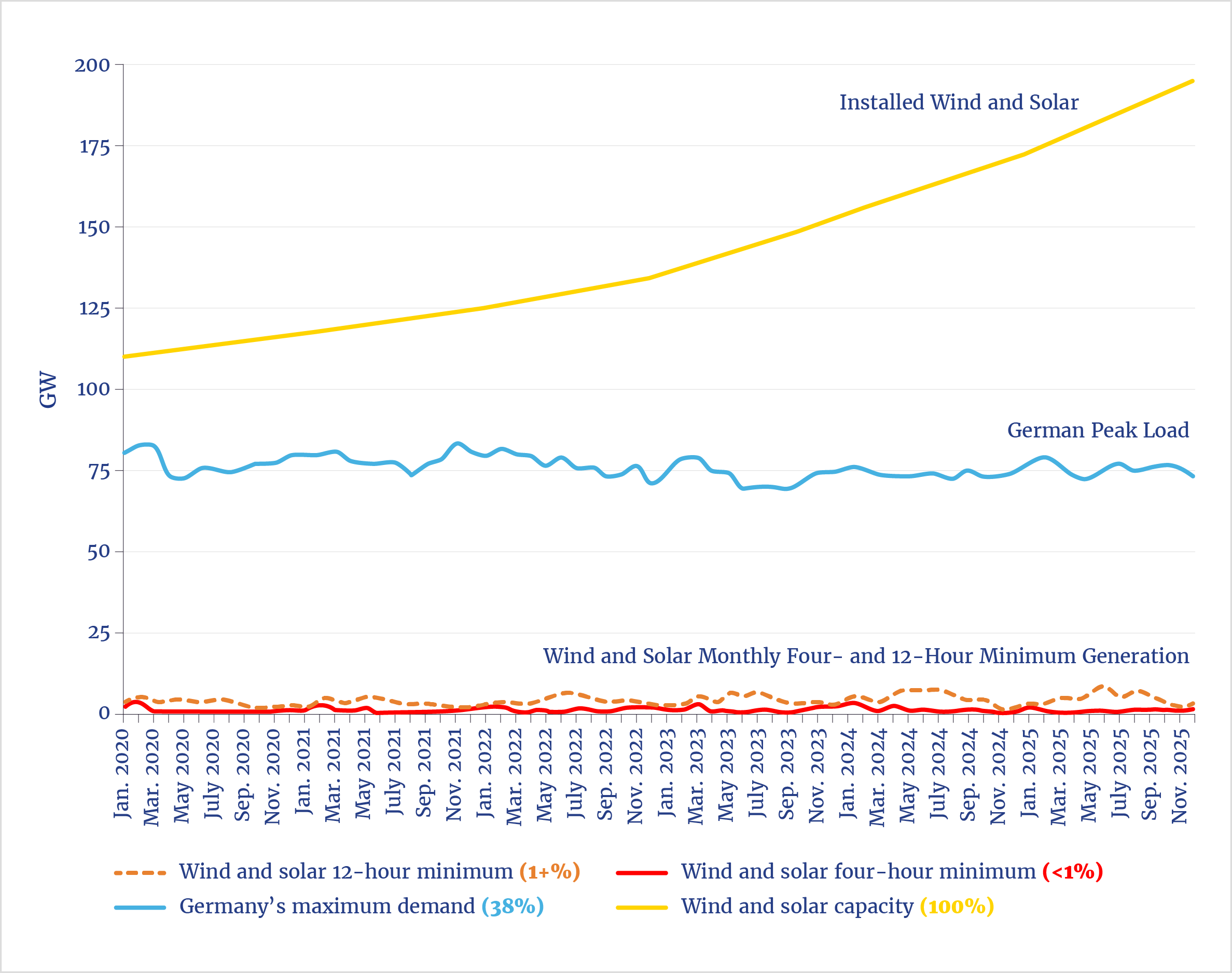
Source: Adapted from Lars Schernikau, “Can Solar and Wind + Batteries Really Provide 24/7/365 Electricity?,” The Unpopular Truth (blog), June 19, 2026, figure 3. Based on data from “Data & Tools,” Agora Energiewende, updated June 11, 2026, https://www.agora-energiewende.org/data-tools.
Batteries Shift Electricity, Not Create It
The discussion changes dramatically when battery storage is considered at the scale required to support an entire electrical system.5 Powering a home overnight is fundamentally different from supplying an industrial economy through prolonged periods of low wind and solar generation. To better understand this process, one should consider the following:
· How much electricity is needed? In Germany, the average national electricity demand is approximately 60 gigawatts (GW), while peak demand exceeds 80 GW. Providing just 12 hours of storage at an average demand would require about 700 gigawatt-hours (GWh) of battery capacity. This is almost equivalent to the world’s entire installed utility-scale battery storage capacity, beginning in 2026.6
· How long is stored electricity needed, and what will charge the batteries? Historical weather records show that Dunkelflauten—periods of low wind and solar generation—can last for days or weeks. During these weather events, batteries cannot recharge because wind and solar are generating insufficient electricity to replenish them. Any wind or solar power generated would be immediately consumed by the grid without recharging batteries.
Batteries can store only the electricity that has already been generated. For batteries to maintain supply during periods of low wind and solar generation, surplus electricity must first be generated to account for 20%–30% round-trip losses and incomplete discharging and charging.7 During extended periods of low wind and solar output, batteries will eventually deplete unless another source of electricity is available.
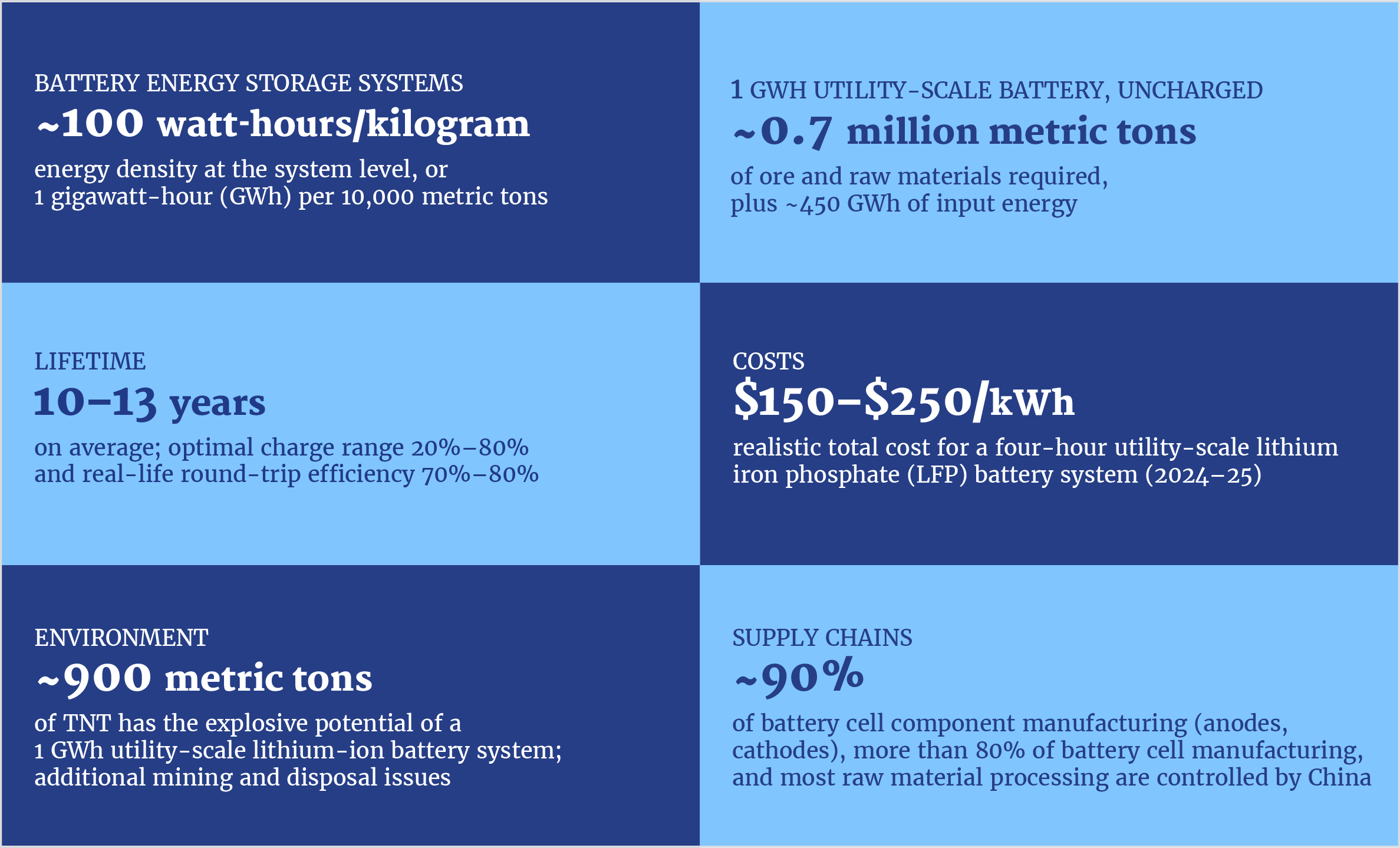
The process of building utility-scale battery systems involves several steps, each of which adds complexity and increases economic and environmental costs. These processes require substantial energy inputs, resulting in embodied energy that is often overlooked; raw materials are also required (see figure 2).8 The key stages in the supply chain and assembly of utility-scale BESS are as follows:
- Metals and materials supply: Mine, upgrade, transport, process, and refine raw materials, and convert concentrates into high-purity metals
- Component manufacturing: Manufacture electrode foil, separators, electrolyte, cell housings, and other components
- Cell production: Coat, dry, calender, and stack or wind electrodes; fill with electrolyte; and complete formation cycling
- Module and pack assembly: Integrate cells into modules and packs, including battery management systems and cooling
- BESS assembly: Integrate thermal management, electricity conversion, enclosures, and controls
The economic cost of wind and solar plus batteries is often mistakenly expressed in terms of the levelized cost of electricity (LCOE). LCOE does not account for the overbuild required to compensate for low natural capacity factors, charge storage, and cover transmission and charging losses. Without storage, the overbuild needed to meet peak demand during the lowest-output hours would mean installed wind and solar capacity tens to hundreds of times that demand. Germany has already overbuilt its wind and solar capacity to about three times its peak demand, yet it still cannot cover demand during Dunkelflauten (see figure 1).9
Figure 2. Utility-Scale Batteries: Fact Sheet
Source: Adapted from Lars Schernikau, “Can Solar and Wind + Batteries Really Provide 24/7/365 Electricity?,” The Unpopular Truth (blog), June 19, 2026, figure 5.
Reliable Electricity Requires More than Energy Generation
A stable electrical system depends on services that are often invisible to consumers but essential to grid operation. Grid-ready electricity has five main characteristics that keep electricity systems stable, resilient, and secure:
· Voltage: System strength or electrical pressure (e.g., 120/240 volts)
· Frequency: The instantaneous balance between supply and demand (e.g., 60 hertz)
· Phase: Synchronism between generators every millisecond
· Current: The actual flow of power through the network (e.g., 10 amperes for a washing machine)
· Short-circuit level: A conventional proxy for system strength, measured in gigavolt-amperes (GVA); strong grids with thermal synchronous units have 20–40 GVA, while weak grids with high wind and solar have <5 GVA10
Providing these characteristics requires a range of special equipment that depends on the physical characteristics of the power sources. Thermal power plants, with large, heavy mass and synchronously rotating generators, supply these five fundamental characteristics and help to maintain grid stability. Wind turbines or solar panels cannot provide this function without additional ancillary systems, each of which adds to system costs that should be considered.11
The power quality reduces with higher wind and solar penetration, and the short-circuit level is one indication. In Germany, grid engineers refer to wind and solar power as unclean power. Even grid-forming inverters cause noise in the system. Inverters do not truly convert direct current (DC) to alternating current (AC); rather, they output rapidly intermittent DC of varying voltage and polarity that attempts to mimic the grid’s AC waveform—without the systemic advantages of synchronous AC power generators. This added noise reduces the efficiency and resilience of a true AC grid. The blackouts in Spain in April 2025 and in Sri Lanka in October 2026 illustrate how high nonsynchronous solar penetration reduces system reliability and can lead to potentially devastating disruptions of service.12
Creating Reliability Requires Additional Infrastructure
As the share of wind- and solar-generated electricity in an electrical system increases, additional infrastructure becomes necessary to maintain grid reliability.13 This infrastructure includes the following systems:
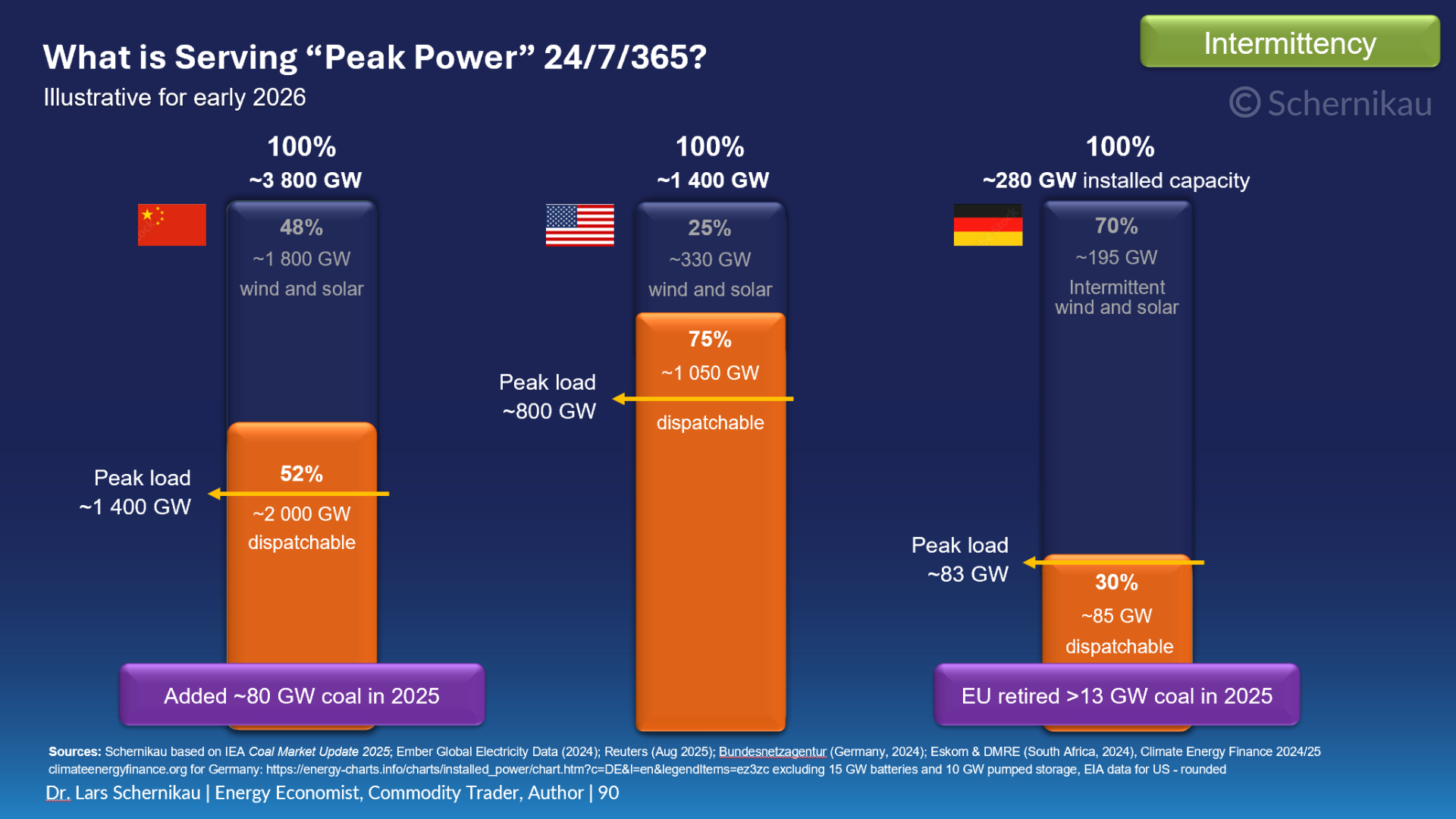
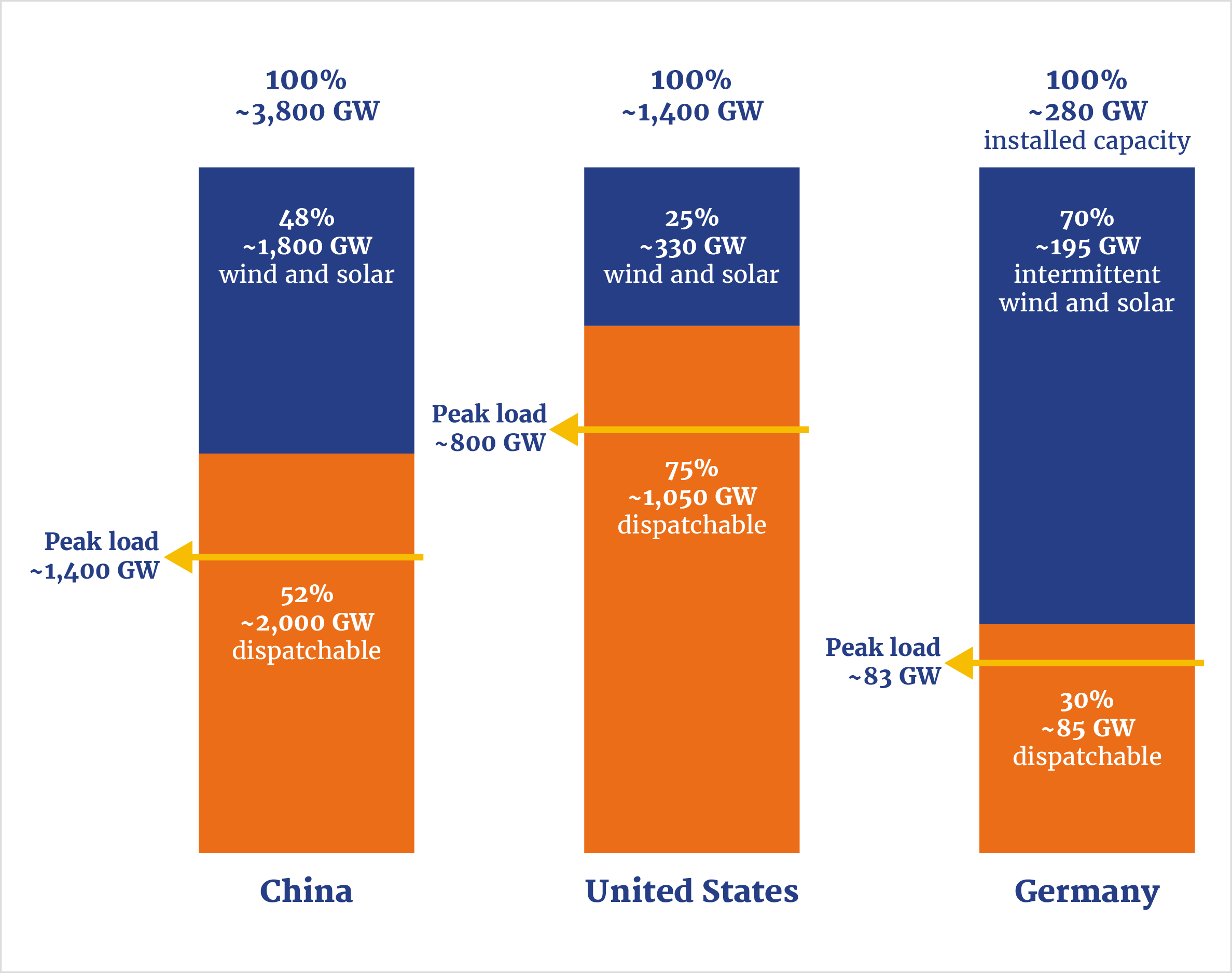
- A vast overbuild to overcome the low natural capacity factor that results in low usage, to help with challenges to intermittency and unpredictability, and to charge any storage (see figure 3)
- Short-duration energy storage, in the form of batteries, to overcome short fluctuations and to balance the grid
- Long-duration energy storage, possibly in the form of hydrogen, to overcome days and weeks of insufficient combined wind and solar generation
- Backup thermal power stations on standby, as needed (in Germany, 22.5–35.5 GW of gas is required by 2035; in the future, this backup is predicted to run on hydrogen14)
- A transmission network and integration infrastructure that are vastly larger and more complex
These five systems, with low utilization contributing to the cost increase, are all required to replace one existing coal, gas, or nuclear power station.15
Because multiple ancillary systems create both reliability and system strength—and because each system increases both cost and complexity—comparisons must account for these additions across entire electricity systems, not just individual technologies. The key point remains that electricity is a service delivered to consumers, not merely a product generated by a particular technology. LCOE does not capture these costs and therefore cannot, on its own, provide a complete assessment of the cost of wind and solar power.
Increasing reliability through additional storage and infrastructure does not just affect system cost and complexity; it also increases material requirements, land use, energy inputs, capital investment, and disposal challenges.
Figure 3. What Is Continuously Serving Peak Power Year-Round?
Source: Adapted from Lars Schernikau, “What Is Serving ‘Peak Power’ 24/7/365?,” The Unpopular Truth (blog), July 2026.
Perspective
Electricity has become so reliable in much of the world that many people take it for granted. From light switches and power sockets to hospitals, factories, data centers, and transport systems, so much of modern life depends on a resilient electrical system that can balance a constant supply and demand.
The appeal of sunlight and wind as free and natural energy resources should apply to all energy sources, including coal, oil, natural gas, wood, and uranium. The challenge with all of nature’s resources is that turning them into usable, reliable power that is constantly available will always cost energy, material, money, and human ingenuity. Therefore, “free” energy is really a misnomer—it requires other costly resources and processes to convert it into usable power.16
The future of electrical systems should ultimately be evaluated not only by how much electricity can be generated but by the ability to provide reliable, affordable, and resilient electricity with the least negative impact on the environment. This evaluation raises several questions:
- Do decision makers evaluate entire electricity systems, or simply compare individual generation technologies?
- Do decision makers incorporate the full engineering requirements for reliable electricity into their plans?
- Do decision makers adequately consider the costs of overbuilding, storage, transmission, backup generation, and system integration?
- What are the opportunity costs of investing in one pathway over another?
- Which electricity systems deliver the greatest overall benefit to society, the economy, and the environment?
Sensible energy policy begins with asking the right questions. Understanding the requirements of reliable electricity is the first step toward making informed decisions about the systems that power modern society.
This issue brief expands upon the author’s original research published in “Can Solar and Wind + Batteries Really Provide 24/7/365 Electricity?,” The Unpopular Truth (blog), June 19, 2026.
- Saied Dardour et al., 24/7 Renewables: The Economics of Firm Solar and Wind (International Renewable Energy Agency, 2026).
- Lars Schernikau, “Can Solar and Wind + Batteries Really Provide 24/7/365 Electricity?,” The Unpopular Truth (blog), June 19, 2026.
- Dardour et al., 24/7 Renewables.
- Lars Schernikau, “Are Wind and Solar Up for the Challenge?,” The Unpopular Truth (blog), November 9, 2024.
- Schernikau, “Wind and Solar.”
- The estimate and calculation were based on cumulative installed global energy storage capacity of about 56 GWh by the end of 2021, with up to about 70 GWh added annually through 2024 and 300 GWh added in 2025. Extrapolating puts cumulative capacity at least 700 GWh entering 2026. BloombergNEF, “Global Energy Storage Market to Grow 15-Fold by 2030,” press release, October 12, 2022; and BloombergNEF, Energy Storage Market Outlook 1H 2026 (BloombergNEF, 2026).
- See Lars Schernikau, The Battery Storage Delusion: Utility-Scale Batteries Are No Silver Bullet (National Center for Energy Analytics, 2025).
- Lars Schernikau, “Rethinking the Cost of Electricity in a Complex Energy System,” The Unpopular Truth (blog), April 25, 2026; and Lars Schernikau, “The Energy Nobody Counts,” The Unpopular Truth, August 8, 2026.
- Schernikau, “Wind and Solar”; and “Data & Tools,” Agora Energiewende, updated June 11, 2026, https://www.agora-energiewende.org/data-tools.
- Schernikau, “Rethinking the Cost of Electricity”; and Dardour et al., 24/7 Renewables. Voltage and frequency examples were converted to U.S. standards.
- Schernikau, “Wind and Solar.”
- Lars Schernikau, “Blackouts, What Causes Them?,” The Unpopular Truth (blog), May 16, 202; and Emiliano Bellini, “Sri Lanka Asks PV System Owners to Disconnect After Nationwide Blackout,” pv magazine, October 19, 2026.
- Schernikau, “Wind and Solar.”
- Bundesnetzagentur, “Publication of Security of Supply Monitoring,” press release, September 3, 2025.
- Schernikau, “Wind and Solar.”
- Schernikau, “Wind and Solar”; and Schernikau, “The Energy Nobody Counts.”