
New Energy Lessons and Realities from the Hormuz Crisis
-2%20(14).png)
The initial closure of the Strait of Hormuz in March 2026 was the unlikely scenario most frequently gamed by the world’s energy cognoscenti.
Listen
The Issue
The initial closure of the Strait of Hormuz in March 2026 was the unlikely scenario most frequently gamed by the world’s energy cognoscenti. Prior to the closure, pundits confidently professed that Iran would keep the strait open, if only to sustain its oil revenue, and that the United States would not risk its closure for fear of disrupting vital world oil flows.1 Almost all related assumptions, scenarios, and forecasts were wrong, including dire warnings that some 20% of world petroleum and petroleum products would be largely removed from the market if the strait were to close.2
The Reality
After the first closure, many energy commentators and influencers predicted that the strait’s blockage would quickly lead to $200-per-barrel oil,3 a global recession, a return to gas lines, and even a wavering response from the International Energy Agency (IEA), which many feared had de-prioritized its energy security mandate.4 At the same time, analysts largely continued to overlook Persian Gulf exports of liquefied natural gas (LNG), the only area where there was (and is) no easy workaround.
The reality is that the institutions of global energy governance—built over 50 years of largely bipartisan domestic and international consensus among major oil-consuming and -producing countries as well as with the global energy industry—all worked largely as planned. A March 2026 letter to The Wall Street Journal by Matthew McManus on behalf of NCEA, titled “Kissinger Helped Create the World’s Oil Reserves,” attributed the creation of the IEA and its still-formidable billion-barrel-plus strategic oil stocks to State Department–led energy diplomacy among the world’s energy-importing countries.5 That diplomacy was a response to the 1970s oil embargoes imposed by Arab members of the Organization of the Petroleum Exporting Countries (OPEC). In the current oil supply disruptions, the IEA’s member governments promptly and effectively authorized a record 400-million-barrel release of strategic oil stocks, all of which are ongoing, including 172 million barrels from the U.S. Strategic Petroleum Reserve (SPR).6 A postcrisis audit of the release rates by Japan, on the high side, and Europe, on the low side, will help fine-tune the IEA’s emergency response system.
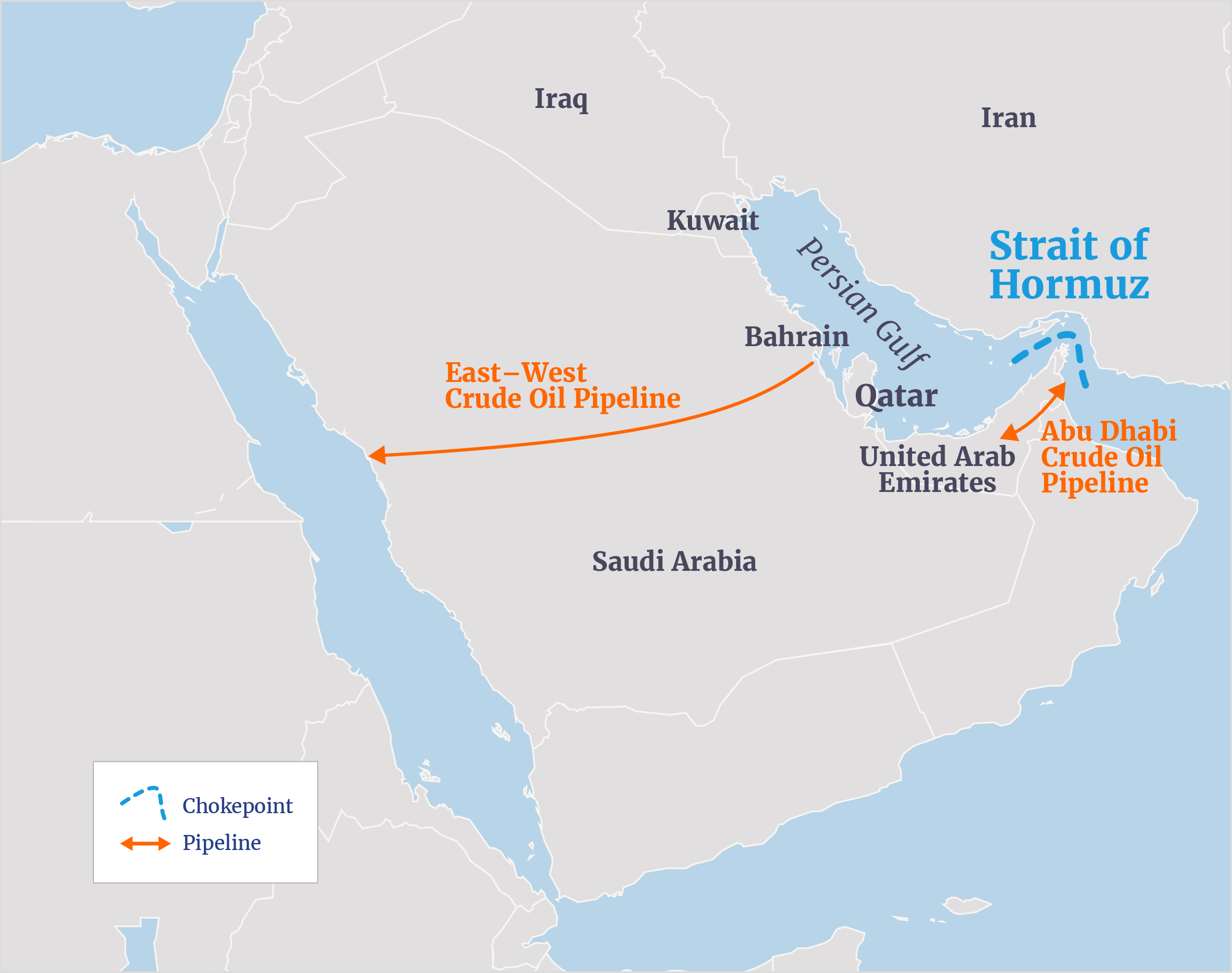
Major producers also invested in redundant energy export infrastructure across the Arabian Peninsula (see figure 1). For example, Saudi Arabia’s East–West Crude Oil Pipeline surged beyond its nameplate capacity to provide 7 million barrels per day (mb/d) to two updated export terminals and a major refinery on the Red Sea at Yanbu.7 The recent strike on this pipeline helps to illustrate the important role it has played thus far in the crisis.8 In addition, Saudi Aramco—mostly state-owned and the world’s largest corporate oil producer—maintained petroleum stocks around the world, while global oil oversupply also contributed to historically high levels of commercial oil stocks at the beginning of the Iran conflict.9
Meanwhile, the United States moved to temporarily waive sanctions on millions of barrels of oil in floating storage that were positioned in the Indo-Pacific, and market liquidity increased still further in June because of the release of stranded oil tankers from the Persian Gulf.10 The United States shepherded dark fleets of transponder-silent tankers along the Omani coast’s “Southern Highway,” while Chinese-flagged ships used their leverage as Iran’s largest oil consumer and mostly won safe passage. Together, these flows augmented the significant volumes of oil that were rerouted by Saudi Arabia and other producer.11
Over a decade ago, the United Arab Emirates made a prescient investment in the 1.8 mb/d Abu Dhabi Crude Oil Pipeline to Fujairah—a terminal beyond the strait, on the Gulf of Oman, with more than 70 million barrels of commercial oil storage.12 The country is now halfway done with doubling the capacity of this pipeline.13 Iraq also rushed to rekindle the Iraq–Turkey Crude Oil Pipeline, which runs from Kirkuk in northern Iraq to the Mediterranean port of Ceyhan, unlocking a few hundred thousand barrels a day of exports.14 The reality, according the U.S. Energy Information Administration (EIA) and others, is that as much as 70% of Persian Gulf oil, condensate, and products continued to reach the market through most of the initial shutoff.15 The deficit was higher for refined products, and the loss of refining capacity in the region has exacerbated the growing shortfall of petroleum products in the wake of the strait’s second closure in June. Separately, attacks on Russia’s refinery network have recently intensified—reducing global refining capacity still further.
Figure 1. Major Oil-Producer Activity Across the Arabian Peninsula: 2026
Source: Adapted from “World Oil Transit Chokepoints,” U.S. Energy Information Administration, updated March 3, 2026, https://www.eia.gov/international/content/analysis/special_topics/World_Oil_Transit_Chokepoints.
With U.S. diplomatic backing, Iraq is also negotiating an oil route through Syria by rebuilding a 1952 pipeline from Kirkuk to the Mediterranean port of Baniyas.16 Kuwait, in contrast, maintains no redundant pipelines.
Qatar, the world’s second-largest exporter of LNG, made wise commercial investments in North American liquefication. But it also saw all of its domestic LNG exports curtailed and some 17% of its capacity lost to Iranian missiles.17 The capital-intensive nature of liquefying natural gas left few economic options to build redundancies—another topic for postcrisis evaluation.
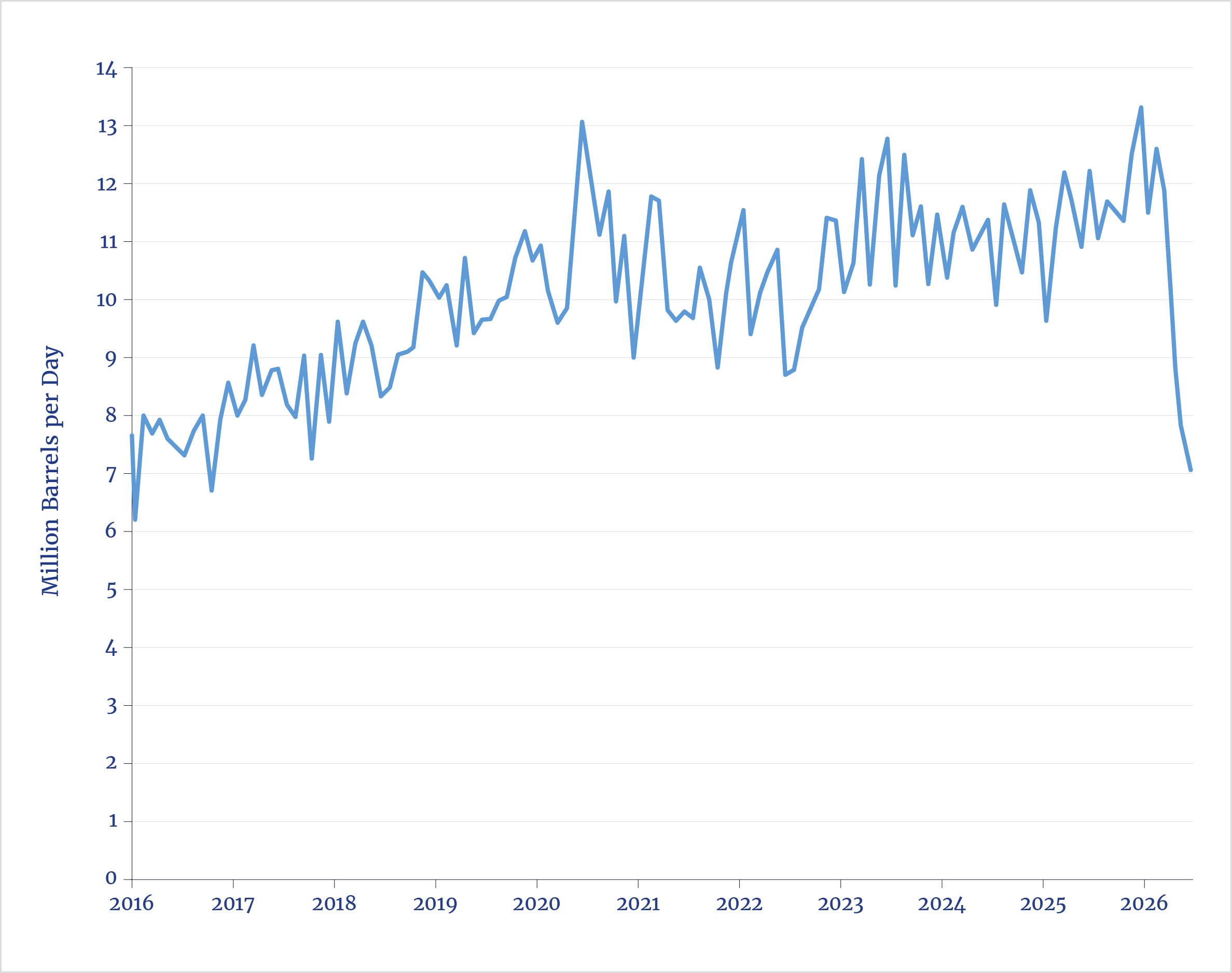
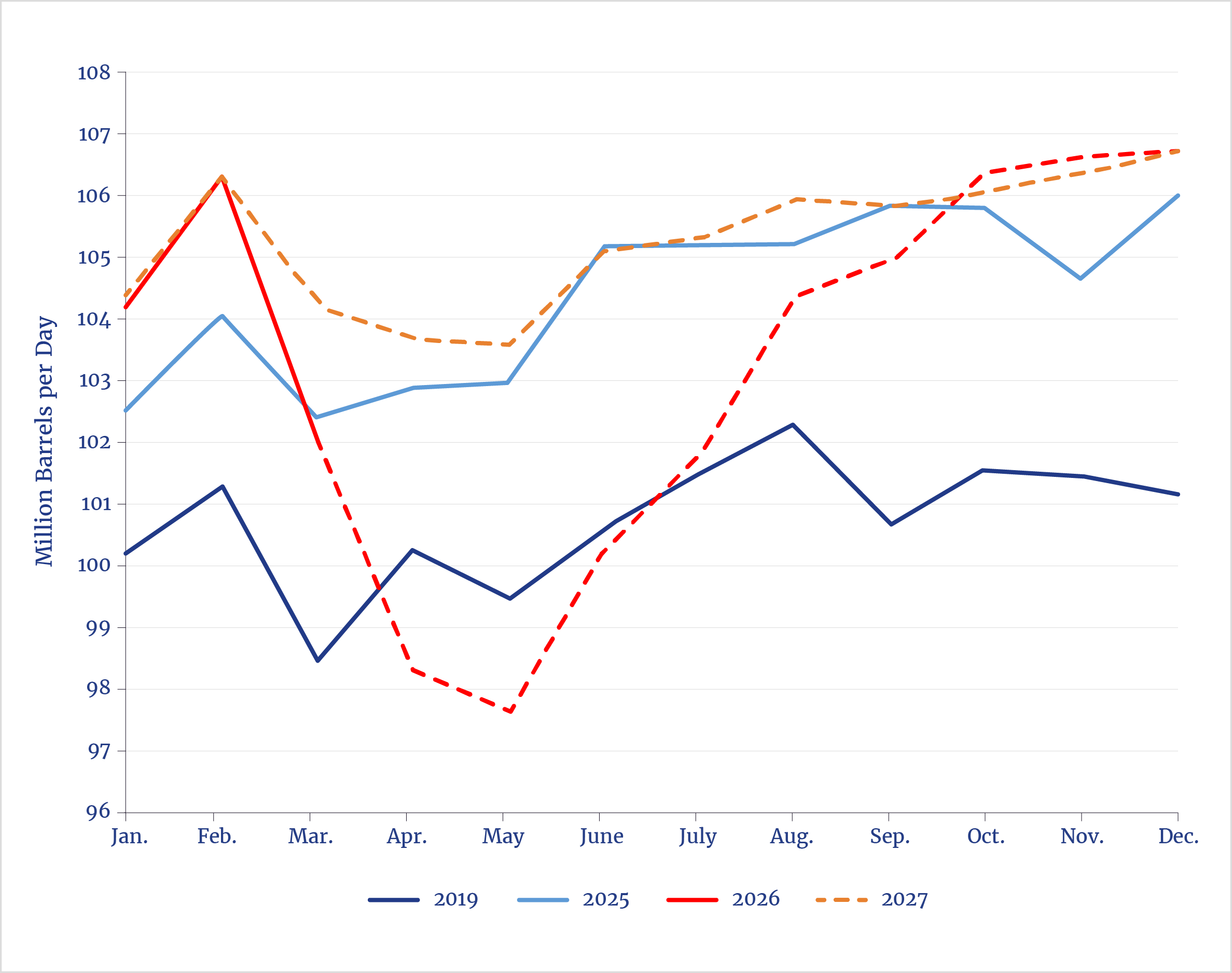
In the wake of the closures, China has become the unanticipated swing consumer, cutting its oil imports sharply (see figure 2). The EIA estimated that China’s oil imports fell by nearly 4 million barrels a day, or 32%, in the second quarter of 2026.18 China reversed builds to its 1.3-billion-barrel strategic reserve and likely drew from it, slowed refined exports to its neighbors, and retooled petrochemical refineries with other feedstocks such as coal.19 How, when, and to what extent the country restores these imports will affect the postcrisis trajectory of oil markets. Chinese oil demand grew in early September, drawing close attention from oil markets.20 Worldwide, the IEA forecast a 2.5 mb/d decline in oil demand for 2026 (see figure 3); the report attributed the largest losses to weaker demand for middle distillates and petrochemical feedstocks, especially in Asia.21
Figure 2. China Crude Oil Imports: 2016–June 2026
Source: Adapted from Jimmy Troderman, “China’s Crude Oil Imports Fell in the Second Quarter,” Today in Energy, July 31, 2026.
Figure 3. Global Oil Demand, Actual and Forecast: Selected Years
Source: Adapted from International Energy Agency (IEA), Oil Market Report—June 2026 (IEA, 2026), 5.
In a creative workaround to the disruption of Persian Gulf oil exports, India pursued a mix of supply diversification and broader adaptability (see figure 4).22 It purchased Russian and Iranian crude oil on the spot market and bought liquefied petroleum gas (LPG) from the United States.23 Domestically, India mandated its refineries to maximize production of LPG, diverting feedstocks from more lucrative uses.24 The country also used soft and hard power to secure and escort shipments from the Persian Gulf,25 and it showed a willingness to absorb short-term losses to avoid formal rationing and contain retail fuel-price increases.26
Figure 4. India’s Crude Petroleum and Natural Gas Imports: June 2025 and June 2026
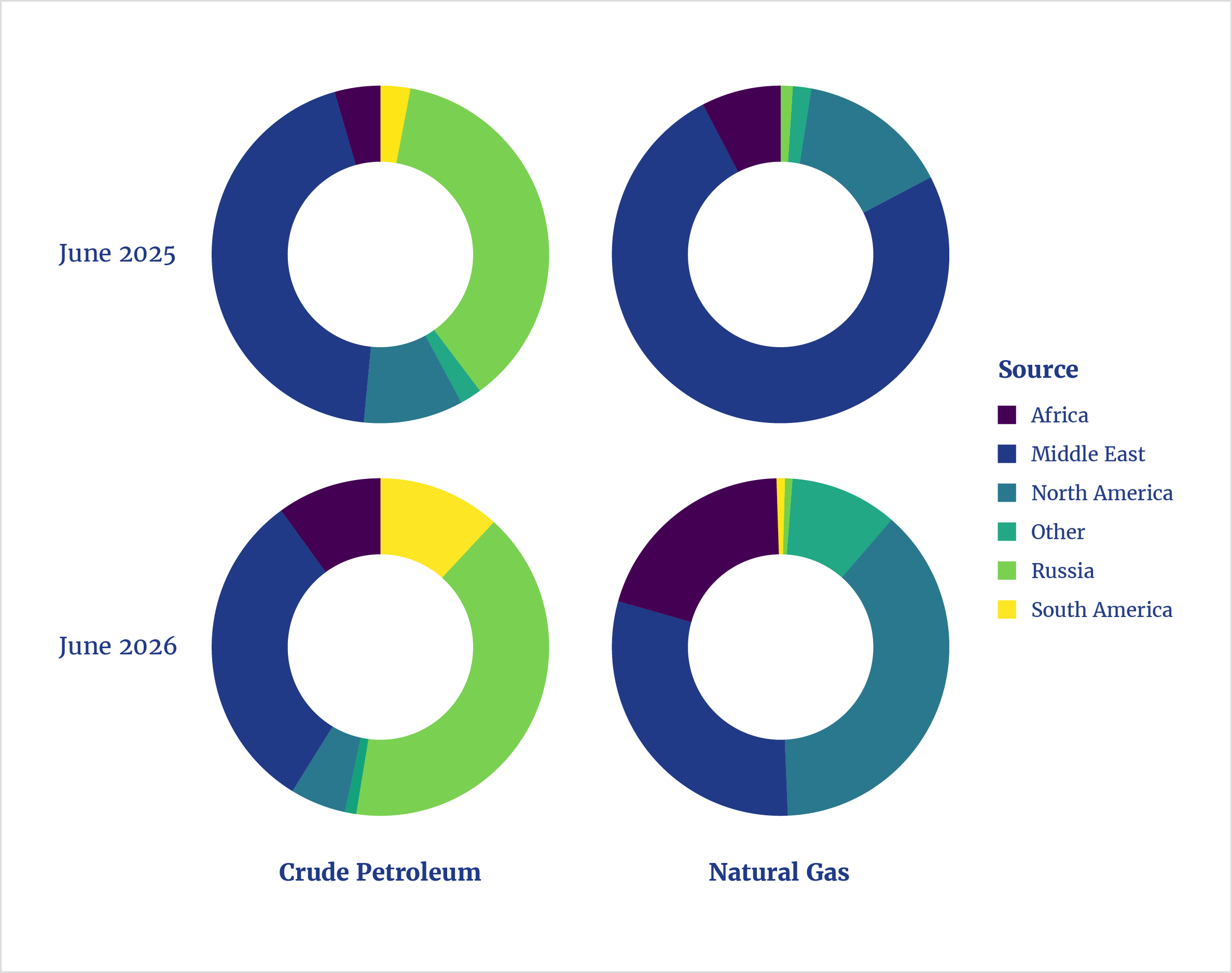
Note: Africa includes Egypt and the Maldives. Other comprises all countries not otherwise categorized.
Source: Data from “UN Comtrade Database,” accessed September 1, 2026, https://comtradeplus.un.org; compiled and analyzed by Parth Sarthi Bajaj.
In the United States, 2026 oil production will average a new record high of 13.8 mb/d, and crude oil exports surged 21% above the previous record set in December 2023.27 Guyana announced new discoveries; a fifth floating production, storage, and offloading ship is on the way, which will put its production over 1 mb/d this year.28 Venezuela is also now producing over 1 mb/d, while Canada’s heavy crude, Brazil’s pre-salt, and Argentina’s fracked onshore Vaca Muerta production all reached records.29
In natural gas, the EIA forecasts yet another record quarter of U.S. LNG exports, with third-quarter estimates at 16.5 billion cubic feet per day. U.S. pipeline gas exports will reach a record 9.6 billion cubic feet per day in 2026. New LNG facilities in Mexico reexport some of this pipeline gas to global markets, thereby reinforcing the U.S. role as the world’s largest natural gas exporter.30
Perspective
The oil embargoes of the 1970s taught OPEC producers—minus Iran—a lesson the group has largely remembered: Producing countries brought on new supplies in the North Sea, enacted oil-substitution and energy-efficiency policies, and invested in strategic oil reserves and redundant infrastructure. This year’s largely unanticipated Hormuz shut-ins are accelerating new investments in alternative pipeline networks and making the Western Hemisphere the place to invest the marginal petrodollar—not the yuan. The Western Hemisphere now produces 40% of the world’s oil.31 Bloomberg’s Javier Blas has described this post-conflict world as “a new land of oil—all within close reach of Washington.”32 More broadly, new U.S.-aligned administrations in Argentina, Bolivia, Chile, Colombia, Ecuador, and Peru are also strengthening natural resource cooperation, including on critical minerals.33
The capacity of the SPR, down from 415 million barrels in February 2026 to 285 million in September 2026, is admittedly under pressure (see figure 5), yet the exchanges will accrue repayments in bonus oil.34 It is now time to begin the long-overdue debate over appropriating funds to rebuild the SPR to its full capacity of 727 million barrels35—a debate that might offer a rare opportunity for bipartisanship in Congress. China’s role as swing importer does give it some market power, as recent events demonstrate. But China has wielded that power unreliably: It suspended fuel exports just when the market needed supply, withheld important data on reserve levels and releases just when the market needed this information, and dumped subsidized electric vehicles on Europe in a distortion of trade.36 In contrast, the United States demonstrated that it is a reliable swing producer of much of the world’s incremental oil and natural gas, exporting both in record quantities without restrictions—even while drawing down its strategic reserve. This is what reliable energy partners do. The White House also sought to assure markets dozens of times—a widely debated but ultimately effective gambit of jawboning that calmed prices almost as effectively as the SPR draw itself.37 The days of quiet oil diplomacy are surely over.
Figure 5. U.S. Strategic Petroleum Reserve Crude Oil Stocks: 2010–26
.png)
Source: Adapted from “Weekly U.S. Ending Stocks of Crude Oil in SPR,” Petroleum & Other Liquids, U.S. Energy Information Administration, accessed September 1, 2026, https://www.eia.gov/dnav/pet/hist/LeafHandler.ashx?n=PET&s=WCSSTUS1&f=W.
The road ahead will require some reflection among the energy-forecasting community, which has been reminded that the oil markets are not easily predicted. The future will also bring new pipeline investments, new mechanisms to hedge natural gas, new producers, and, likely, new energy technologies—all of which will make dependence on energy from any single source the exception and not the rule. The best that Iran can hope for is a bigger share of a shrinking market. The United States will emerge as the proven swing supplier of first and last resort, with its new hemispheric partnerships shattering OPEC’s already-weakening grip on the global economy.
- Lim Hui Jie, “Iran’s Parliament Backs Blocking Strait of Hormuz. Its Closure Will Alienate Tehran Further,” NBC News, June 23, 2025.
- International Energy Agency (IEA), “IEA Closely Monitoring Strait of Hormuz Situation, Stands Ready to Act if Needed,” news release, July 22, 2019.
- Tsvetana Paraskova, “Six More Weeks of Choked Hormuz Supply Could Send Oil to $200,” OilPrice.com, March 31, 2026.
- Reuters, “U.S. Will Either Reform IEA on Climate Issues or Leave the Group, Energy Secretary Says,” Reuters, September 23, 2026.
- Matthew McManus, “Kissinger Helped Create the World’s Oil Reserves,” Opinion, The Wall Street Journal, March 18, 2026.
- IEA, “IEA Member Countries to Carry Out Largest Ever Oil Stock Release amid Market Disruptions from Middle East Conflict,” press release, March 11, 2026; and U.S. Department of Energy (DOE), “United States to Release 172 Million Barrels of Oil from the Strategic Petroleum Reserve,” press release, March 11, 2026.
- IEA, “Strait of Hormuz Factsheet,” updated February 2026, at “Alternative Export Routes,” https://www.iea.org/about/oil-security-and-emergency-response/strait-of-hormuz.
- For the September 2026 strike, see Kylie Atwood et al., “Saudi Oil Pipeline Shut Down After Attack Triggers Fires,” CNN, September 11, 2026; updated September 12, 2026.
- IEA, Oil Market Report—March 2026 (IEA, 2026), 5; and Tori Bosoni, “As Oil Market Surplus Keeps Rising, Something’s Got to Give,” IEA, October 17, 2025.
- Cherylann Mollan, “U.S. Eases Sanctions on Russian Oil Sales to India During Iran Conflict,” BBC News, March 6, 2026.
- NDTV Business Desk, “Trump Says Oil-Loaded Ships Moving Out of Hormuz, ‘Southern Highway of Strait Totally Safe’,” NDTV Profit News, June 15, 2026; and Austin Ramzy and Rebecca Feng, “One Megabuyer—China—Finds a Way to Get Mideast Oil,” The Wall Street Journal, July 28, 2026.
- Tala Michel Issa, “From Insurance Policy to Trade Powerhouse: How Fujairah Is Reshaping UAE Commerce,” Arabian Business, August 5, 2026.
- Yousef Saba and Ahmad Ghaddar, “New UAE Pipeline Bypassing Hormuz Now 50% Complete, ADNOC CEO Says,” Reuters, August 26, 2026, republished by gCaptain.
- Joseph Wilkins, “Iraq and UAE Race to Establish Alternative Oil Pipelines as Exports Through Hormuz Dry Up,” CNBC, June 9, 2026.
- “Global Energy Security Data,” Short-Term Energy Outlook, U.S. Energy Information Administration (EIA), released August 12, 2026, https://www.eia.gov/outlooks/steo/report/energysecurity/article.php. The authors’ calculation used data from table 4.
- Neville Teller, “Trump’s Syria–Iraq Pipeline Plan Aims to Weaken Iran’s Leverage,” Jerusalem Post, August 4, 2026.
- MI News Network, “QatarEnergy’s Largest Investment in the U.S. Marks Historic Milestone with First LNG Production,” Marine Insight, April 2, 2026; and Maha El Dahan et al., “Iran Attack Wipes Out 17% of Qatar’s LNG Capacity for Up to Five Years, QatarEnergy CEO Says,” Reuters, March 19, 2026, republished by CNBC.
- Jimmy Troderman, “China’s Crude Oil Imports Fell in the Second Quarter,” Today in Energy, July 31, 2026.
- Dannie Peng, “China Is Replacing Middle East Oil with Xinjiang Coal. What Does It Mean for the World?,” South China Morning Post, May 22, 2026.
- Bloomberg News, “China’s Oil Imports Strengthen as Refiners Diversify Supply,” Bloomberg, September 7, 2026.
- “Highlights,” Oil Market Report—September 2026, IEA, published September 11, 2026, https://www.iea.org/reports/oil-market-report-september-2026.
- Sudhi Ranjan Sen and Mihir Mishra, “India Prepares to Send Oil Tankers Through Hormuz for New Supply,” Bloomberg, May 20, 2026.
- Sambit Mohanty and Ratnajyoti Dutta, “India Banks on Diversification, Diplomacy to Counter Oil Market Volatility,” S&P Global, August 12, 2026; and Felicity Bradstock, “The Hormuz Crisis Has Forced India to Rethink Its Energy Strategy,” OilPrice.com, June 21, 2026.
- Rakesh Sharma and Rajesh Roy, “India Readies LPG Output Boost as Hormuz Uncertainty Lingers,” Bloomberg, August 16, 2026.
- Mihir Mishra et al., “India Seeks Safe Hormuz Passage for Nine Ships as Truce Falters,” Bloomberg, July 8, 2026; and Sudhi Ranjan Sen, “India Sends Warships Near Gulf of Oman to Escort Its Fuel Ships,” Bloomberg, March 18, 2026.
- Asmatwali, “Energy Security Shock: India’s Response to the Strait of Hormuz Crisis,” Impact and Policy Research Institute, August 10, 2026.
- Jimmy Troderman, “U.S. Exports of Crude Oil and Petroleum Products Reached Record in April,” Today in Energy, July 8, 2026; and Trinity Manning-Pickett, “United States on Track for Record Crude Oil Production in 2026,” Today in Energy, September 10, 2026.
- Staff Reporter, “Guyana’s Fifth FPSO to Push Oil Output Beyond 1 Million Barrels per Day,” Guyana Chronicle, August 19, 2026.
- “Petroleum & Other Liquids,” International Data, EIA, accessed September 16, 2026, https://www.eia.gov/international/data/world/petroleum-and-other-liquids/monthly-petroleum-and-other-liquids-production; “Crude Oil,” Canadian Centre for Energy Information, Government of Canada, last modified September 16, 2026, https://energy-information.canada.ca/en/subjects/crude-oil; Matthew Smith, “Brazil’s Record Oil Production Comes at a Crucial Moment for Global Markets,” OilPrice.com, May 18, 2026; and Matthew Smith, “Argentina’s Oil Production Soars as Vaca Muerta Breaks New Records,”OilPrice.com, July 26, 2026.
- “Short-Term Energy Outlook,” Analysis & Projections, EIA, released August 11, 2026, https://www.eia.gov/outlooks/steo.
- IEA, Oil Market Report—May 2026 (IEA, 2026), 20.
- Javier Blas, “The Americas’ Challenge to Middle East Oil Won’t Let Up,” Opinion, Bloomberg, August 17, 2026.
- See Evan Ellis, “Latin American Outlook 2026,” The Policy Spotlight (blog), December 22, 2025.
- DOE, “United States to Release 172 Million Barrels”; “U.S. Ending Stocks SPR of Crude Oil and Petroleum Products (Thousand Barrels),” Petroleum & Other Liquids, EIA, released August 31, 2026, https://www.eia.gov/dnav/pet/hist/LeafHandler.ashx?n=pet&s=m_ep00_sas_nus_mbbl&f=m; “Strategic Petroleum Reserve Inventory,” DOE, updated September 18, 2026, https://www.spr.doe.gov/dir/dir.html; and “What Are Exchanges of Oil? How Does an Exchange Differ from a Sale?,” SPR FAQs, Office of Petroleum Reserves, DOE, accessed September 24, 2026, https://www.energy.gov/hgeo/opr/spr-faqs#Q2.
- “Inventory,” SPR Quick Facts, Office of Petroleum Reserves, DOE, accessed September 24, 2026, https://www.energy.gov/hgeo/opr/spr-quick-facts.
- Trixie Yap et al., “China Urges Refiners to Suspend Fuel Exports amid Mideast War, Sources Say,” Reuters, March 5, 2026; “Global Energy Security Data”; and Associated Press, “The European Union Moves to Hike Tariffs on Chinese Electric Car Imports, Escalating Trade Spat,” AP News, June 12, 2024.
- Javier Blas, “Trump Is Winning the Oil-Price Jawboning Battle,” Opinion, Bloomberg, March 25, 2026, republished by The Brunswick News.
About the author
Continue Reading
-2%20(10).png)
-2%20(9).png)
-2%20(8).png)
Regional Transmission Organizations: Problem or Solution?
The bulk power system—an interconnected network of generating plants and high-voltage transmission lines—is an often-overlooked part of the electric industry.
-2%20(7).png)