
Energy Investment and the Iran War
-2%20(9).png)
The battle over the Strait of Hormuz has caused massive disruptions to the global economy, mainly in the energy sector.
Listen
The Issue
The battle over the Strait of Hormuz has caused massive disruptions to the global economy, mainly in the energy sector.
Numerous reports suggest that more than 80 Middle Eastern energy facilities, including refineries, petrochemical plants, production sites, and liquefaction units, have been damaged, with the impact particularly severe at Qatar’s Ras Laffan liquefied natural gas (LNG) complex.1 In addition, more than 25 tankers have been damaged.2 The cost of repairs is hard to estimate, but it will certainly be tens of billions of dollars.3 As a consequence of the disruption, exporters are using and expanding routes that reduce dependence on the strait. At the same time, importers are reassessing exposure to current and future disruptions to the supply chain chokepoint.
Where will investments now flow—and at what scales—to expand the production of oil and natural gas? The International Energy Agency’s (IEA) World Energy Investment 2026 provides a useful starting point for answering this critical question.4
The Reality
While the IEA’s report is understandably provisional because of the war’s uncertain outcome, it contains useful data that show how energy investment has been allocated among the various sectors as well as between fossil fuels and renewables.
The report estimates that total global energy investment in 2026 will be $3.4 trillion, up about 5% over 2025, with renewables, nuclear, grids, and energy efficiency accounting for two-thirds of the total.
The IEA expects that fossil fuel investment will be just over $1 trillion in 2026, close to the 2024 level after a fall in 2025. Oil and gas upstream spending fell in 2024 and 2025, but it has increased modestly in 2026, even though higher oil prices have boosted producer revenues. Upstream investment in the Middle East will decline overall in 2026 as investments in growth are offset by the cost of repairs to damaged infrastructure. A sudden and definitive achievement of peace could, of course, see this last assessment amended. Regardless, producers without alternatives to Hormuz have been hit especially hard.
Globally, natural gas is the main source of growth in fossil fuel investment. Spending will rise by more than 10%, to about $330 billion—the highest level in a decade. More than 100 billion cubic meters of new LNG export capacity was approved in 2025, nearly 90% of it in the United States. The downside is that the Iran war and the damage to Qatar’s LNG facilities have delayed the expected easing of LNG markets and damaged Qatar’s reputation among customers. Qatar was the world’s second-largest exporter in 2025, behind the United States;5 82% of Qatar’s exports are to Asia, with China and India the biggest buyers.6
Despite the IEA’s regular forecasts of coal’s demise, the agency now sees investment rising again, driven by China. Global investment in 2026 is likely to be $180 billion—the highest since 2012—with China contributing nearly 70% of the total. For understandable reasons of security, the Iran war is likely to encourage Asian countries to run coal plants for longer than planned.
This year, the IEA restated its regular message from recent investment reports: The world is moving toward what the IEA calls an age of electricity.7 The emphasis has hitherto been on investments in generation capacity, with grid investments and battery storage lagging behind. Grid investments have lagged partly because of permitting issues, which plague projects almost everywhere, and partly because of slow improvements to battery technology.
The IEA notes a welcome rebalancing of electricity investment toward grids and storage. Global network investment is expected to reach $550 billion in 2026, up nearly 20% since 2025, while battery storage investment for the power sector is expected to exceed $100 billion. The IEA points out, however, that the increases are not all positive. Higher costs for transformers, cables, and other grid components are due to tight supply chains.
The Iran War Has Upended Trade in Energy and Other Products
Economic damage resulting from the Iran war is regularly reassessed. On June 3, 2026, the Organisation for Economic Co-operation and Development projected that global gross domestic product (GDP) growth would decline from 3.4% in 2025 to 2.8% in 2026 before recovering to 3.1% in 2027.8 While this might appear benign, given the circumstances, the organization also warned that the energy disruptions could last well into 2027, in which case global GDP growth would be 2.1% in 2026 and 1.8% in 2027.
The organization is right to point out that most of the focus on disruptions caused by the war has been on energy supplies, mainly oil and gas. By now, it is well known that approximately 20% of global oil supply normally passes through the Strait of Hormuz, as does approximately the same share of global LNG flows, mainly from Qatar.9
Less well known but also very important is that 24% of seaborne flows of ammonia pass through the strait, as do roughly a third each of urea and finished fertilizers. Data show that the Persian Gulf region supplies Brazil and Australia with 45% and 72%, respectively, of their urea, India with 80% of its ammonia, and the United States with 20% of its phosphate fertilizers.10
Oil Prices Have Been More Subdued Than Expected
Contrary to the consensus view of energy analysts when the war started, oil prices did not reach the record heights, in cash terms, that were anticipated.11 The Dated Brent price of physical barrels reached $144 per barrel in April,12 as buyers bid up prices for prompt barrels, before settling back down.
Traders took the view that the consequences of the war were so serious that the fighting could not be allowed to last. The United States would achieve a quick military victory, or there would be a negotiated peace.13 Oil supplies would then return to normal, and prices would fall. The Brent futures curve reflected this view (see figure 1). However, despite successive ceasefires and peace agreements of various durations, there has been no victory.
Figure 1. Brent Futures Curve: 2026–28
.png)
Source: Adapted from “Brent Last Day Financial Futures—Quotes,” CME Group, last updated September 4, 2026, https://www.cmegroup.com/markets/energy/crude-oil/brent-crude-oil-last-day.quotes.html.
For Countries Dealing with Damages, Time Is Money
When hostilities end, countries whose energy infrastructures were damaged or forced to close because of the war will want to restore normal operations as soon as possible.14 The impact of the war has been immense; in 2025, flows of crude oil and condensate from countries inside the Strait of Hormuz averaged 15.6 million barrels per day (mb/d), and these countries shipped an additional 2.6 mb/d from outside the strait.15 At the end of July 2026, the combined shipments were about 6.5 mb/d.16
Countries that have been unable to supply customers will want to resume operations as soon as possible, for two reasons. First, these countries need the export revenues; second, they are wary of losing market share to other exporters that were unaffected by the crisis (e.g., the United States) and possibly to nonfossil forms of energy. There is an additional complicating factor: The United Arab Emirates announced its departure from the Organization of Petroleum Exporting Countries in April and is no longer bound by any collective action that the alliance undertakes to manage an orderly return to normal levels of production. The country can now fight for market share against its former colleagues.17
Have Electric Vehicle Sales Received a Sustainable Boost from Higher Oil Prices?
Since the Iran war started, considerable attention has been given to reports of dramatic increases in sales of electric vehicles (EVs) in many countries. According to the IEA’s Global EV Outlook 2026, there were signs of strong growth in many markets even before the war started18—and the IEA repeated this fact in World Energy Investment 2026. Sales in developing countries were particularly strong, albeit from a low base. Southeast Asian nations saw sales more than double in 2025 to half a million EVs, nearly 20% of new vehicle sales. Some countries, including Vietnam, extended or expanded EV tax incentives as part of their crisis response. Thanks to European Union regulations, battery EV registrations took a 21% share of the European market in the first half of 2026, with strong performance also for hybrids; the combined share of gasoline and diesel vehicles was only 30%, down drastically from 38% in the first half of 2025.19
These figures are impressive, but buyers considering an EV may have accelerated their purchase in response to increases in fuel prices rather than something more fundamental. In the United Kingdom, for example, gasoline prices were $6.71 per gallon just before the war started, and in mid-April, they peaked at $8.34 per gallon before declining. The corresponding prices of diesel, which fuels nearly 30% of U.K. cars, were $7.22 per gallon and $9.83 per gallon.20 Therefore, it is not surprising that EV sales had a growth spurt, and growth might decline in 2026 and into 2027.
In the trucking sector, there are signs that the market share of electric trucks is rising, albeit from a very low base. In Global EV Outlook 2026, the IEA reported:
Electric truck sales more than doubled in 2025 compared with 2024, reaching 9% of all truck sales worldwide. The vast majority of this growth came from China, where sales doubled for the second consecutive year in 2025; one in four trucks sold in China was electric. Electric truck sales also grew in Europe and North America, albeit at a much lower level. Electric trucks remain two to three times more expensive to purchase than diesel trucks, but the total cost of ownership . . . is already competitive in China thanks to falling battery prices and is coming down in other markets.21
It appears that EV sales are growing rapidly in developing countries where government support may encourage more buyers to move directly from having no car to purchasing an EV. This will reanimate the debate over the timeline of when global gasoline demand will peak.
Can the Energy Transition Speed Up? The IEA Warns That Critical Minerals Are Key
One obvious impact of the disruption to global oil and gas markets has been a resurgence of proposals from policymakers and analysts to accelerate the global energy transition, something that has been occurring at what can only be called a sclerotic pace. But such proposals must acknowledge that fossil fuels remain dominant in the global energy balance and are hard to replace at the scale needed. As recent data show, the share of fossil fuels in total global energy supply was 86.2% in 2025, marginally down from 86.6% in 2024.22 Sensible policymaking must start by recognizing that fossil fuels are and will remain essential to the global energy system.23
The IEA’s 2026 investment report is clear that a key barrier to the energy transition is the supply of critical minerals. In 2025, after several years of rapid growth, capital spending by large mining companies fell by about 9%. Battery metals were hardest hit: Lithium investment fell by roughly 40%, and lithium and nickel exploration also declined sharply. Copper was the exception, with investment rising about 8%, reflecting its broad role in electrification, regardless of the source of primary energy.24 The IEA’s report stresses the geopolitical concentration of critical minerals and, thus, the risks to supply chains at the refining and processing stages. China has an average refining market share above 70% for 19 of 20 prominent strategic energy minerals, including copper, lithium, cobalt, graphite, and rare earths. Diversifying supply is strategically important, but projects outside incumbent regions face higher costs, financing difficulties, price volatility, and uncertainty over long-term offtake.
Adapting to the Iran War: Temporary Measures Might Become Permanent
Although the current crisis is usually framed as global, Asian countries have been more directly affected by actual shortages. The United States, unaffected by shortages, has increased its oil exports to record levels. European consumers have not experienced significant shortages despite initial fears that, for example, jet fuel might be in short supply.25
Japan was hit hard by the war but has been able to adapt. Before the war, it imported 2.8 mb/d, of which 1.6 mb/d came from Saudi Arabia and further supplies from the United Arab Emirates, Kuwait, and Qatar; as a whole, the Middle East supplied roughly 95% of Japan’s crude imports. By April, supplies from the region had fallen to only about 800,000 barrels per day. Shipments from the United States climbed rapidly over the following months, reaching nearly 900,000 barrels per day by July and making up more than one-third of Japan’s crude imports, a far larger share than the roughly 5% that the United States represented before the war.26
Pakistan Provides an Example of a Transition Spurred by Geopolitical Uncertainty
In the short term, oil and gas users cannot significantly improve security by pursuing alternative energy. However, some countries have taken aggressive steps to achieve just that. Pakistan has reacted decisively to the energy crisis unleashed by Russia’s invasion of Ukraine in 2022 and to the outbreak of the Iran war.27 Starting in 2022, it imported a huge quantity of Chinese solar panels—50 gigawatts’ (GW) of capacity—in three years, and it increased domestic natural gas production to such an extent that 21 LNG cargoes scheduled for delivery in 2026 and 2027 were canceled.28 In 2022, Europe and other buyers scrambled to find alternatives to sanctioned Russian gas supplies, and this saw Pakistan edged out of the LNG market as richer buyers outbid it.29 In time, countries that are highly dependent on the Middle East for oil and gas imports will likely diversify their sources of supply when economically feasible.
As in Pakistan, purchases of low-cost Chinese solar panels and electric vehicles in other developing countries could moderate growth in oil and natural gas demand. Progress, however, is unlikely to accelerate with the hoped-for renaissance of nuclear power. While the IEA is quite bullish on nuclear, it reported that 78 GW of new capacity are under construction in 15 countries at a cost of $80 billion, of which China accounts for nearly 80%.30 If these plans come to fruition, by 2035 global nuclear generation capacity is projected to increase by at least one-third.31
Energy Security Returns to the Forefront of the IEA’s Work
Since the world will remain dependent on fossil fuels for many decades, the key issue is the timing and extent to which production capacity is restored in the Middle East and the degree to which importing nations, in the meantime, look for ways to reduce their reliance on the Strait of Hormuz. The IEA stated that “the way that global oil and gas supply—and large parts of the global economy—can be disrupted by blocking a 50-[kilometer-]wide waterway will not be quickly forgotten.”32
On July 9, IEA Executive Director Fatih Birol urged the European Union to revisit its moratorium on drilling for oil and gas in the Arctic on the grounds that supplies from this region could be important for European energy security.33 In light of the great Hormuz disruption, how the IEA calibrates its energy scenarios and forecasts in its forthcoming World Energy Outlook 2026 will be interesting.
This was a striking shift in viewpoint because, until recently, the IEA advocated vigorously for energy investments that would decrease greenhouse gas emissions while placing far less emphasis on security. Indeed, in 2021 the IEA began publishing and advocating for scenarios proposing no investment in new oil and gas projects in pursuit of the controversial net-zero emissions path.34
Reality has a history of intervening, and only four years later, the IEA’s World Energy Outlook 2025 stated that policies directed at the net-zero scenario were “stretching feasibility to its limits.”35
Upstream Oil and Gas Investment Has Been Low for Many Years
It is already clear that damage to energy infrastructure in the Middle East will cost billions of dollars to repair, as will investments aimed at expanding or building new infrastructure to avoid supplies that pass through the Strait of Hormuz.
It is also now clear that investment in the oil and gas industries will be substantially higher than levels seen in recent years. This has yet to be reflected in the IEA’s forecasts.
The IEA estimate for 2026 shows global oil and gas investment at $546 billion,36 which is only 64% of the 2015 level and well below the pre–COVID-19 level (see figure 2).
Figure 2. Oil and Gas Upstream Expenditure
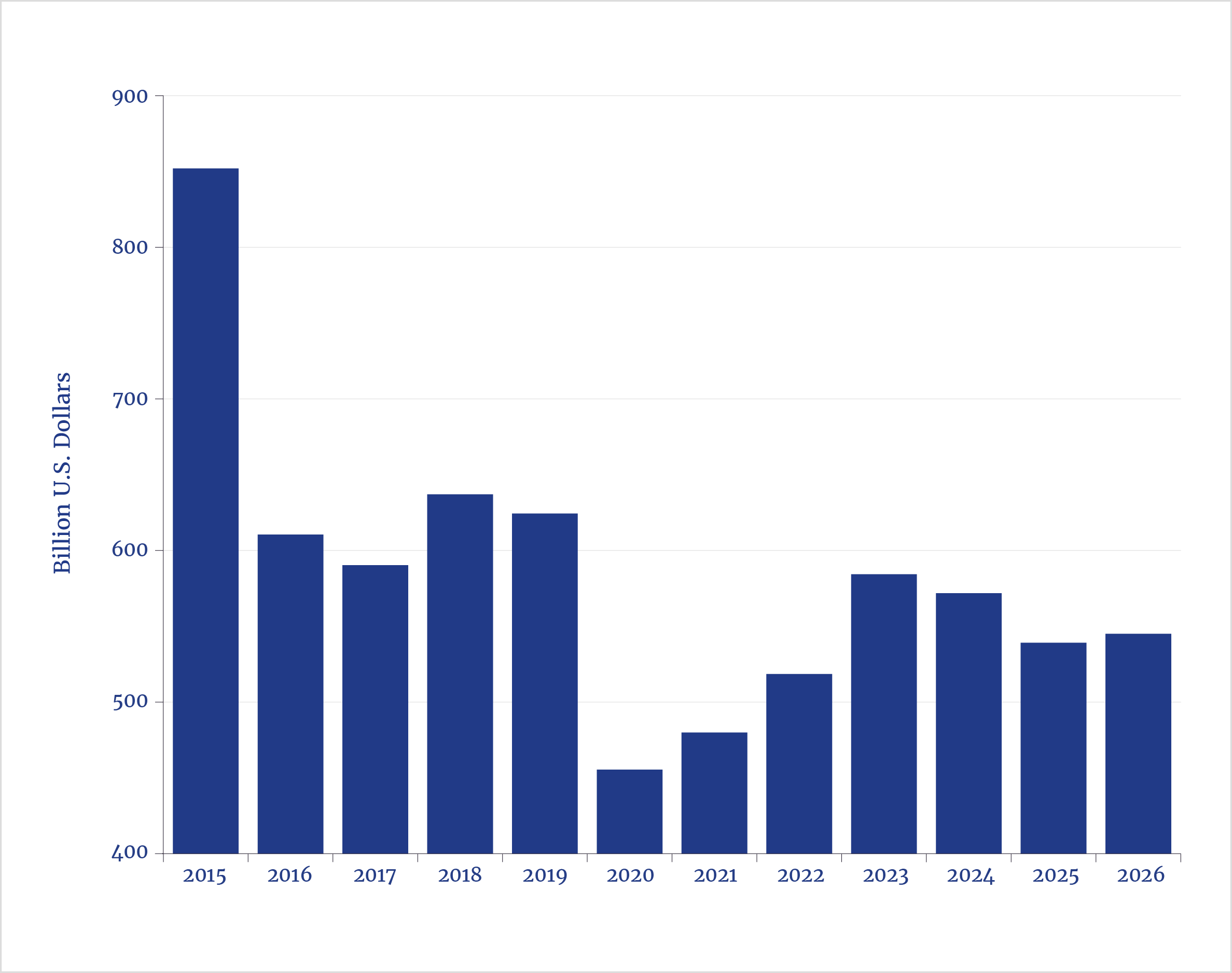
Source: Based on data from International Energy Agency (IEA), World Energy Investment 2026 (IEA, 2026).
Some portion of the reduced capital needs has come from technology improvements and capital efficiency, notably in the shale oil sector in the United States. Most companies have focused on maximizing output from existing assets rather than embarking on new large-scale projects. Investment responses are also constrained by long project cycles and tight offshore rig markets. Future price expectations are always an important factor driving investment, and there is ongoing uncertainty over whether higher prices will persist. In addition, the international oil industry has lacked access to many significant countries where investments might otherwise have occurred, including Iran itself, Russia, and, until recently, Venezuela.
Geopolitical uncertainty will doubtless prop up prices to a significant degree, but the extent is hard to forecast. Add to this the fact that strategic oil stocks will need to be replenished at scales that will also support prices. In March 2026, IEA member countries agreed to offer the market more than 400 million barrels of emergency stocks. In late July, just under 300 million barrels were thought to have been dispersed.37 In addition, China has drastically reduced its imports from the Middle East, from over 5 mb/d before the war to a 14-year low of only 1.42 mb/d in June 2026. More recently, they have recovered to 2.71 mb/d. As imports fell to low levels, China used its strategic stockpile to maintain industry operations. On the eve of the war, the stockpile was thought to have been at least 1.2 billion barrels.38 Following China’s example, there are now reports that several countries plan to either create strategic stocks or expand existing ones. Examples include India and South Africa.39
Middle East Producers Hit by War Face a Big Challenge
Saudi Arabia and the United Arab Emirates have partially offset their dependencies on the Strait of Hormuz by diverting volumes to Yanbu on the Red Sea Coast and Fujairah off the Gulf of Oman, respectively. For Middle East oil shipments as a whole, 18.2 mb/d left the Persian Gulf in 2025, of which 15.6 mb/d came from inside the strait. From the start of the war to the signing of the memorandum of understanding in June, only 3.9 mb/d came from inside the strait; at times, volumes were far lower. The signing of the memorandum was followed by a surge in shipments that averaged 6.5 mb/d until July 23. Shipments have since declined again.40
For leading producers elsewhere, 2026 has seen a bonanza in pricing. Before the war started at the end of February, several producers were forecast to increase output collectively by more than 1 mb/d, with further growth anticipated in 2027.41 These producers have expanded production and exports and increased revenues. Among them, the United States has led the way with higher production. Of even greater importance, its exports of crude oil and refined oil products reached an all-time high of 13.6 mb/d at the end of May and have maintained a steady average to date of about 11.8 mb/d.42 Whatever the benefits that U.S. producers and exporters might gain from higher prices, their ability to increase shipments to global markets has been a crucial component in offsetting the loss of barrels from the Strait of Hormuz.
Perspective
Recent events have demonstrated that fossil fuels remain central to global energy systems. The IEA has maintained that the shift to an age of electricity is not only a response to climate change but also a key energy security tool.43 The agency claimed that cumulative investments in renewables and efficiency from 2015 to 2024 have resulted in $260 billion in savings on fossil fuel import costs in 2025.44 Prior to the outbreak of the Iran war in 2026, there was thought to be less need to maintain expensive strategic and commercial stocks of fossil fuels. Policymakers, however, are rethinking this notion.
The IEA’s view of the Iran war is that it is a historic moment but that the world will not simply try to move away from fossil fuels as quickly and extensively as possible. Indeed, projects designed to bypass existing trade routes used for oil and natural gas will see investment increase significantly. In addition, some importing countries will expand strategic stocks, and some producing countries will seek to expand their foreign energy investments to offset any future disruptions in the Middle East.45
It is inevitable that investments in nonfossil energy will rise to offset the need for imports from the Middle East. But as the IEA pointed out, such investments in what might be viewed as a form of spare capacity are an expensive approach to energy security, not least because dependence on oil and gas will remain for decades.
As NCEA has stated,46 fossil fuels remain central to the global energy system. The Iran war has reinforced this fact and highlighted the need to expand, not shrink, fossil fuel investments to ensure future security.
- See, for example, Nuran Erkul, “34 Energy Facilities in Gulf Seriously Damaged, Head of IEA Says,” Anadolu Agency, April 21, 2026.
- “Middle East—Highlighted (Confirmed) Incidents,” International Maritime Organization, accessed August 28, 2026, https://www.imo.org/en/mediacentre/hottopics/pages/middle-east-highlighted-incidents.aspx.
- Karan Satwani and Audun Martinsen, “Gulf War Leaves $58 Billion Repair Bill and a Global Equipment Crunch,” Rystad Energy, April 14, 2026.
- International Energy Agency (IEA), World Energy Investment 2026 (IEA, 2026).
- “All About the Statistical Review of World Energy,” Energy Institute, accessed August 28, 2026, https://www.energyinst.org/statistical-review.
- International Group of Liquefied Natural Gas Importers (GIIGNL), GIIGNL Annual Report 2026 (GIIGNL, 2026).
- IEA, Electricity 2026: Analysis and Forecast to 2030 (IEA, 2026).
- Organisation for Economic Co-operation and Development (OECD), OECD Economic Outlook: Under Pressure (OECD, 2026).
- Candace Dunn and Justine Barden, “About One-Fifth of Global Liquefied Natural Gas Trade Flows Through the Strait of Hormuz,” Today in Energy, June 24, 2025.
- Michael Liebreich, “Liebreich: The Great Clean Energy Acceleration 2.0,” BloombergNEF, May 27, 2026.
- Sam Fraser, “After 6 Months of War, Why Aren’t Oil Prices Even Higher?,” Responsible Statecraft, August 25, 2026.
- Alex Longley, “Brent Oil Hits $144 a Barrel in Key Physical Market,” Bloomberg, April 7, 2026.
- See, for example, John Kemp (@JKempEnergy), “Oil prices still anticipate short war or early re-opening of the strait[.] Oil traders are still betting war between the United States and Iran will end relatively quickly—or that the United States will soon be in a position to enforce a re-opening of the Strait of Hormuz,” X, March 13, 2026, https://x.com/JKempEnergy/status/2032502234471137760.
- These countries include Iran, Iraq, Saudi Arabia, the United Arab Emirates, Kuwait, Oman, Bahrain, and Qatar.
- Piper Sandler, The Flowing Oil Data Digest, June 25, 2026, 3.
- Piper Sandler, The Flowing Oil Data Digest, July 20, 2026, 2.
- This author published an issue brief on the United Arab Emirates’ departure from the Organization of the Petroleum Exporting Countries (OPEC). See Neil Atkinson, After UAE Departure, What’s Next for OPEC? (National Center for Energy Analytics [NCEA], 2026).
- IEA, Global EV Outlook 2026 (IEA, 2026).
- European Automobile Manufacturers’ Association, “New Car Registrations: +5.7% in H1 2026; Battery-Electric 20.7% Market Share,” press release, July 23, 2026.
- “U.K. Fuel Price Index,” Petrol Prices, updated August 17, 2026, https://www.petrolprices.co.uk/fuel-price-index.php. NCEA converted the figures in this paragraph from liters to gallons.
- IEA, Global EV Outlook 2026, 13.
- Energy Institute, 2026 Statistical Review of World Energy, 75th ed. (Energy Institute, 2026).
- Neil Atkinson, The Return of Realism in Global Oil Forecasts: A Critique of the International Energy Agency’s World Energy Outlook 2025 (NCEA, 2026).
- IEA, Global Critical Minerals Outlook 2026 (IEA, 2026).
- Julian Kasapi, “No Jet Fuel Crisis, Commission Reassures While Continuing to Prepare for One,” EU Perspectives, April 20, 2026.
- “Trade Statistics of Japan,” Ministry of Finance Japan, accessed September 10, 2026, https://www.customs.go.jp/toukei/info/tsdl_e.htm.
- Alice Harrison, “The Hedge That Paid Off: How Pakistan’s Solar Boom Is Shielding It from the Hormuz Crisis,” Centre for Research on Energy and Clean Air, March 17, 2026.
- Muhammad Sheraz Aamir, The Many Dividends of Solar Rush in Pakistan (Renewables First, 2025).
- Rakesh Sharma, “Pakistan’s Power Crisis Exposes Reliance on LNG Imports,” Gas Outlook, November 8, 2022.
- IEA, World Energy Investment 2026, 8.
- IEA, World Energy Outlook 2025 (IEA, 2025), 21.
- IEA, World Energy Investment 2026, 12.
- See, for example, Nick Heubeck, “IEA Chief Urges EU to Reconsider Arctic Drilling Moratorium,” Bloomberg, July 10, 2026.
- IEA, Net Zero by 2050: A Roadmap for the Global Energy Sector (IEA, 2021).
- IEA, World Energy Outlook 2025, 38.
- IEA, World Energy Investment 2026, 32.
- Ashitha Shivaprasad, “IEA Says Substantial Emergency Oil Stocks Remain After Record Release,” Reuters, July 21, 2026.
- Clyde Russell, “China Surprises Oil Markets Again with a Return to Stockpiling in July,” Reuters, August 17, 2026.
- Joseph Cotterill, “India and South Africa Lead Push to Amass Emergency Fuel Stockpiles,” Financial Times, July 25, 2026.
- Piper Sandler, The Flowing Oil Data Digest, July 20, 2026, 2.
- IEA, Oil Market Report—January 2026 (IEA, 2026), 24. The group comprises the United States, Canada, Brazil, Argentina, Guyana, Norway, and Kazakhstan.
- “Weekly Imports & Exports (Thousand Barrels per Day),” Petroleum & Other Liquids, U.S. Energy Information Administration, released August 19, 2026, https://www.eia.gov/dnav/pet/pet_move_wkly_dc_NUS-Z00_mbblpd_w.htm.
- IEA, Electricity 2026.
- IEA, World Energy Investment 2026, 16.
- Giulia Petroni, “Saudi Aramco Weighs Expanding Storage Capacity After Iran War,” Wall Street Journal, June 18, 2026.
- Atkinson, Return of Realism in Global Oil Forecasts.
About the author
Continue Reading
-2%20(14).png)
-2%20(10).png)
-2%20(8).png)
Regional Transmission Organizations: Problem or Solution?
The bulk power system—an interconnected network of generating plants and high-voltage transmission lines—is an often-overlooked part of the electric industry.
-2%20(7).png)