
Reliability in the Crosshairs
-2%20(10).png)
On May 4, 2026, the nation’s reliability regulator, the North American Electric Reliability Corporation (NERC), issued a rare Level 3 Alert.
Listen
The Issue
On May 4, 2026, the nation’s reliability regulator, the North American Electric Reliability Corporation (NERC), issued a rare Level 3 Alert. NERC’s Level 3 Alert indicates the highest level of severity. The alert identifies the measures that NERC designates as Essential Actions and directs registered entities to carry them out, mitigating the risks that computational loads pose to the stable operation of the bulk power system.1 Known as the grid, the bulk power system is the interconnected network of facilities and control systems that generate and move electricity across regions. The May 2026 issuance is the latest in a series of actions that address a serious degradation in reliability. Although the alert focuses on sources of demand, it complements recent key findings about electric supply and resource adequacy. NERC noted earlier in the year that the overall resource adequacy of the North American Bulk Power System is worsening.2
Today’s situation emerged from decades of decisions that, collectively, have compromised reliability in more than half of the regions that constitute the nation’s electricity system.3 These regional grids have taken decades to engineer. System operators have taken reliability seriously, aligning the growth of load demand with the power generation and delivery equipment necessary to serve such demand.
Over recent decades, however, electric grid infrastructure—transmission, distribution, and generation resources—has not kept pace. Today’s resurgent demand for electricity, notably from data centers but also from reshoring industries, has compounded the problem.
During the same period, most utilities and other power suppliers have focused on dramatically expanding inherently intermittent wind and solar resources and have retired generation resources that could serve when operators called on them. The change in the generation mix and the resultant shortfall have upended the long-standing balance of supply and demand that ensured reliability.
Indeed, many have taken that balance for granted over the past century. Further, the load demands and their concentration have changed rapidly over the past two decades—significantly faster than the legacy system’s ability to react.
The Reality
Although prices always matter, the availability of electricity is critical for a vibrant and growing economy. Ensuring reliability across the bulk power system at the scale required to serve society is a complex engineering task, complicated by a heavy combination of federal and state regulatory oversight.
Reliability means that the entire supply chain must generate and deliver electricity continuously and instantaneously across entire regions for all users, regardless of their size or configuration, weather conditions, supply or delivery disruptions, and unexpected imbalances in supply or demand.
Physics and engineering provide the foundation for reliability. The nation’s electric grids have been described as one of the greatest engineering accomplishments in history.4 Reliable operations, however, require more than ensuring that supply constantly and instantaneously meets demand. Operators must also manage for contingencies, including single or multiple failures, while ensuring that all the elements of the grid (generators, transmission, and distribution) operate within certain critical bands of acceptable voltage, current, frequency, power, phase, and a vital technical feature called reactive supply. All of this is critical not only to keep lights on but also to avoid physical damage to the systems’ components.
The bulk power system is structured as a broadcast network that requires all generators to function in synchronism and all transmission lines to operate in parallel. This design minimizes the potential that an outage of any single element will lead to a catastrophic blackout. Operators designate a certain amount of generation reserves and, in some cases, of critical transmission flow paths to buffer short-term disruptions or sudden changes in demand. These operating reserves are referred to as spinning, supplemental, regulating, or contingency reserves.
With nearly 1,400 gigawatts (GW) of generation and hundreds of thousands of miles of high-voltage transmission lines in the United States,5 the regional controls for the various grid systems are largely conducted through highly sophisticated dispatch algorithms. These computations are based on network characteristics and something called rotational inertia, provided by the big generating machines that produce electricity from spinning turbine blades.
Grid stability requires that the transmission grid remains within design parameters and that there are sufficient operating reserves to effectively respond to various contingencies. All system operators use algorithms that include economic and reliability parameters, and many also set pricing for energy, capacity, and ancillary services that are essential for reliable grid operations.
A Brief History
Expansion of electric grids in the United States during the twentieth century focused on developing economies of scale through large central power stations—mostly coal, hydro, and then nuclear. Over time, various types of power pools formed to centrally monitor and dispatch the generation within defined areas and, via transmission lines, with adjacent power pools.
The first major reliability failure, in 1965, caused a significant blackout in the Northeast.6 This event led to the formation of a voluntary organization, the North American Electric Reliability Council (the predecessor of today’s NERC), to develop reliability standards. The grids subject to NERC’s purview were about 200 GW at the time.
Over the following decades, grids expanded—including the addition of natural gas plants to meet peak demand. Concerns about the escalating costs of new nuclear plants and emissions from coal-fired plants led to the development of electricity markets that were designed to address those challenges at the lowest possible cost.7
Alongside this growth, the grid suffered several significant regional failures, including blackouts. A major blackout in 2003, for example, affected parts of the mid-Atlantic, New England, and Midwestern regions of the United States, as well as areas of Canada. The 2003 blackout prompted Congress to amend the Federal Power Act in 2005 by empowering the Federal Energy Regulatory Commission (FERC) to enforce mandatory reliability standards, including physical security and cybersecurity. Under that authority, FERC certified NERC as the Electric Reliability Organization in 2006.8
Today, the generating capacity of the United States has expanded to about 1,400 GW, including 1,050 GW of dispatchable capacity serving about 800 GW of peak-power demand, as shown in figure 1.9 Since roughly 2005, the resource mix of the power system has shifted. Increased wind, solar, and natural gas generation has supplanted many retired coal plants and some nuclear facilities.10 During this recent period of transition in much of the grid, a series of consequential reliability failures have also occurred, including during the winter storms Uri (2021) and Elliott (2022). NERC followed each event with extensions of the reliability standards.
Figure 1. U.S. Power Capacity for Serving Peak Load, 2026
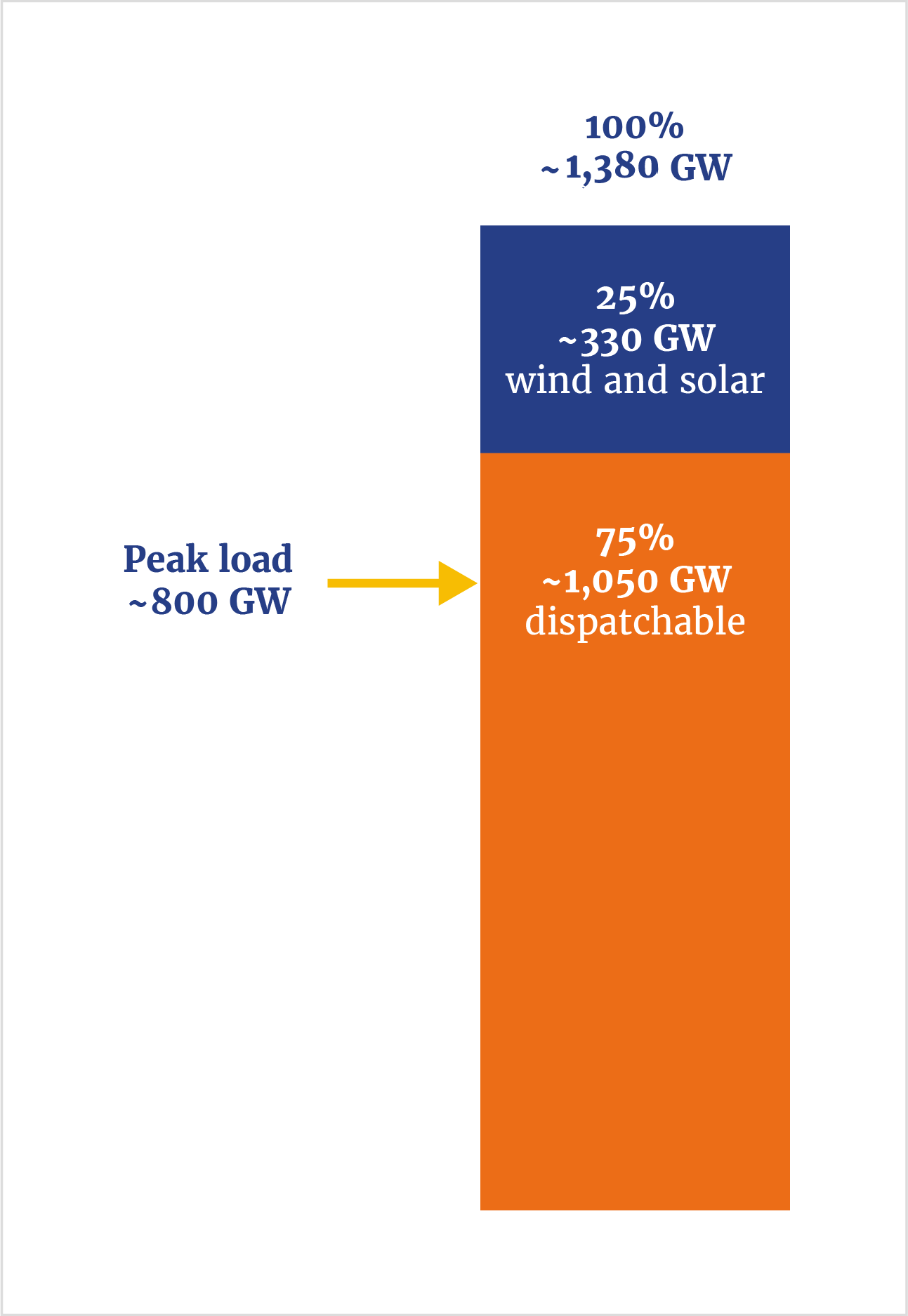
Source: Adapted from Lars Schernikau, “Europe’s Energy Challenge: Why Wind and Solar Cannot Power Europe,” presentation at Unternehmertag am Tegernsee [Entrepreneurs’ Day at Lake Tegernsee], March 18–20, 2026.
The Big Dislocation
The twenty-first-century evolution of grid resources now coincides with the rapid emergence of distinct new electricity demands, including large loads from AI data centers—which can range from tens of megawatts (MW) to more than 1 GW in exceptional cases—along with the reshoring of manufacturing and the electrification of transportation. The combination of changes in both the demand mix and the supply mix now threatens to upset critical balances for grid reliability.11
At the turn of the twenty-first century, roughly 95% of the generation resource mix was dispatchable by system operators, meaning that these units could be called upon when needed to reliably match both anticipated and unanticipated demands. Moreover, the same 95% of generation also contributed to the inertia critical for ensuring that the supply could withstand rapid disturbances that can occur at the speed of electricity.
Two major changes have taken place in the nation’s overall generation mix, each with very different reliability implications. First is the expansion of natural gas from about 16% of the mix in 2000 to about 40% in 2025. Second is the growth of intermittent wind and solar generation. Increasingly in recent years, the expansion of wind and solar generation has been accompanied by retirements of mostly coal and some nuclear facilities. Consequently, the proportion of generation capacity that is dispatchable declined from about 99% in 2000 to about 76% by 2025.12
These developments have three primary consequences. First, the nameplate capacity of intermittent resources must be discounted to recognize that the supply may not be present when needed. Second, solar and wind units require the use of large electronic conversion systems to feed power into the grid. Such conversion systems, or inverters, introduce additional reliability challenges. Third, wind and solar resources require large amounts of land or sea surface and thus must be located far from where electricity is demanded, requiring significantly more long-haul transmission.
These supply-side changes are coming while new large-load facilities are being introduced. Consequently, reliability concerns are heightened on all time scales from seconds and minutes to months, to seasonal and longer. These concerns are at the heart of the NERC Level 3 Alert, which points to the need for guardrails, standards, and oversight to improve reliability of the bulk power system.
The Level 3 Alert
The May 2026 Level 3 Alert, the third ever issued to date, provides specific Essential Actions that various entities “should consider in response.”13 The entities must acknowledge receipt of the alert and report on the status of their actions. NERC requires aggregation of these reports and, in turn, submits results to FERC. In September 2025, NERC issued a Level 2 Alert recommending practices to address emerging risks from large loads.14 The responses indicated that there were not sufficient processes in place to address risks associated with the addition of large computational loads.15
The May 2026 alert requires a set of Essential Actions that registered entities should take to reduce the risk to the bulk power system. These actions center on:
· Providing modeling data
· Conducting revised studies
· Determining changes that would trigger review of these studies
· Establishing a commissioning process for data center loads
· Initiating studies and corrective actions by transmission owners for data center relay protection
· Requiring transmission owners to install dynamic fault recorders
· Establishing effective communication capabilities for data center situational awareness and joint operating procedures
Most of the May 2026 alert elements involve studies, data submission, fault recorder installation, and process enhancements. These tasks are directed mostly to the transmission owners and planners, planning coordinators, reliability coordinators, balancing authorities, and transmission operators. NERC required these entities to respond to an extensive series of questions by August 3, 2026, indicating how and by when (e.g., prior to 2028 or beyond) they would address each of the Essential Actions.
In addition, NERC identified certain other risks, gaps, and materials that could serve as useful guidance for these entities to address the Level 3 reliability threats, including NERC’s Large Loads Action Plan and Risk Mitigation for Emerging Large Loads.16
In general, the May 2026 alert will prompt bulk electric system entities to gather sufficient data and modeling information about a large load’s reliability performance. Some of these entities must also install adequate dynamic fault recorders to capture the load facility’s electrical performance during system disturbances, formalize communications with large loads, and establish commissioning processes to integrate new large loads.
Although these steps potentially involve a considerable level of effort to implement, especially in areas with a greater concentration of large loads, all the obligations fall on utility entities. Many of the Essential Actions depend on the voluntary cooperation of large-load entities, which represent a wide array of private ventures.
Studies, analyses, and enhanced processes, although useful, do not by themselves address the infrastructure expansion needed to develop both significant generation and transmission assets. Neither NERC nor FERC possesses the authority to order the construction of transmission or generation resources. Rather, FERC and NERC oversee standards, guidelines, market rules, and tariffs that indirectly point to a certain degree of infrastructure development. These steps are essential to reliably integrate large loads into the bulk system.
The May 2026 alert does not address the inherent cost-allocation issues associated with the substantial infrastructure needed to keep pace with the large-load expansions. Further, while the alert indicates an urgency for Essential Actions, the potential utility response efforts may extend for several years beyond 2026, into 2028 or later. This timeline does not seem commensurate with emergency action.
The various system operators have a long history of responding to critical reliability conditions, even under stress. System operators have historically taken immediate operational steps to sustain reliability based on the infrastructure in place, weather conditions, disturbances, and innumerable variables affecting the bulk power system.
To highlight the urgency of addressing the larger data center integration and resource expansion issues, on July 22, 2026, a 3-GW power disconnection near a data center cluster in the PJM Interconnection system took 10 minutes for operators to resolve.17 During a heat wave in early July 2026, the U.S. Department of Energy issued two emergency orders under Section 202(c) of the Federal Power Act: one waiving power-plant pollution limits, and another authorizing PJM to curtail loads of 50 MW or more (mostly consisting of large data centers) in the Washington, DC area to preserve reliability.18
As the development of large loads places increasing demands on existing infrastructure, many system operators have had to take additional actions to maintain reliability. Naturally, it is preferable that such interventions remain at a minimum. A robust infrastructure in balance with load demand offers the bandwidth to keep critical conditions in check.
One obvious way to bolster the grid and ensure reliability is to incorporate more dispatchable generation. Reforms to approval and market processes could help accelerate the addition of new and refurbished generation. Battery resources, for example, could complement the intermittency of solar and wind resources, but their contribution to bulk reliability is limited by their short delivery periods and the vast number of batteries that would be required. Transmission additions could reinforce stressed portions of the grid, especially where additional capacity is feasible. New transmission could provide a substantial boost to dispatch existing generation and reinforce pathways to emerging load centers.
However, numerous approval processes and environmental concerns prevent these options from being near-term solutions. Greater development of demand-side management approaches, such as load-shedding (voluntary, economic, and otherwise), could lessen peak loads. These measures could provide time to complete longer-term generation and transmission options.
In fact, many demand-side options have already been implemented. Their impact, however, is limited because their more local effect may not provide much relief to the broader grid. Further, the load performance of many data centers requires high levels of reliability to function. While training data centers and some inference centers are flexible enough to enable certain types of demand-side management, they involve significant effort, and traditional data centers require near-perfect reliability.19
Understanding the load-profile capabilities of the various forms of data centers is a key focus of the data and modeling elements of the Level 3 Alert. The grid’s reliability needs are immediate and will continue to be under stress until resource infrastructure pressures can be relieved.
Perspective
A NERC Level 3 Alert is a serious reliability condition, but the velocity of data center building and development is far faster than the actions that today’s legacy bureaucracy was designed to accommodate. Two decades of overall policy approaches generally ignored the essential importance of sustaining reliability within a large and complex bulk power system. The reliability situation is an increasing source of stress. The trajectory is off track.
NERC has recognized these conditions, and its May 2026 alert was a notable response. In its reliability assessment published prior to the alert, the commission stated that “projections for resource and transmission growth lag what is needed to support new data centers and other large loads that drive escalating demand forecasts.”20 At FERC’s July 2026 technical conference on PJM reforms, the chair emphasized the urgency of reaching a resolution and warned that, if PJM and stakeholders could not reach one, FERC would intervene.21
Even with the recognition and approaches already underway, serious and sustained efforts over several years will be required to unwind the current reliability situation. Renewed efforts in regulation and legislation, grid infrastructure development, and capital finance are necessary to restore bulk system reliability as the paramount priority.
Although there is no single immediate solution to restore reliability’s primacy of place, a potential interim approach may be to develop private data center grids that would prevent interim pressure on the existing bulk power system. Refined approval processes for both supply resources and large demand centers would also lessen reliability stress. One important step in this direction, for example, is to redouble recent efforts to reduce the backlog of interconnection and other infrastructure approvals that persists in many regions. For its part, NERC—with enabling support from FERC—appears likely to adopt new reliability guidelines and standards that begin to address the present reliability constraints.
Coordinated action by planners, data center developers, and supply-resource developers begins to address a portion of the current imbalance and enable data center expansion while ensuring bulk reliability. Interim operational guidelines could improve reliability and satisfy customer needs for steady supply.
Addressing the reliability challenge will demand particular attention to several priorities over the coming years. The overall imperative is to take sustained, coordinated action to bring reliability back into balance, as future business performance and economic growth depend on it. Key priorities include:
· Getting the essential reliability components of the supply resources in place
· Fundamentally rethinking how to integrate large data centers into the grid and requiring centers to include generation resources in their integration proposals
· More closely matching the physical reality of the grid infrastructure with integration changes that can be executed in a reasonable time frame
· Removing supply approval and execution barriers while accelerating the infrastructure completion cycle to better match data center pacing
· Adapting data center implementation to available or buildable infrastructure to help relieve stress on the grid; restarting, when necessary, recently retired or marginal plant resources for jointly sited data centers as an interim measure
· Further coordinating among utilities, system operators, and large data center entities to better accommodate the enormous increase in, and concentration of, large data centers
The reliability challenge is affecting decisions about how the power system is planned, developed, and operated. The actions taken will determine whether the system can continue to meet the nation’s changing electricity needs while maintaining the reliability on which it depends.
- North American Electric Reliability Corporation (NERC), Essential Action to Industry: Computational Load Modeling, Studies, Instrumentation, Commissioning, Operations, Protection, and Control (NERC, 2026).
- NERC, 2025 Long-Term Reliability Assessment (NERC, 2026), 6. See also John Helme, “Bulk Power System or Bulk Electric System,” Utility Services, April 16, 2026.
- NERC, 2025 Long-Term Reliability Assessment, 6.
- Wm. A. Wulf, “Great Achievements and Grand Challenges,” The Bridge 30, nos. 3–4 (Fall–Winter 2000): 5–10.
- Lars Schernikau, “Europe’s Energy Challenge: Why Wind and Solar Cannot Power Europe,” presentation at Unternehmertag am Tegernsee [Entrepreneurs’ Day at Lake Tegernsee], March 18–20, 2026.
- NERC, History of NERC (NERC, 2023), 1.
- Jonathan Lesser and Patrick J. McCormick III, America’s Electricity Grids: At a Crossroads (National Center for Energy Analytics, 2026).
- Following Order No. 888 in 1996 and Order No. 2000 in 1999, FERC—rather than NERC—became exclusively responsible for market rules in organized wholesale electricity markets. For example, FERC pervasively regulates the terms and conditions, including market rules, for regional transmission organizations. The North American Energy Standards Board promulgates rules governing the natural gas market and transmission.
- Schernikau, “Europe’s Energy Challenge”; and U.S. Energy Information Administration (EIA), “U.S. Electricity Peak Demand Set New Records Twice in July,” Today in Energy, August 5, 2025.
- EIA, Monthly Energy Review: August 2026 (EIA, 2026), 135, table 7.2a; and “United States Electricity Profile 2024,” State Electricity Profiles, Electricity, EIA, released November 10, 2025, https://www.eia.gov/electricity/state/unitedstates.
- NERC, 2025 Long-Term Reliability Assessment.
- EIA, Monthly Energy Review: August 2026.
- NERC, Essential Action to Industry, 2. Entities included in the scope of this Level 3 Alert are transmission planners, planning coordinators, transmission owners, balancing authorities, reliability coordinators, and transmission operators. In addition, primary interest groups such as transmission planning, generation engineering, generation operations, system operators, system operators–system protection, and system operators–transmission engineering have also received the alert.
- NERC, Industry Recommendation: Large Load Interconnection, Study, Commissioning, and Operations (NERC, 2025).
- NERC, Essential Action to Industry.
- NERC, Essential Action to Industry, 15.
- Tim McLaughlin, “Massive Disconnect of Power Roils Largest U.S. Electric Grid,” U.S. News & World Report, July 22, 2026. A transmission line outage near a data center cluster in northern Virginia caused wide-area voltage and frequency disturbance that resulted in 3 GW of data center load suddenly separating from the grid. Operators had to take emergency actions to restore voltage and frequency stability.
- Federal Power Act § 202(c), 16 U.S.C. § 824a(c); U.S. Department of Energy, Order No. 202-26-32 and Order No. 202-26-33, issued June 30, 2026, https://www.energy.gov/ceser/2026-doe-202c-orders.
- Google and Electric Power Research Institute (EPRI) have done a great deal of work on load shaping and demand-side management capabilities for load centers. See EPRI, Integrating Data Centers into the Grid: Benefits of Flexibility and Strategic Siting (EPRI, 2025); and Michael Terrell, “How We’re Making Data Centers More Flexible to Benefit Power Grids,” News from Google (blog), August 4, 2025.
- NERC, 2025 Long-Term Reliability Assessment.
- “Commission-Led Technical Conference on PJM Governance and Stakeholder Reforms,” Docket No. AD26-7-000, Federal Energy Regulatory Commission, last updated August 11, 2026, https://www.ferc.gov/news-events/events/PJM-Governance-Stakeholder-Reforms. This technical conference explored actionable reforms to improve PJM’s ability to address operational, market, and resource infrastructure adequacy to ensure reliability.
About the author
Continue Reading
-2%20(14).png)
-2%20(9).png)
-2%20(8).png)
Regional Transmission Organizations: Problem or Solution?
The bulk power system—an interconnected network of generating plants and high-voltage transmission lines—is an often-overlooked part of the electric industry.
-2%20(7).png)