Rupert Darwall
Rupert Darwall is a senior fellow at the National Center for Energy Analytics, researching such issues as energy and environmental policy and corporate governance. Prior to joining NCEA, he was a senior fellow of the RealClearFoundation. He previously worked as an investment analyst and in corporate finance, as well as serving as a special advisor to the UK's Chancellor of the Exchequer. The author of three books (Green Tyranny, The Age of Global Warming, and The Age of Error: Net Zero and the Destruction of the West) and numerous think-tank reports, Darwall has also written for the Wall Street Journal, The Hill, and Daily Telegraph, among others.

Rupert Darwall is a British energy policy analyst, author, and strategy consultant whose work focuses on transportation analysis and strategy, climate change, and corporate governance. He has more than two decades of experience analyzing how governments design and implement energy and climate policy.
Darwall’s expertise lies at the intersection of economics, public policy, and political institutions. His research examines how decarbonization strategies, particularly net-zero targets and renewable energy mandates, affect economic growth, industrial competitiveness, and energy affordability. He has written extensively on the unintended consequences of climate policy, including the role of subsidies, regulatory interventions, and financial market pressures in reshaping energy systems.
He is the author of several books on climate and energy policy, including Green Tyranny and The Age of Global Warming, which trace the historical development of climate policy frameworks and critique the political and institutional forces behind them. He also wrote Paralysis or Power? (2003) on Conservative Party renewal and A Better Way to Help the Low Paid (2005) on reforming tax credits for the Centre for Policy Studies.
Most recently, he served as a senior fellow at RealClearFoundation, where he researched environmental policy and the pitfalls of climate leadership in the U.K. Before that, he was at Reform, an independent, non-party think tank whose mission is to set out a better way to deliver public services and economic prosperity, informing two of Reform’s earliest reports on economic change.
Earlier in his career, Darwall held roles at major financial institutions throughout London. He drew on this experience while serving as a Treasury special adviser. This background informs his work on ESG investing and sustainable finance, where he examines how financial regulation and investment trends influence energy markets and corporate behavior.
Darwall has contributed to a wide range of publications, including policy journals, opinion pages, and energy-focused media outlets. He has also participated in public policy discussions, conferences, and media interviews on topics such as energy security, the economics of climate change, and the geopolitical implications of energy transition policies.
He holds bachelor’s degrees in Economics and History from Magdalene College.
Interview Topics
- Government energy policy design
- Climate leadership in the UK
- Green energy skepticism
The critical thing to understand about the energy transition is it means you need more resources to produce less and that is exactly what we're seeing.
In the media
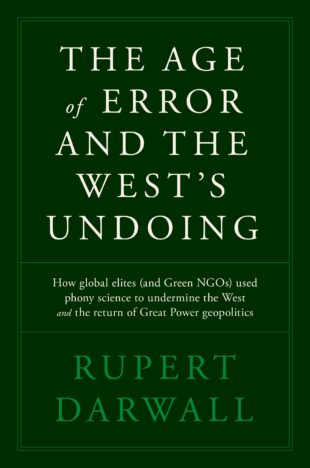
The Age of Error and The West’s Undoing
In The Age of Error and The West’s Undoing, Rupert Darwall examines the fundamental incompatibility between Western elites’ obsession with achieving net zero in the face of allegedly catastrophic climate change and the West’s capacity to safely navigate a twenty-first century world riven by geopolitical tensions, the increasing use of hard power, and the rise of China as a great power to rival the United States.
In the trauma of the 2008 financial crisis, Western democracies morphed into technocracies. Elected politicians lost legitimacy and sought to regain political authority by importing experts: central bankers, who failed to revive stagnant economies with ultra-low interest rates; public health experts, who gave politicians cover to impose draconian lockdowns during the Covid pandemic; and climate scientists, who justified economically disastrous net zero energy policies while the Global South, including China, powered ahead with carbonizing their economies. Along with a dependence on experts, Western democracies also developed a troubling censorship industrial complex and the tendency to aggressively silence dissent, especially with respect to pandemic policies, the cover-up of the origins of the Covid virus, and climate change.
In The Age of Error and The West’s Undoing, Darwall takes the reader back to 2006—the beginning of the age of error—and ultimately through the brutal return of geopolitics signified by Russia’s invasion of Ukraine in 2022. He concludes by examining the West’s path forward: Will the age of error forge a new age of realism? Or will it beget only further dissolution and disintegration, earning the epitaph: “The West’s undoing was its own doing”?
Press Kit &
Media Resources
Download official headshots, bio, and media materials for interviews and publications.
Media inquiries: media@energyanalytics.org

Related Experts




Request a Scholar
NCEA scholars are available for media interviews, expert testimony, speaking engagements, and custom briefings on energy policy.