Report: New Financing Strategy Needed to Spark America's Nuclear Energy Revival


As America's power grid faces mounting reliability concerns and unprecedented demand growth driven by the digital economy, a new report from the National Center for Energy Analytics proposes a financing strategy to spark nuclear energy's revival: unlock private equity capital to build the next generation of large-scale nuclear reactors.
The report, authored by senior fellow Paul H. Tice, argues that financial risk, not technology, is the primary blocker to kickstarting nuclear construction in the United States.
"Despite nuclear's proven reliability and long operating life, there is minimal support for building new large reactors, largely due to cost perceptions. The sticker shock from Georgia Power's Vogtle Units #3 and #4 at $16,000 per kilowatt still looms large, even though much of that cost escalation came from several nonrecurring factors," says Tice. "Cost and financial risk should not be limitations. The United States can revitalize its nuclear sector by tapping into the nearly $1 trillion of infrastructure-related private equity capital available, including the $479 billion in cash on hand at Big Tech companies."
Tice proposes an asset-based project finance model which would replace the outdated utility-driven approach of the past 60 years. It shifts reactor sponsorship away from risk-averse electric utilities and toward global infrastructure investment firms who are more experienced in managing and financing complex greenfield construction projects. The core of the plan includes:
- Use Asset-Based Project Finance: Apply the same model used for building LNG terminals, toll roads, and data centers--highly leveraged financing with up to 90% debt, secured by project assets and cash flows, not utility balance sheets.
- Tap into Private Capital: Firms like Brookfield, Blackstone, KKR, and Macquarie have billions of dollars of dry powder ready to deploy. Big Tech companies--Microsoft, Amazon, Google, Meta--have already signed nuclear PPAs and could invest directly in new builds that power their data centers.
- Deploy Large Scale, Proven Technology: Focus on replicating the 1.1-gigawatt Westinghouse AP1000 reactor used at Vogtle, which has now been de-risked. Unit #4 was built 30% more efficiently than Unit #3, with improved economics and performance. Over time, the cost of building the next AP1000 should continue to decline.
- Leverage Government Loans, Not Subsidies: The Department of Energy's Loan Programs Office can provide low-cost credit guarantees to support early projects. No new tax subsidies should be necessary once the first projects prove successful.
For policymakers, Tice urges them to focus on demonstrating proof-of-concept with one or more privately financed AP1000 reactors completed on budget and on time then let market forces scale deployment nationwide. He recommends identifying 5 to 10 new AP1000 reactor sites, particularly at existing nuclear or recently retired coal plants, where permitting hurdles are lower and grid connections already exist. Several sites across Georgia, Illinois, and the Carolinas are strong candidates.
Attracting private equity capital to the nuclear sector will also require greater regulatory certainty. Tice recommends that the recently announced reforms at the Nuclear Regulatory Commission be implemented as soon as possible, given that this agency has been the chief source of reactor construction delays over the past 50 years.
"Shortening the U.S. nuclear building cycle while switching to a project finance approach should be enough to allow new large nuclear reactors to stand on their own economic feet," the report states. "Fast-tracking the approval of a short list of nuclear project sites...should be a Trump priority."
The report, "A Strategy for Financing the Nuclear Future," is available at https://energyanalytics.org/financing-the-nuclear-future/
About the National Center for Energy Analytics (NCEA):
The National Center for Energy Analytics is a think tank devoted to data-driven analyses of policies, plans, and technologies surrounding the supply and use of energy essential for human flourishing. Through objective analyses of energy policies and their implications, NCEA aims to inform policymakers, industry leaders, and the public on critical energy issues.
More insights

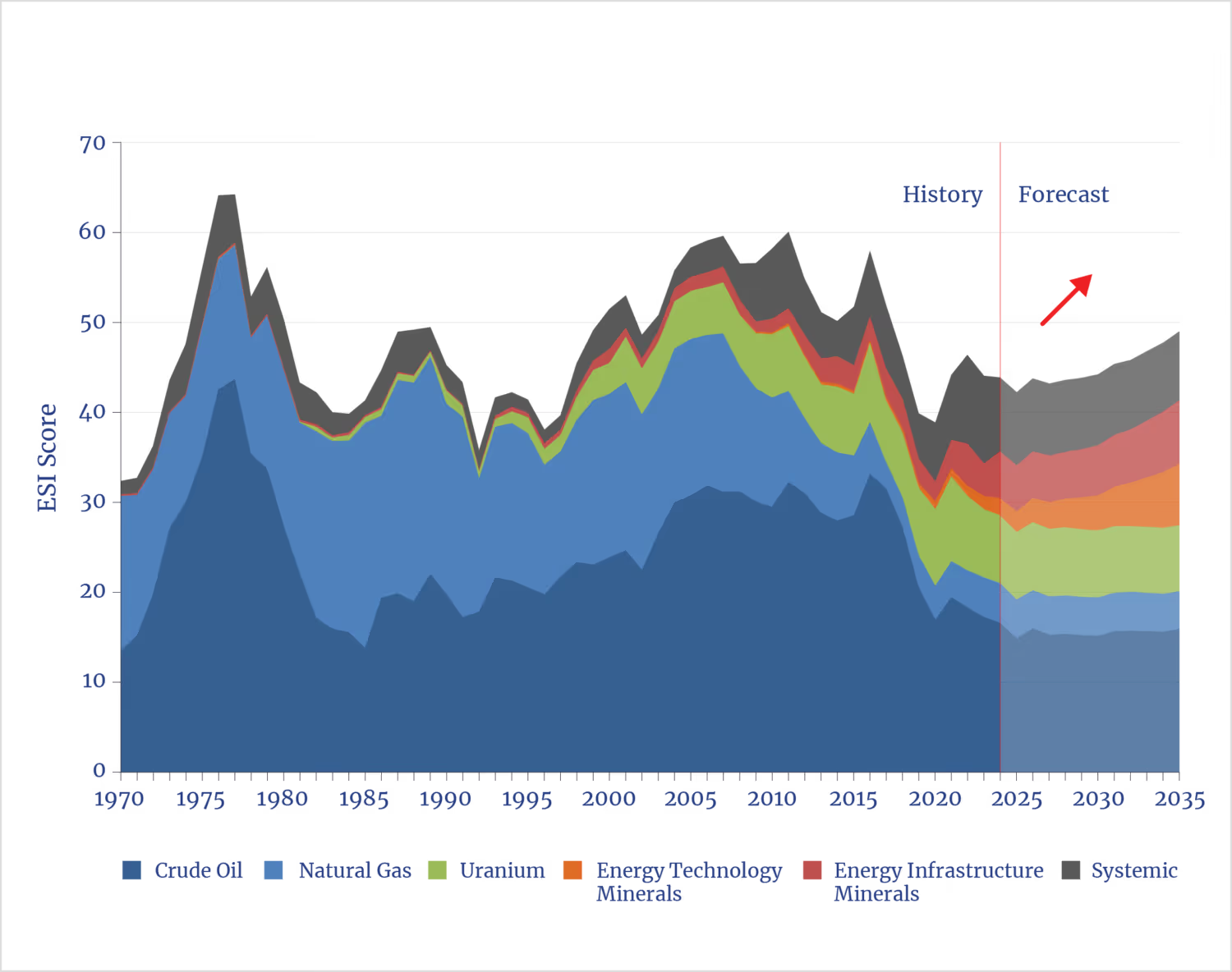
New Energy Security Index Warns U.S. Risks Losing Shale-Era Energy Security Gains
The energy security gains the United States achieved during the shale revolution are beginning to erode and could continue weakening through 2035, according to a new report from the National Center for Energy Analytics (NCEA).

.jpeg)
New Analysis Warns of Hidden $50 Billion Liability as Wind and Solar Projects Age Without Decommissioning Safeguards
WASHINGTON, D.C., October 27, 2025 -- As wind turbines and solar panels reach the end of their operational life spans, the United States is facing a massive and largely unacknowledged financial risk: billions of dollars in unfunded liabiliti

National Center for Energy Analytics Welcomes Stephen D. Eule as Visiting Fellow
The National Center for Energy Analytics (NCEA), a Washington, D.C.-based energy think tank, today announced the appointment of Stephen D. Eule as a visiting fellow, bringing decades of experience in energy, climate, and technology policy t
Former IEA Oil Market Chief Joins National Center for Energy Analytics as Visiting Fellow
National Center for Energy Analytics (NCEA), a Washington, D.C.-based energy think tank, announced today it has added Neil Atkinson as a visiting fellow. In this role, he will provide research and analysis of oil market issues.

NCEA Report Urges Policymakers to Reject Flawed "Social Cost of Carbon" as Basis for Energy Decisions
Federal and state governments use a measurement known as the social cost of carbon (SCC) to quantify the economic damage caused by each additional ton of carbon dioxide (CO2) emitted into the atmosphere. More specifically, policymakers are

Study: Maritime Shipping is the Black Hole of the Energy Transition
The global shipping industry has long played a central role in the energy-materials supply chain. Yet, few energy forecasts and analysts have considered how maritime shipping is a weak link of the energy transition, according to a National

Veteran energy experts find 23 problematic assumptions within IEA's World Energy Outlook 2024
WASHINGTON, January 30, 2025 -- Industry players consider the International Energy Agency's signature annual report, the World Energy Outlook, to contain highly credible analyses. However, a new critique from the National Center of Energy An

New Report Suggests Electrification Mandates Worsen Energy Affordability, Power Access, Economist Jonathan Lesser, PhD, urges policymakers to adopt a more rational planning framework
According to a National Center for Energy Analytics (NCEA) report, mandates to electrify the American economy while rationing customers' energy use may worsen the energy affordability crisis and power access.

National Center for Energy Analytics Appoints Policy Analyst Rupert Darwall as Senior Fellow
Washington, D.C., - National Center for Energy Analytics (NCEA), a Washington, D.C.-based energy think tank, has added policy analyst Rupert Darwall as a senior fellow. In this role, Darwall will leverage his extensive knowledge on U.S. ene

NCEA Releases Inaugural Report Revealing Projected $2 - 4 Trillion Cost to Build Nationwide Electric Vehicle Charging Infrastructure
WASHINGTON, D.C. -- Today, the National Center for Energy Analytics (NCEA) released its first-ever study, which evaluates the realities of the ongoing push for an all-electric vehicle (EV) future. The study documents the overlooked and

New Report from the National Center for Energy Analytics Outlines Pathways to Preserve and Expand U.S. Dominance in Global LNG
Washington, D.C. - Today, National Center for Energy Analytics (NCEA) Senior Fellow Tristan Abbey published a report examining the politicization of liquid natural gas (LNG) exports and recommending three pathways to ensure the United

Critical Minerals Expert Peter Bryant Joins National Center for Energy Analytics Advisory Board
National Center for Energy Analytics (NCEA) announces the addition of Peter Bryant to its Advisory Board. Bryant, Board Chair of Clareo and Co-Founder and Board Chair of the Development Partner Institute, brings decades of practical experience in advising the mining and energy sectors.

New Report Shows Securities and Exchange Commission Planned Climate Rules Will Accelerate Systemic Financial and Economic Risk
Washington, D.C. - Today, National Center for Energy Analytics (NCEA) Advisor and Senior Fellow Paul H. Tice published an in-depth report evaluating the impact on U.S. financial markets from the planned climate rules from the U.S. Securitie