The $4 Trillion Problem With a Battery-Powered Grid
-6%20(9).png)

Batteries are often presented as the missing piece of a wind- and solar-powered electric grid. Store electricity when the sun is shining or the wind is blowing, the argument goes, then discharge it when demand rises.
Batteries can provide valuable services to the grid. But they cannot solve the central challenge of relying primarily on weather-dependent generation: sometimes the wind does not blow and the sun does not shine for extended periods.
NCEA's July 2026 study, Batteries and the Grid: Hype, Hope, and Economic Reality, examines whether a system powered mainly by wind, solar, and batteries could provide reliable and affordable electricity. Using the PJM Interconnection, which serves more than 67 million people across 13 states and the District of Columbia, the study finds that the answer is no, at least with current technologies and costs.
The Numbers Are Striking
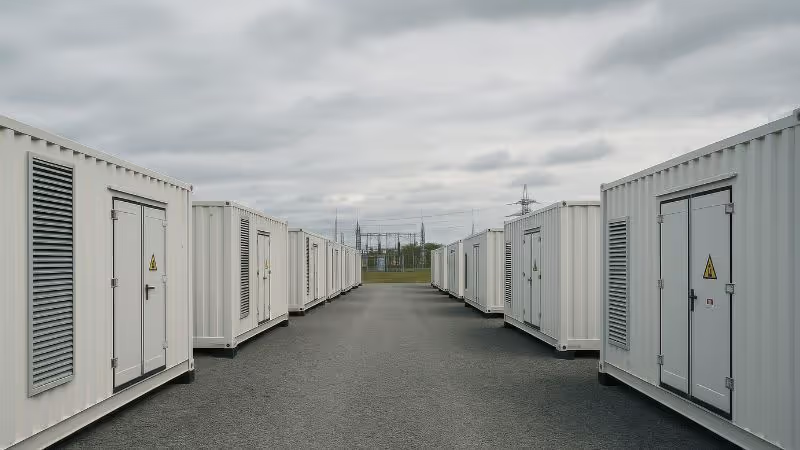
At the beginning of 2026, all grid-scale batteries in the United States could supply roughly 15 minutes of average national electricity demand. In PJM, meeting the electricity consumed during a single peak hour in July 2025 would have required about 50% more battery storage than existed across the entire country.
That is not because batteries are useless. It's because most utility-scale batteries are designed to discharge for roughly four hours. They can help manage short-term peaks, balance supply and demand, and provide grid services. They cannot reliably cover multiday periods of low wind and limited sunlight—sometimes called wind and solar “droughts.” The study found, for example, that PJM experienced a 113-hour stretch, just under five days, in July 2024 when wind generation stayed below 1,000 megawatts (MW), against a total installed wind capacity of about 11,400 MW at the time.
Three Ways to Build the Grid of 2045
The study's PJM modeling tested three basic approaches through 2045:
- A renewables-only (RO) system relying primarily on wind, solar, batteries, and existing nuclear and hydroelectric generation, with all fossil-fuel generation retired.
- A natural-gas-and-nuclear (NGN) system relying primarily on natural gas and nuclear generation.
- A natural-gas-and-nuclear-plus-battery (NGN+B) system that also uses batteries to help meet short-term peak demand.
The renewables-only scenario would require roughly ten times more total generating capacity than the natural-gas-and-nuclear scenario—about 2 million MW of new wind, solar, and battery capacity, versus roughly 330,000 MW under NGN. That additional capacity would be needed to compensate for the intermittency of wind and solar, charge the batteries, meet growing demand, and maintain reliability during extended periods of unfavorable weather.
The Price Tag
The cost would also be enormous. NCEA estimates that the renewables-only scenario would cost PJM ratepayers more than $4 trillion through 2045, even after accounting for savings on fossil fuels. By comparison, the natural-gas-and-nuclear scenario would cost about $668 billion, and adding batteries as a peaking resource (NGN+B) would add roughly $768 billion on top of that. In other words, the renewables-only path costs roughly six times more than a natural-gas-and-nuclear grid, and still more than five times the natural-gas-and-nuclear-plus-battery alternative.
The study also evaluates the cost of reducing carbon dioxide emissions. Under the renewables-only scenario, the annual cost of avoided emissions started at just over $55 per ton in the early years of the study and reached as high as $771 per ton by 2045. That is substantially higher than the study's cited estimates of the social cost of carbon, which rose from $195 per ton in 2026 to about $306 per ton by 2045; meaning the cost of the emissions reductions was two to three times higher than the social benefit the study cites in most years.
Why Land and Materials Matter Too
The scale required also carries physical costs beyond dollars. The renewables-only scenario's roughly 991,000 MW of wind capacity would require about 991,000 square kilometers of land—an area almost 20% larger than all of the PJM states combined. And building the study's estimated 510,000 MW of battery storage by 2045 would require more than 1.54 billion tons of raw materials and over 900,000 gigawatt-hours of energy to manufacture, based on the study's per-unit estimate of what a single utility-scale battery installation requires in mined and processed materials.
Reliability Isn't Optional
These findings matter because electricity demand is expected to grow. Data centers, manufacturing, electric vehicles, heat pumps, and other technologies are all increasing society's reliance on the grid. As electricity becomes more essential, reliability becomes more—not less—important.
A power system that fails during a multiday wind and solar drought is not merely inconvenient. Outages can spoil food, shut down businesses, interrupt medical services, and create serious risks during extreme weather. The economic cost of unreliable electricity can quickly exceed the savings from building a less dependable system.
The Takeaway
The policy lesson is not that batteries should never be built. Batteries can be useful for short-duration applications, and future storage technologies may improve. But policymakers should distinguish between a battery that helps stabilize the grid and a battery fleet expected to replace firm, electricity-generating resources for days at a time.
NCEA's foundational The Choices We Face: Energy for the 21st Century emphasizes that human flourishing requires energy that is affordable and reliable, and that energy systems must be designed around what physics, engineering, and economics allow.
That means evaluating batteries honestly, not by their nameplate capacity or the optimism surrounding new technologies, but by how much reliable electricity they can provide when customers need it most and what that reliability costs.
Batteries can be part of a stronger grid. They cannot substitute for one.





.webp)
-3%20(1).png)
-2%20(5).png)
-2%20(1).png)
-6%20(8).png)


-2%20(11).png)
-2%20(12).png)
-2%20(13).png)
-2%20(3).png)




.avif)