What would an all-EV future look like?
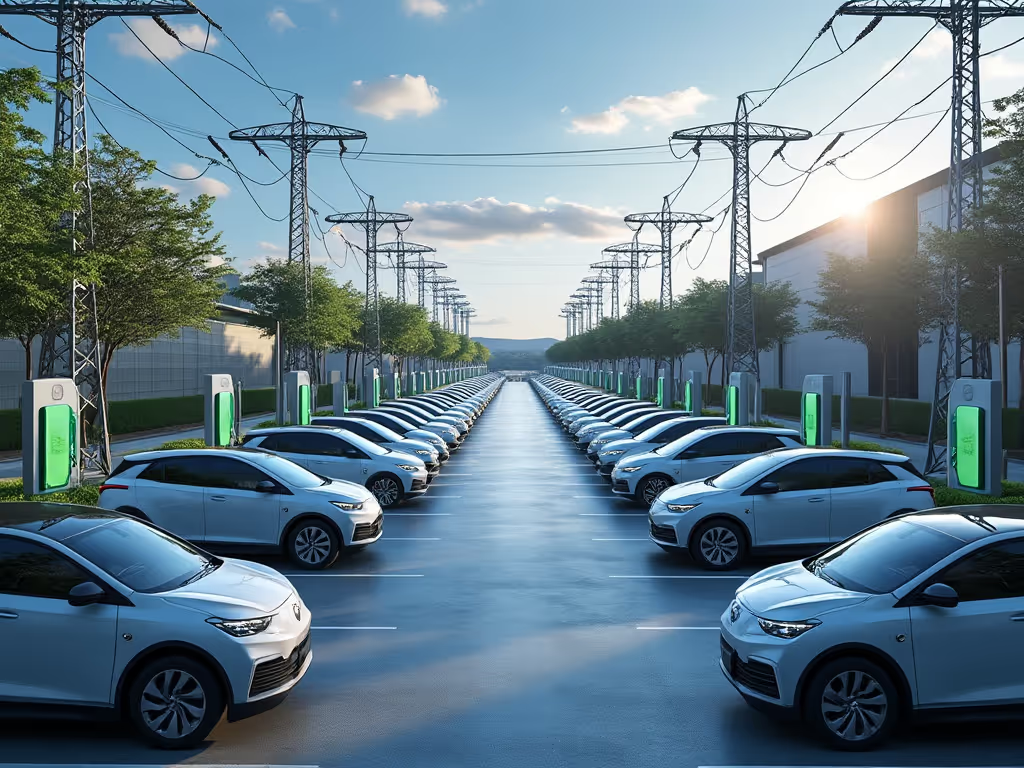

Is it possible to convert to an all-EV car society in America and, if so, what would it cost to do it?
Eighteen states have already approved regulations that will require all new vehicle sales to be electric vehicles (EVs) beginning in 2035. Nationally, the EPA has enacted stringent carbon dioxide emissions that can only be met with automakers selling more EVs and fewer gasoline-powered vehicles.
Mass adoption of EVs would be complicated. It takes more than installing more charging stations-but how much more?
Let's start small. Imagine your HOA adopted a mandate requiring only electric vehicles in your neighborhood. What would this look like for a typical American?
Let's imagine you live in an average-sized HOA...say 400 homes, like this one in the Dallas area.
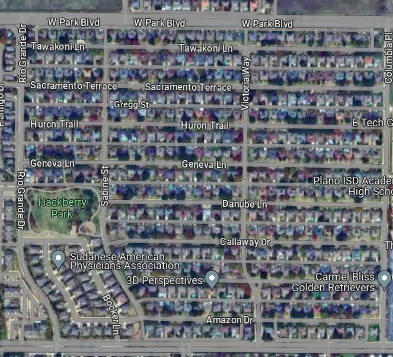
With an average of two cars per home, we're talking about 800 EVs for you and your neighbors.
To power your EVs, you'd need to install a charging port at your home-two if you want to be able to charge both vehicles at the same time. So, you look in Car and Driver and choose their best budget option for a charger. It costs about $400 per home...or $160,000 for the neighborhood.
To install it, you call an electrician. He tells you these chargers require a dedicated circuit, like your clothes dryer. Installing the wiring for the charger would cost another $500 or so...or $200,000 for the neighborhood.
But if your home is like most homes built in the 1980s or earlier, your home's electrical panel won't support this additional load. You'll need the electrician to install a new service panel at a cost of about $1,750. For you and all of your neighbors, the cost would total $700,000.
So, at this point, the cost of charging capability is over $1 million for you and your neighbors.
As the chargers are installed, you'd start to see trucks from your local utility company on the streets working on the power poles. Charging one car increases your home's electrical load by about 50%. If you're charging two cars with two chargers, you've doubled the load.
Your neighborhood's grid - the poles and wires running down the streets - was installed many years ago and cannot handle the increased load. The transformers-the gray cylinders mounted on the wooden poles-that convert high voltage electricity to home-voltage electricity need to be replaced with larger ones.
The utility also needs to upgrade the wires themselves. And because the the wires and transformers are heavier than the old ones, the utility has to install new poles that can handle the extra weight. The cost of these upgrades - new transformers, heavier wires, and larger poles - will average almost $7,000 per EV. For this 800-EV neighborhood, that means another $5.6 million in costs.
But it won't be just your neighborhood that adopted all EVs. If a city the size of Dallas, Texas, we're talking about 484,000 single-family homes-so we'd need to repeat this expense more than 1,200 times to cover the entire city, at a cost of over $6 billion. Apartment buildings would also require retrofits to allow renters to charge their EVs, adding millions of dollars more to the costs.
As you drive your EV to work, you'd start to see construction all over the city. Like your neighborhood, the city's grid wasn't designed for this load. The utility would need to upgrade substations-those fenced-off areas filled with gray electrical equipment-throughout the city at a cost of a few million dollars each. Plus, the transformers in those substations are in short supply, with utilities often waiting years for delivery. The transformers also require specialized steel, another component in short supply.
The increase in electricity consumption to charge the EVs would require new electrical high-voltage transmission lines running to those substations, which would bring the electricity the city needs to power the EVs.. These lines cost about $450,000 per mile and can span hundreds of miles between the power plants providing the electricity and the substations in the city, adding tens of millions of dollars to the cost.
After driving across town to your job and running errands, it would be nice to plug in your EV at the office, shopping mall, or a parking deck to keep it charged. Each of these away-from-home charging sites would add costs, totaling millions of dollars more. .
In total, upgrading just the city of Dallas to support the electricity demands of an all-EV city would cost over $7 billion dollars, enough to build several regional airports in most areas of the country.
Dallas only accounts for about 6% of the single-family homes in Texas. Supplying 8.2 million homes across Texas, many of them rural, would require more than 17 times this cost for distribution upgrades. In total, the costs to wire Texas for EVs would cost $100 billion or more.
Converting a single state to all EVs would be a massive task, and you'd start to see other impacts. Raw materials like iron, copper, and electrical steel aren't unlimited. We'd need to increase mining and factory production to fulfill the need. Meanwhile the cost of raw materials for every other application from refrigerators to cans for food would increase.
Tens of thousands of utility poles would require felling forests, and thousands of additional linemen and utility workers would be needed to make the installations.
At the same time, gas stations would be put out of business. Some would be converted to high-speed charging stations for EVs, adding demand. A travel plaza that can charge electric semi-trucks draws as much electricity as a modern steel mill. Dozens, if not hundreds, of those charging plazas would be required in a state like Texas.
You'd also start to see job postings for the thousands of linemen and electricians needed to keep up with the installations. These skilled trades people require years of training to be safe and effective around high voltage electricity.
On a national level, the costs are truly staggering...between $2-$4 trillion dollars, or more. This is a massive sum that's hard to imagine. To put it in perspective, the total value of all goods and services produced in one year in Great Britain...every car, ship, train, can of food, pint of beer, home, office, and pencil...everything...is $3 trillion dollars.
Here in the US, think of the 49,000 miles of our national interstate system. The cost to build it was about $500 billion dollars adjusted for inflation. So, for the cost of converting to an all-EV passenger car fleet in the US, you could build 6-8 interstate highway systems.
And we haven't even discussed the cost of building the generating capacity to supply the electricity that will be required.
So, is it possible for the US to become an al-EV society? Yes. But the costs and the materials requirements would be so vast as to make it a challenge that would dwarf World War II.
The headlong rush toward EVs, driven by subsidies and mandates, ignore the physical and economic realities involved. Policymakers may try to ignore that reality, but reality will always make itself known.
Jonathan Lesser, PhD is the President of Continental Economics with over 35 years of experience working and consulting for regulated utilities and government.





.webp)
-3%20(1).png)
-2%20(5).png)

-2%20(1).png)
-6%20(8).png)


-6%20(9).png)

-2%20(11).png)
-2%20(12).png)
-2%20(13).png)
-2%20(3).png)






.avif)